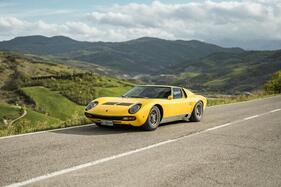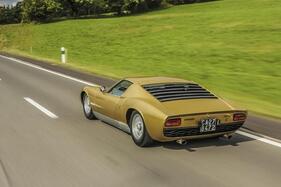


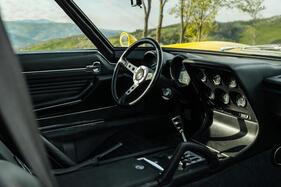
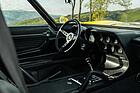








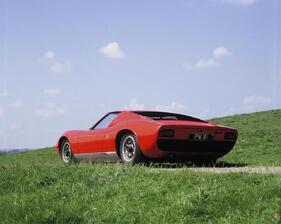




When Lamborghini unveiled the Miura at the Geneva Motor Show in March 1966, it was far more than just the presentation of a new model. The Miura with its transversely mounted V12 engine redefined what a sports car could be - a radical architecture that broke with the previous GT tradition.
The Miura offered performance figures that seemed surreal for the time. And a ravishing body designed by Bertone that arouses emotions at first glance and immediately captures hearts - even today. The Miura was not just another Lamborghini model, but a declaration of intent. As the company's third model, presented just three years after Automobili Lamborghini was founded, the Miura sets out the brand's core values for the coming decades: courage instead of convention, innovation without compromise, design and technology taken to the limits of what is possible.
With the Miura, Lamborghini creates a completely new vehicle segment and thus shapes the modern mid-engined super sports car. Six decades after its premiere, the Miura is still regarded as a pioneer of technical radicalism, visionary technology and timeless design. Its history is characterized by youthful ambition and technical audacity.
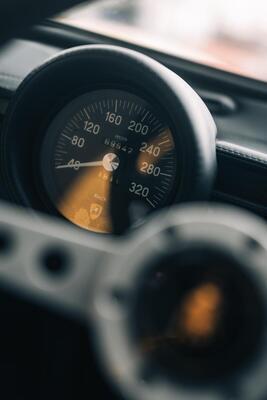
The V12 engine delivers an impressive output of up to 380 hp, which can accelerate the Miura to a top speed of 290 km/h, making it the fastest production car in the world.
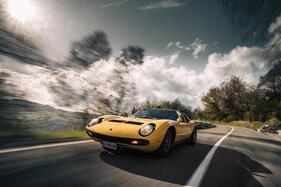
In 2026, Lamborghini celebrates this extraordinary vehicle by tracing its origins, its evolution and the characteristics that made the Miura the first true super sports car in history. It is a journey through creation, design, performance and legacy and a tribute to the car that made dreams come true and wrote the first chapter of the Lamborghini legend.
"For me, the Lamborghini Miura is a dream car not only because of its performance, design and cult status," says Stephan Winkelmann, Chairman and CEO of Automobili Lamborghini S.p.A. "The Miura is more than a car model - it changed the course of automotive history. With its revolutionary architecture, breathtaking design and uncompromising performance, it has defined the concept of the super sports car and set Lamborghini on a path of fearless innovation."
"The Miura embodies our DNA: bold, visionary and always ahead of its time. In celebrating this anniversary, we honor a masterpiece that continues to inspire us - not by looking back, but by remembering that true innovation comes from the courage to challenge convention," continued Stephan Winkelmann.
The birth of a revolution
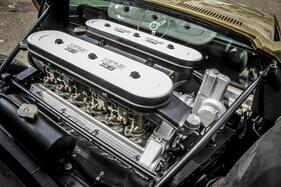
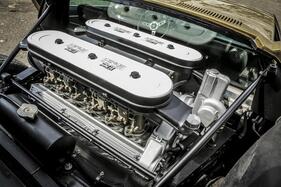
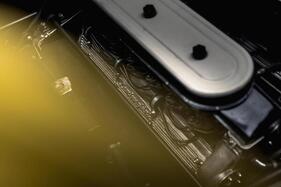
Less than two years after the company was founded, Lamborghini was still considered a niche manufacturer, but the 350 GT had already demonstrated the company's technical ambitions. Ferruccio Lamborghini was proud of the first GT car, but dreamed of an even more powerful vehicle. The young team of engineers led by Gian Paolo Dallara and Paolo Stanzani set about realizing this dream. At the heart of the Miura was a transversely mounted 3929 cc V12 engine with a bank angle of 60 degrees, equipped with four camshafts, V-shaped overhead valves, a crankshaft with seven bearings and four Weber 40 IDL 3L carburettors (later IDL 40 3C) with twelve throttle valves.
From 1964, Dallara, Stanzani and the New Zealand test driver Bob Wallace jointly developed the idea for a new super sports car inspired by motorsport. After work, they then built a ready-to-drive prototype chassis, which was trimmed for uncompromising performance. At the presentation, Ferruccio Lamborghini immediately recognized the potential of the idea and gave the green light for the further development of the 400 TP as Project L105.
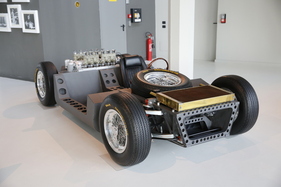
On November 3, 1965, Lamborghini presented the chassis in satin black at the Turin Motor Show, with the engine installed transversely behind the driver. The model stands alongside the Lamborghini 350 GT and the 350 GTS. Never before and never since has a naked chassis attracted so much attention. The steel body with a wall thickness of just 0.8 millimeters and numerous punched holes weighs just 120 kilograms, and the four white exhaust pipes immediately attract the attention of visitors. It is a show of strength and a radical gesture by the young sports car brand from Sant'Agata Bolognese. Several design studios offer their support in cladding the chassis according to their own ideas.
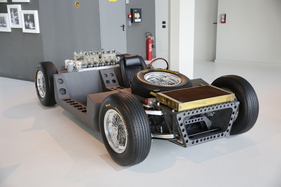
But Lamborghini hesitates. Legend has it that Nuccio Bertone appears at the Lamborghini stand towards the end of the show and is the last coachbuilder to stop by. Bertone examines the chassis on display and confidently tells Ferruccio Lamborghini that his studio will design "the perfect shoe for this wonderful foot". Whether this dialog actually took place can no longer be proven today. What is undisputed, however, is that this anecdote impressively reflects the direct mutual understanding and creative agreement between the two entrepreneurs.
Thanks to the collaboration with Carrozzeria Bertone and Marcello Gandini, the steel chassis is clothed in an eye-catching garment
Just a few weeks after the first meeting, at the beginning of January 1966, the designers finalized the Bertone draft and the prototype was built by March with the support of 30 Bertone employees. It offers comfort and reliability as well as very impressive performance figures. Behind the driver, the V12 engine is housed in the lightweight vehicle frame, and for the first time in the company's history, a bull adorns the hood as a brand emblem. Even the design of the wheel rims is completely new.
In March 1966, Lamborghini presents an orange-colored car at the Bertone stand at the Geneva Motor Show that leaves all existing conventions behind. The mid-engine concept fundamentally changed the weight distribution and offered a driving experience that was unsurpassed at the time. This is complemented by Bertone's incomparable, elegant design. Thirty orders for the new model are received at the show, exceeding expectations for this model.
Miura: a name that has gone down in history
The connection between Lamborghini and the symbolism of the bull is deeply rooted in the history of the brand. The Miura is the first time Lamborghini has deliberately used the name of a famous Spanish bull breed. The model is named after the mighty bull breed bred by Don Eduardo Miura Fernández.
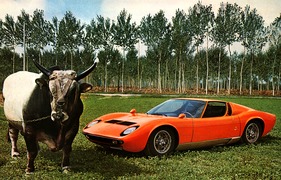
This history is directly reflected in Lamborghini's model designations. Names such as Miura, Espada, Islero and later Murciélago are deliberate references to legendary bulls and their characteristics.
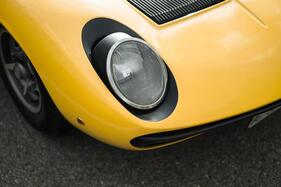
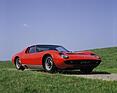
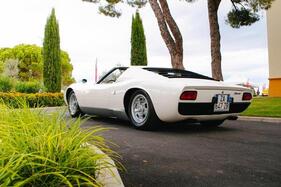
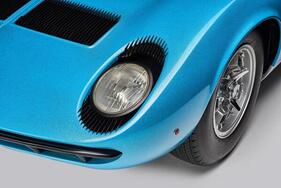
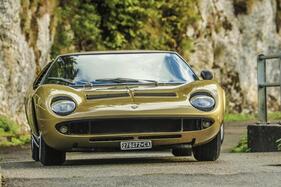
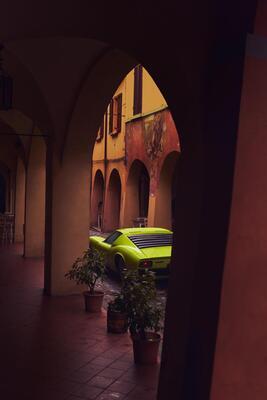
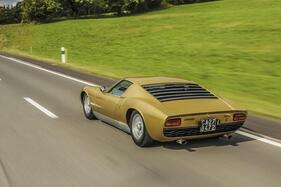
Lamborghini collaborates with Carrozzeria Bertone for the first time on the design. The renowned design studio creates a body that sets new standards. Flat, wide, elegant and aggressive at the same time, the Miura looks like a predator ready to pounce. The silhouette is low, the overall height of the car is only around 105 centimeters. The striking folding headlights with "eyelashes" and the generous air intakes characterize an appearance that is still considered timeless today.
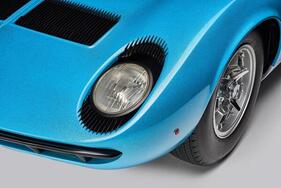
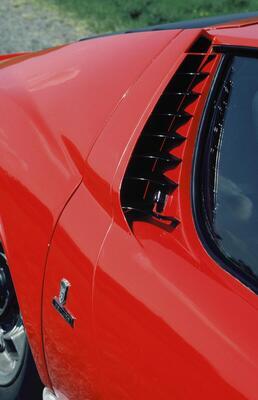
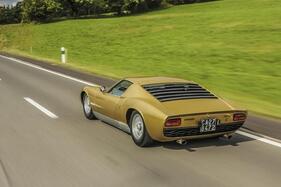
Bertone takes its cue from racing cars: flat, swivel headlights, radiator grilles that direct the air to the brakes and louvred surfaces on the hood that allow air to escape from the almost horizontal radiator (in this position only in the prototype). The V12 is supplied with air via air intakes behind and under the doors. The black louvers serve as covers for additional ventilation and at the same time provide a strong design accent.
The black anodized trim, used in place of the usual chrome trim, and the engine and gearbox layout set a trend for years to come. The Miura is not only low, but also compact in length at just 4.36 meters thanks to the engine layout. The design is still appreciated by many today.
In addition, the elegant body can be painted in unusual colors according to the customer's wishes. The Miura becomes one of the first super sports cars with bold colors. In addition to the basic colors orange, yellow, blue, green, white, emerald green and racing red, customers can also choose between the special colors Miura Red, Alpha Red, Special Red, Metallic Ruby Red, Eurolac Red, Granada Red, Orange, Metallic Purple Red or Caracas Purple Red. Various individual shades of blue such as Special Blue, Tahiti Blue, Metallic Blue, Midnight Blue and Spear Blue are also available - along with over 50 other paint colors. Lamborghini has been offering highly customizable models for more than 60 years.
The Lamborghini V12: heart, soul and legacy
The Lamborghini V12 is a technically revolutionary engine that has shaped the brand's DNA for almost six decades. It is an expression of engineering skill, innovation and vision. With the last pure V12, which was installed in the Aventador Ultimae in 2022, Lamborghini ends an era that stretches back to the 1960s. In 2023, the V12 will open a new chapter with the Revuelto, in which the engine will be combined with a hybrid system, marking the development of the V12 into a new, electrified era.
Depending on the model, P400 or Miura S, the engine produces 350 or 370 hp, making the Miura one of the fastest production cars of its time. The Miura 400 accelerates to 100 km/h in 6.7 seconds and reaches a top speed of 280 km/h. At the time, this super sports car was the fastest production car in the world. The engine of the later P400 SV delivers even more power with 385 hp at 7,850 rpm and a torque of 388 Nm at 5500 rpm, thus offering even better drivability. Power is transmitted via a dry clutch to a manual five-speed gearbox with an open shift gate.
The engine, transmission and differential share a common housing and lubrication system, which was unusual at the time. This saves space, but is technically demanding. During production, Lamborghini develops a separate lubrication system for the engine and gearbox, a technically significant change. Its performance, coupled with the groundbreaking V12 mid-engine, makes the Miura an exceptional vehicle and a pioneer among super sports cars.
Engineer Paolo Stanzani plays a central role in this story. He developed the V12 originally designed by Giotto Bizzarrini for road use and ensured that it was ready for series production. Together with the team, he developed the modern technical solutions that set the Miura apart from other sports cars of its time. Stanzani is also heavily involved in the design of other Lamborghini models such as the Countach, the Espada and the Urraco. The V12 not only provides the power, but also the character of the Miura. Its sound is unmistakable. The V12 is one of the reasons why the Miura plays a leading role in films, including the legendary opening scene of "The Italian Job" (1969). The engine becomes the star, its sound contributes to the performance.
The Miura appears on countless magazine covers and in articles, shaping the idea of what constitutes a super sports car. Celebrity owners such as Rod Stewart, Eddie Van Halen and Miles Davis appreciate the Miura for its design and engine characteristics that make every drive an unforgettable experience, because the Miura's V12 is more than just an engine. It is the heart of the Lamborghini brand, the embodiment of passion, innovation and uncompromising performance.
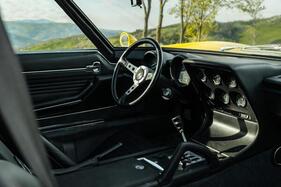
As befits a super sports car, the Lamborghini Miura is an uncompromising car. With no power steering, no electronic assistance systems and direct mechanical feedback, it still demands the driver's full concentration. At the same time, it rewards the driver with an unadulterated, emotional driving experience. The V12 delivers plenty of power and an unmistakable sound. The chassis consists of a lattice frame that closely connects the engine and suspension. This compact construction makes the unmistakable design with exceptional road holding possible. Double wishbones and coil springs at the front and rear ensure sporty, firm and precise handling for its time.
The Lamborghini Miura: production and special versions
According to official figures, 763 Lamborghini Miura models were built at the Lamborghini plant in Sant'Agata Bolognese (Italy) between 1966 and 1973. The first production Miura was delivered to Milan on April 20, 1967, followed by 107 more vehicles in the first year. By 1968, Lamborghini had already sold 184 Miura models, an average of almost four vehicles per week - an extraordinary number for a super sports car of the time.
Before the start of series production, Lamborghini builds an official prototype and around ten prototypes of the early P400 model. These test vehicles are not included in the official production figures. In addition, a small number of vehicles with minor technical or regulatory modifications are produced for specific markets such as the United States and the Middle East, which are sometimes counted separately in historical sources. Lamborghini is also developing early transitional Miura P400 S models that combine features of the P400 and the later P400 S.
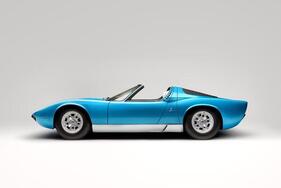
At least ten Miura models are considered one-offs, special projects or show cars. One of the best known is the Miura Roadster from 1968, a unique, open-top version created by Carrozzeria Bertone. It is painted in lamé light blue, fitted with a white leather interior and red carpeting and features characteristic elements such as larger air intakes in the doors, aroundair intakes in the doors, around 120 structural reinforcements, a more steeply raked windshield and unique rear lights, which clearly distinguish it from the Coupé.
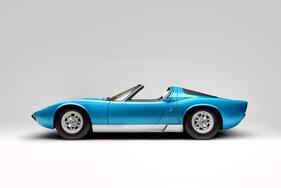
To celebrate the legacy of the Miura, Lamborghini unveiled the Miura Concept at the 2006 Geneva Motor Show to mark the model's 40th anniversary. It is a tribute to one of the most influential super sports cars in automotive history. Designed by Walter de Silva, the Miura Concept reinterprets the flat silhouette, broad rear shoulders and short overhangs of the original in a contemporary design language and deliberately dispenses with retro elements. It is conceived solely as a design study and remains more of a technical concept than a production proposal.
Miura today
Between 1966 and 1973 in particular, the Lamborghini Miura established a clear DNA that Lamborghini continues to follow to this day. Models such as the Countach, Diablo, Murciélago, Aventador and Revuelto continue its legacy. The Miura is what makes Lamborghini a genuine series manufacturer.
Even today, the Lamborghini Miura remains a benchmark for automotive design and cultural relevance. Sixty years after its introduction, it has not aged, but matured. Over the years, various Miura models have won prestigious awards at leading Concours d'Elegance, including Villa d'Este, Pebble Beach Concours d'Elegance, Salon Privé and Hampton Court Palace, and have been awarded Best in Class and special jury prizes for outstanding design, authenticity and historical significance. Many of these award-winning cars are restored or certified by the Lamborghini Polo Storico, the official department responsible for preserving Lamborghini's historical heritage through archival research, certification, restoration and participation in major international heritage events.
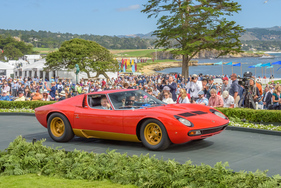
Lamborghini Miura P400 (1966-1969)
- First presentation: Geneva Motor Show, 1966
- Engine: 3.9-liter V12, 350 hp at 7000 rpm, 355 Nm at 5000 rpm
- Transmission: 5-speed manual gearbox, transversely mounted engine
- Top speed: approx. 280 km/h
- 0-100 km/h: approx. 6.7 s
- Unladen weight: 985 kg
- Special features: first production vehicle with mid-engine concept in the road vehicle sector, steel spaceframe chassis. Flat, elegant bodywork by Marcello Gandini/Bertone, "eyelash" headlights that give the Miura its characteristic face. The P400 is the original Miura, uncompromising and purist, extremely rare today.
- Price: 7'700'000 Lire
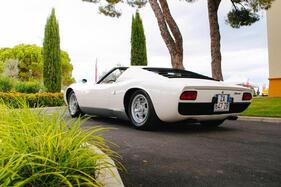
Lamborghini Miura S (1968-1971)
- Engine: 3.9-liter V12, 370 hp at 7500 rpm, 390 Nm at 5500 rpm
- Top speed: approx. 280 km/h
- 0-100 km/h: 6.4 s
- Unladen weight: 1180 kg
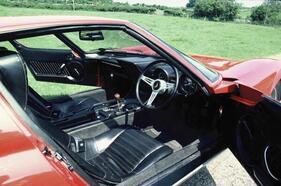
- Improvements: wider track, modernized suspension set-up with Koni shock absorbers, electric windows, higher quality interior (luxury options), more comfortable than the P400, ventilated front and rear disc brakes from vehicle 501 body: Slight changes to air intakes, seats and dashboard, chrome window frames instead of black anodized, optional air conditioning
- Special features: still extremely sporty, but more suitable for everyday use. The P400 S combines the raw power of the original Miura with a little more luxury.
- Price: 7,850,000 lire + 350,000 lire for the air conditioning.
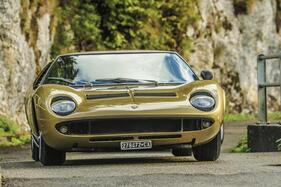
Lamborghini Miura SV (Spinto Veloce) (1971-1973)
- Engine: 3.9-liter V12, 385 hp at 7850 rpm, 388 Nm at 5500 rpm
- Top speed: over 290 km/h
- 0-100 km/h: 5.5 s
- Unladen weight: 1245 kg
- Improvements: separate engine and gearbox lubrication, wider rear axle for better traction, modified rear suspension, increased performance, faster and easier to control, some with limited slip differential
- Special features: last version of the Miura series, no headlight flaps, modern look, highest performance and road holding of the series, SV stands for Spinto Veloce (stronger and faster)
- Price: 8'600'000 Lire