
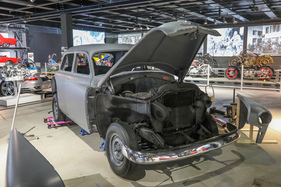
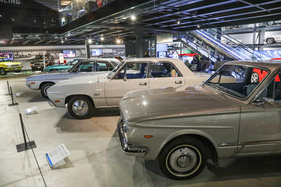
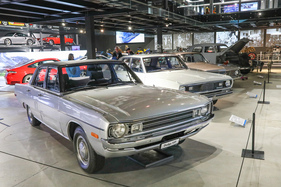
What prompted a car dealership to assemble vehicles in Switzerland? As is often the case with such decisions, the tax authorities were reason enough. The Swiss customs authorities had imposed almost protectionist customs duties on complete vehicles from the USA. Deliveries of parts, on the other hand, were very favorable because they created jobs.

The Schinznach-Bad site
On January 3, 1945, Walter Haefner founded Neue AMAG Automobil und Motoren AG with its headquarters on Utoquai in Zurich. Initially, the limited space available on Lake Zurich was sufficient. But it soon became too cramped. In 1947, the purchase of the site of a former cement factory with production halls in Schinznach-Bad presented itself. Within two years, the halls were converted and expanded into an assembly plant and a new administration building was added directly on the main road. In the second half of 1949, the first 66 Plymouth Special Deluxe cars rolled off the production line. Assembly work was carried out by a legally independent company, ASAG Automontage Schinznach AG, which, like AMAG, belonged to Walter Haefner Holding AG.

Over the years, necessity became a virtue. What began in Schinznach for cost reasons very quickly developed into a quality label. The manufacturing quality of the bodyshells, the rust protection treatment and the materials used, some of which were Swiss-made, were significantly better. Willy Huter, the long-serving and only director of car assembly, put it in a nutshell back in the 1950s: "The small lettering "Montage Suisse", which we affix to all the vehicles we assemble, must always vouch for the highest quality!"
Assembly in the comparatively small rooms in Schinznach-Bad is not the same as assembly at GM Biel or in a large car factory. There was much more teamwork and manual labor; classic Taylorism was only applicable to a limited extent.
The Plymouth years
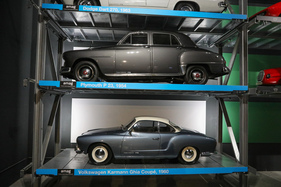
The first ten years of assembly can be described as "the Plymouth years". In the very first year of assembly, 66 vehicles rolled off the production line in Schinznach-Bad. By 1959, over 7,100 vehicles had been built. In comparison, the few Chryslers and around 250 DeSoto and Dodges each look modest.
As both the delivery reliability from Detroit and the manufacturing quality of the Standard Vanguard imported by AMAG were very poor in the early 1950s, Standard models were also assembled until 1953.

When the Americans became bigger and bigger (and too big for Swiss roads) at the end of the 1950s, Schinznach-Bad was grateful that around 1000 units of the then new, sleek Karmann-Ghia coupé could be assembled in Switzerland - to relieve the pressure on production in Osnabrück. The short-term production of Studebaker vehicles from 1959 onwards can be described as an intermezzo. The bankruptcy of the US company prevented greater success.
The decade of Valiants and Darts
The large American road cruisers were too big for Swiss customers, European alternatives were more compact and practical, and the VW Beetle, also imported by AMAG, had long since begun its triumphal march on Swiss roads. Alternatives were needed. The solution in 1960 was the Chrysler Valiant, a compact mid-size sedan by US standards at the time, powered by in-line six-cylinder engines.

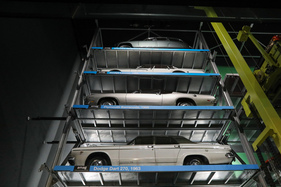
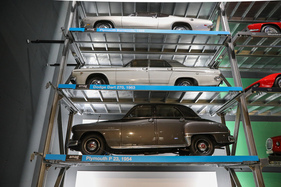
AMAG even positioned the "Valiant" as an independent brand. This was to clearly show that the Valiant was not a big 'Amischiff'. By the time assembly operations in Schinznach-Bad ceased, around 14,000 Valiants had been built. The product portfolio was supplemented by the sister models Dodge Lancer (until 1963) and Dart (from 1963).
In-house competition - the end
Towards the end of the sixties, the American car industry fell back into gigantism, this time in terms of engine capacity and performance. However, the chassis and (drum) brakes of these vehicles did not meet the engine performance and customer expectations. The Swiss topography in particular was not made for the American 'muscle cars'. As a result, interest in the Valiants and Dodge Darts steadily declined.
At the same time, AMAG, having acquired Audi Auto Union AG from Volkswagen, suddenly had a new, more fuel-efficient offering in the mid-range and upper mid-range with the Audi 90 and Audi 100.
While assembly in Schinznach had begun with a Plymouth, it also ended in 1972 with a Plymouth, a Plymouth Valiant, after 29,227 units.
The import contract for vehicles from the Chrysler Group ran until 1980.
The assembly facilities at the Schinznach site were demolished. Following several conversions, the assembly halls now house a large workshop with a plumbing shop, paint shop and spare parts warehouse as well as AMAG offices. Schinznach-Bad is still a large garage business in the region and for many Swiss people it is the "home of AMAG".
Special exhibition "Automontage Schinznach" at the Museum of Transport
From now until April 30, 2025, a special exhibition at the Swiss Museum of Transport is paying tribute to Schinznach. Selected models from various years of Swiss production can be admired in the high-bay warehouse and in the exhibition.

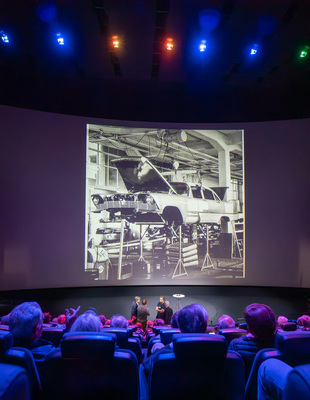
An interactive audio-visual show in the car theater also provides an exciting insight into this period. Detailed vehicle descriptions provide an insight into the products and their manufacture.
The Museum of Transport is open 365 days a year. Until October 26, 2024 and from March 30, 2025 from 10 a.m. to 6 p.m., from October 27, 2024 to March 29, 2025 from 10 a.m. to 5 p.m.

Further information can be found on the website of the Museum of Transport and the dedicated website on car assembly in Schinznach, which provides extensive information on this part of Swiss automotive history, including eyewitness accounts.