
The exhibition will open on July 1, 2022 and close on September 4, the same day as this year's Formula 1 race in Zandvoort. Eight Formula 1 cars driven by legendary drivers at the Dutch Grand Prix between 1948 and 1970 will be on display.
The F1 legends Ascari, Fangio and Clark
The highlights of this special exhibition are undoubtedly the three winning Ferrari 500 F2 cars driven by Alberto Ascari in 1952/1953, Juan Manuel Fangio's Mercedes-Benz W 196 from 1955 and the Lotus 33 driven by Jim Clark in 1965.
Ascari became world champion in the Ferrari 500 F2 in 1952 and 1953, winning the races in Zandvoort in both seasons. In 1953, he won seven consecutive Grand Prix races, a record that was only equaled in 2013. Alberto Ascari was Ferrari's first Formula 1 world champion.

In the following years, 1954 and 1955, the drivers' title went to Juan Manuel Fangio. In 1955, the Argentinian drove the Mercedes-Benz W 196 to the Stuttgart manufacturer's only victory to date at Zandvoort. Today, Fangio is more or less unanimously regarded as the best racing driver of the 1950s; his five world championship titles were only surpassed 46 years later by Michael Schumacher.

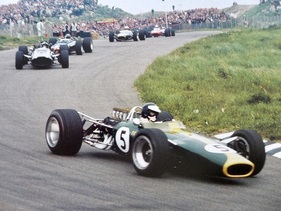
Jim Clark drove to world championship honors in 1963 and 1965, and in 1965 he also won the Dutch Grand Prix in Zandvoort behind the wheel of a Lotus 33 with a Coventry Climax V8 on the way to his second Formula 1 title. Nobody won at Zandvoort more often than Clark, who won here from 1963 to 1965 and in 1967 and is often described as the strongest driver of the 1960s.

Even more Formula 1 stars
The Talbot Lago T26C (1950/51) driven by Frenchman Louis Rosier, the BRM P25 (1959) driven by Swedish driver Jo Bonnier and Graham Hill's Lotus 49 all finished on the top step of the podium at world championship races in Zandvoort. Louis Rosier won in 1950 and 1951, when the Grand Prix was not yet part of the Formula 1 championship. Jo Bonnier took his first and only Formula 1 victory in 1959 in a BRM 25.
The great Graham Hill
The Lotus 49 of two-time Formula 1 world champion Graham Hill can also be admired at the exhibition. However, the first race of this model was won by Jim Clark, who drove the 49 to his fourth victory at the Dutch Grand Prix in 1967. The Lotus 49 was powered by the successful Ford-Cosworth DFV engine, which took on a load-bearing function that had never been seen before. The DFV V8 was jointly responsible for 155 Grand Prix victories and is rightly regarded as one of the best racing engines ever built.

Dutch Formula 1 icons
Dries van der Lof's 1952 HWM-Alta and Carel Godin de Beaufort's Porsche 718 complete the exhibition. Together with Jan Flintermann, Van der Lof was the first Dutch Formula 1 driver. He took part in the 1952 race in Zandvoort, but dropped out. De Beaufort finished sixth ten years later, scoring his first world championship points.
The development of Formula 1 technology
The "F1 Legends" exhibition offers an overview of the technological developments in Formula 1 between 1948 and 1970. Just like today, changes to the regulations influenced the maximum engine capacity, for example, and determined whether superchargers could be used. Visitors can trace the process from the space-frame chassis to the monocoque as well as the change from front-engine to mid-engine construction.

The Louwman Museum
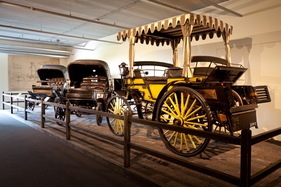
The museum's collection can of course also be visited during the F1 Legends exhibition. The museum presents every detail of automotive history and over 250 vehicles from more than 100 manufacturers from many eras. The huge variety of car bodies and mechanical innovations is beautifully presented, along with many works of art that embed the automobile in its historical context.
More information can be found on the Louwman Museum website.