


The first Audi RS model, the Audi RS 2 Avant, was launched 25 years ago - the beginning of a success story. With their proximity to motor racing and their exclusivity, Audi RS models have always exerted a special fascination. To date, Audi Sport GmbH, formerly quattro GmbH, has presented a total of 25 RS models. Six more new products will be presented in 2019, including two completely new RS models.
Performance for everyday use
At Audi, the term "RS" stands for a philosophy that is driven by the pursuit of top performance and perfection. "Every RS model expresses the passion with which we develop our high-performance cars," says Oliver Hoffmann, Managing Director of Audi Sport GmbH. "For 25 years, our customers have experienced the RS models as superior everyday companions that convey pure emotion and the greatest possible driving pleasure."
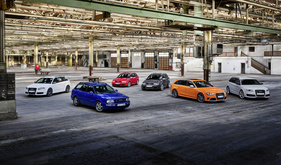
The RS models are the spearheads of their respective model series, they stand for performance prestige and exclusivity at the limit of what is technically feasible without compromising on everyday usability. Many of them are pioneers in their market segments and trailblazers in technical innovations - this was already true 19 years ago for the Audi RS 4 Avant with its brilliant biturbo V6 and is just as true today for the TT RS and its characterful, multi-award-winning five-cylinder engine in its latest evolutionary stage.
Genuine milestones
The RS models have been making their mark for a quarter of a century - five milestones deserve special mention.
In 1994, the Audi RS 2 Avant (232 kW/315 hp) with its four-valve five-cylinder engine, long since installed, wrote the first chapter of the RS story. With it, the company opened up the segment of dynamic high-performance station wagons. The racing and rally-proven quattro drive with self-locking intermediate differential made it possible to transfer the high performance to the road with ease.
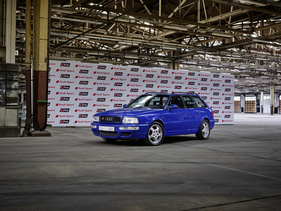
In 1999, the Audi RS 4 Avant, based on the then S4, brought a new dimension of power to the mid-size class. As in the S4, a V6 engine with a displacement of 2.7 liters, five valves per cylinder and biturbo charging was at work under the hood. The engine engineers at the then quattro GmbH further developed the already very powerful engine for use in the RS 4 to make it even more powerful and torquey. In collaboration with Cosworth Technology, the cylinder head was redeveloped, the intake and exhaust ducts were redesigned and the air ducts on the intake and exhaust sides were enlarged in cross-section. The turbochargers are also larger and the boost pressure has been increased compared to the S4. As a result, the RS 4 engine develops a maximum output of 280 kW (380 hp) instead of 195 kW (265 hp).
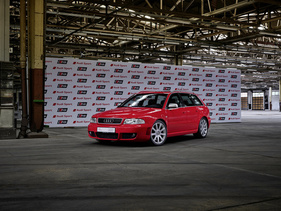
The second generation of the RS 4 followed in 2005 and was characterized by numerous innovations, many of which had their origins in motorsport. The V8 engine with 309 kW (420 hp) was outstanding. For the first time, a manufacturer used a combination of direct petrol injection and a high-revving concept that allowed engine speeds of up to 8,250 rpm. The direct petrol injection system enabled a more effective generation of the fuel-air mixture for improved power output. The FSI technology had already impressively demonstrated its performance in the then Le Mans-winning R8. In 2007, the unit was also used in the first generation of the Audi R8.
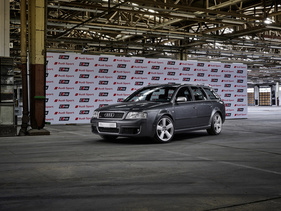
The suspension featured the latest generation of permanent all-wheel drive and the Dynamic Ride Control damper system, which was first used in the RS 6 in 2002. The further developed quattro drive with self-locking center differential provided optimum traction with its asymmetric-dynamic torque distribution in a ratio of 40 percent front to 60 percent rear. The first and so far only RS 4 Cabriolet created open-top driving pleasure with the accompaniment of the sonorous naturally aspirated V8 engine.
In 2008, the RS 6 Avant appeared, a sports car in the guise of an inconspicuous business estate. With a completely newly developed V10 engine with FSI direct injection, biturbo charging, dry sump lubrication as used in motorsport and quattro permanent all-wheel drive, the RS 6 Avant took the lead among the competition. With its impressive V10 power output of 426 kW (580 hp) and 650 Nm of torque, the RS 6 Avant was the most powerful production Audi to date. The crankcase of the V10 engine was made from an aluminum alloy using a low-pressure die casting process - a high-tech material that combines low weight with high strength. The cylinder liners of the contiguous crankcase were mechanically exposed so that the complete engine weighed only 278 kilograms. In order to meet the highest demands in terms of driving dynamics, the engine's oil circuit was developed with dry sump lubrication, which has proven itself in racing. The external oil reservoir and the oil pump module, which operates with numerous suction stages, ensured the lubrication of all engine components and the two turbochargers at all times.
In 2011, the five-cylinder RS 3 Sportback with 250 kW (340 PS) brought the RS philosophy to the compact class. In 2013, the RS Q3 opened up another market segment as the first compact SUV. As in the TT RS and RS 3, the engine was the transverse-mounted 2.5-liter five-cylinder engine. With a length of less than 50 centimeters, the engine was very compact. The long stroke (stroke 82.5 x 92.8 millimeters) was therefore perfectly suited for transverse installation. It initially produced 228 kW (310 hp), from the end of 2014 even 250 kW (340 hp).
The RS Q3 performance, which followed in 2016, even achieved 270 kW (367 PS).
With turbo
The RS models have exceptional turbo engines under the hood, above all the furious five-cylinder, which has a long tradition under the four rings. In the 1980s, they propelled Audi's rally cars, touring cars and production models to the top of the competition. The first RS model, the RS 2 from 1994, also had such an engine. In 2009, the five-cylinder engine made its comeback in the Audi TT RS, in 2011 it moved into the RS 3 Sportback and two years later into the RS Q3.
25 years of the RS - exhibition at the Audi Forum Neckarsulm
An exhibition opened at the Audi Forum Neckarsulm on July 12, 2019 to mark the anniversary. In addition to the well-known series models, a total of 14 genuine RS rarities are presented.
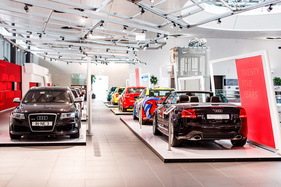
These include the Audi TT RS racing car from 2011, which was developed for factory use at the Nürburgring, the RS 5 DTM race touring car that won the 2013 season and a prototype of an Audi RS 8 that did not go into production. The exhibition also features an RS 4 saloon, which has been given a particularly exclusive paint job by the Brazilian pop artist Romero Britto.
The RS models in chronological order:
- Audi RS 2 Avant (1994): 2.2-liter five-cylinder turbo, 232 kW (326 hp)
- Audi RS 4 Avant (2000): 2.7-liter V6 biturbo, 279 kW (380 hp)
- Audi RS 6 Sedan and RS 6 Avant (2002): 4.2-liter V8 biturbo, 331 kW (450 hp); from 2004 RS 6 plus, 353 kW (480 hp), limited to 999 units
- Audi RS 4 Sedan (2005), RS 4 Avant (2006), RS 4 Cabriolet (2006): 4.2-liter V8, 309 kW (420 hp)
- Audi RS 6 Sedan and RS 6 Avant (2008): 5.0-liter V10 biturbo, 426 kW (580 hp),
and many more


