
When over 150 vehicles from the history of rallying come together every year at the ADAC Eifel Rallye Festival around Daun to celebrate the history of this fascinating sport, there is always a special additional theme. For the current edition (19 to 21 July 2018), the organizers have opted for the legendary Pikes Peak International Hill Climb. Pikes Peak is a 4,301 m high mountain in the Rocky Mountains in the US state of Colorado. The race distance of 19.99 kilometers includes 156 bends and was still held entirely on gravel in the 1980s. From the start at an altitude of 2,862 meters, the route has an average gradient of 7% over an altitude difference of 1,439 meters to the finish at the summit.
Pikes Peak's role in rallying is just as special as its route. "After Group B was excluded from the World Rally Championship, Pikes Peak became a new home for these spectacular monsters," says Reinhard Klein (Cologne) from personal experience. The co-organizer and head of Slowly Sideways, the association of owners of historic rally cars, was on site as a photographer at the time. "At the hill climb, the Group B cars from Audi, Peugeot, Ford, Lancia and Austin Rover were driven in their most extreme form. And that's exactly how we want to bring them to the Eifel. When selecting the participants, as with the entire festival field, we attach great importance to originality or faithful replicas. "The Pikes Peak cars will compete in two selected stages. They will start on Friday evening on the "proWIN Hilgerath" night circuit and on Saturday in the second 'Risselberg' stage, which appropriately takes place on a former hill climb track.

Highlights in the Pikes Peak Parade
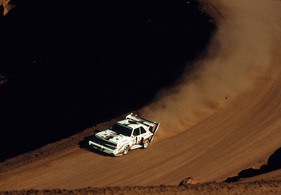
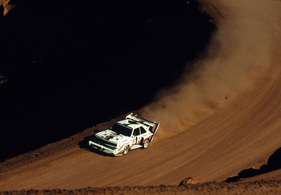
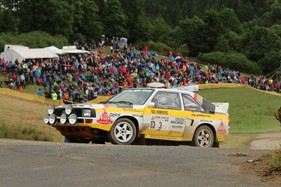
While entries for the Eifel Rallye Festival are now open, some highlights for the Pikes Peak Parade have already been confirmed. Audi Tradition is opening its museum gates and bringing two original winning cars to the Volcanic Eifel. Firstly, the Audi Sport Quattro, in which Michèle Mouton won in 1985, and also the absolute super S1. The 'winged monster' Audi S1 Pikes Peak, which Walter Röhrl piloted to victory in 1987 with around 600 hp. The Mouton Quattro will be driven by Harald Demuth, the 'winged monster' will be driven by Röhrl himself as things stand at present.

Wolf-Dieter Ihle from Stuttgart is bringing another winning car to the start, the Audi Quattro A2 from 1983, with American rally ace John Buffum at the wheel, just like back then. Audi won six times in a row on Pikes Peak from 1982 to 1987, and with the Audi Quattro A2, the Audi Sport Quattro and the Audi S1 Pikes Peak, all the winning models used at the time will be united in the Eifel for the first time.

A very special vehicle will complete its first kilometers in the Eifel after the Pikes Peak race in 1986. The VW Golf Bimotor also comes from the Ihle collection. The twin-engine Golf - a few kilos of sand from Colorado came to light during the restoration - will be driven by former European champion Jochi Kleint, just like back then. As in Stuttgart, the lights in Erich Müller's 'Schrauberhallen' in Austria will not go out until the festival.
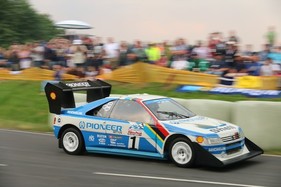
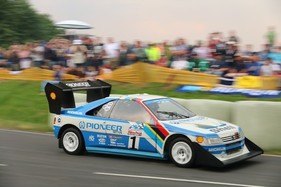
Peugeot challenged Audi with three Peugeot 205 T16 Pikes Peak cars in 1987. However, the three cars no longer exist. Two were converted in 1988 as the basis for the 405 T16 then in use, and one was modified for rallycross use. Müller fills this gap and rebuilds a faithful 205 T16 Pikes Peak, the maiden voyage with it at the wheel will then take place at the festival.
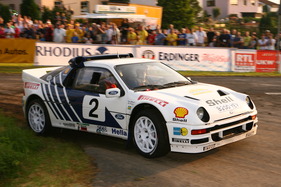
Brit Mark Rennison is bringing the original Ford RS200 to Daun, in which he himself took part in the 'Race To The Clouds'. The project was initiated by festival regular John Wheeler, who was also the 'father' of the RS200 project at Ford. "That's a really impressive Pikes Peak entry list, which we are very proud of. But discussions are still ongoing and it is quite possible that one or two 'sweethearts' will join us," says organizer Otmar Anschütz (Daun) from the organizing MSC Daun.

Walter Röhrl: It's great that Audi is showing this car again
Double world champion Walter Röhrl still remembers every detail of his victory on Pikes Peak in 1987. "It's great that Audi is bringing this unique S1 out of the museum again and showing it to the public in action," says the long-time Regensburg resident. He sees two reasons for the success at his first and only start in Colorado: "The Audi technicians quickly understood that downforce, i.e. a wing system, is also necessary with all-wheel drive on gravel." After the first fabulous times with the 600 hp 'wing monster' in practice, Peugeot in particular tried to build its own wing system on site, but they were unable to prevent the Röhrl combination from winning in the S1 on Pikes Peak. The second reason probably lies in the meticulous preparation of the rally genius. "I drove up the mountain eight times in the road car with my wife Monika and wrote down the route with her. Then I gave each of the 156 bends a name and memorized them," Röhrl adds mischievously, "unlike some of my competitors, I knew where I was at all times." Röhrl is particularly proud of the track record he set in 1987, the first time he set a time under eleven minutes.