




Karl (Carlo) Abarth (November 15, 1908 - October 24, 1979), born and died in Vienna, was a well-known and successful motorcycle racer before the Second World War. After the war, he re-established old contacts with the Porsche family and became their representative in Italy.
Together with Rudolf Hruschka (Hruska), a former employee of Ferdinand Porsche, and Tazio Nuvolari, he launched a Formula 1 project, which Piero Dusio joined with his Cisitalia. Abarth and Hruschka both became employees of Cisitalia, but after a short time the company ran into financial difficulties and Dusio disappeared to Argentina.
Foundation of the Abarth company in 1949
Abarth founded the company Abarth & C. in Bologna on March 31, 1949, together with Armando Scagliarini as financial backer. In 1949, Abarth opened its headquarters in Turin on Via Trecate, where production took place. There, the company could also count on people from the Cisitalia days.
Its first own sports cars, such as the 205A, were also related to Cisitalia.

Immediately after the company was founded, the bread and butter business was the sale of exhaust silencers (marmitte Abarth), later complete exhaust systems, and intake systems (collettori Abarth) consisting of manifolds and carburetors.
At the beginning, he also sold a steering wheel gearshift for the Fiat 500 (Topolino), which was even advertised by Tazio Nuvolari.
Selling noise
The exhaust system business expanded rapidly and Abarth gradually offered versions for practically all European brand models. The trademark was the pithy sound and Carlo Abarth is quoted as saying that he was selling noise.

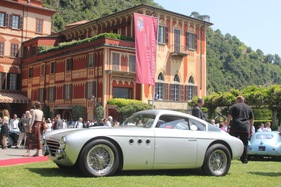
Abarth has also always produced cars. Initially in the tradition of Cisitalia, based on Fiat mechanics, and with bodies by designers such as Boano, Ghia, Michelotti and Scaglione. However, the numbers produced remained minimal.
Fast racing cars
The leap came with the introduction of the Fiat 600 in 1955. In the same year, Zagato developed a Berlinetta for the 600 and Abarth slipped a 750 cm3 with 41.5 hp underneath. At the same time, he offered the Fiat 600 from the series with the "750 package" as well as the components as a tuning package (cassetta di trasformazione) for self-installation. Zagato also found a whole series of imitators, all of whom also relied on Abarth.

The first Abarths appeared at the 1956 Mille Miglia and caused quite a stir. In the summer, Abarth then set a first series of world speed records in Monza with a 750 monoposto from Bertone, achieving an average speed of 140.6 km/h over 72 hours. More records were to follow. He aroused the interest of Fiat.
As the 600 had start-up difficulties due to its price and low power (21.5 hp), the news of the world records and sporting successes came at just the right time.
Contract with Fiat
In accordance with Carlo Abarth's wishes, the contract with Fiat, signed at the beginning of 1958, stipulated that Abarth would receive a bonus for every victory (class wins and records) anywhere in the world. [According to Renzo Avidano (AISA Monografia 90, 2010), Carlo Abarth's right-hand man since 1949, this contract was the reason why Abarth only had limited opportunities to move away from the small classes and offer large-volume sports cars, as the flow of money from Fiat always remained important for Abarth].

The Fiat 600 derivazione Abarth (1955-1970) was followed by the derivate 500 (1957-1971) and the derivate 850 (1964-1971). The derivative Simca (1962-1965) was also very successful, whereas the experiment with Porsche led to problems because Porsche was not satisfied with the quality delivered.
Own racing cars
From 1961, Abarth developed the Spider prototypes with tubular frame chassis. From 1000 cm3 to finally 3000 cm3.

There were also repeated plans to enter Formula 1 or at least Formula 2. A 6-liter was built for the Can-Am. All these projects were unsuccessful. Instead, they were able to supply the monoposti for Formula Italia.
Sale to Fiat
On July 31, 1971, Abarth sold its company to Fiat. In 1969, the company had set up its own department to support customers in races and was considering discontinuing the prize money to Abarth. Carlo Abarth bought the stocks of the racing department, in which Fiat showed no interest, and passed them on to Enzo Osella, a former employee.

Following the sale, Abarth became the racing division of the Fiat Group (Abarth Corse, later Fiat Auto Gestione Sportiva). This is where the Autobianchi A112 Abarth (still developed by the old company), the Fiat Ritmo Abarth, the Abarth Grande Punto and the Abarth 500 came from, as well as rally cars such as the SE030 (based on the Fiat 131), the SE037 (based on the Lancia Beta Montecarlo) and the SE038 (Lancia Delta S4). The company was later merged with Fiat.
"Independent" again
Abarth has been an independent subsidiary again since 2007 and the Abarth brand is part of the Alfa Romeo/Maserati brand group within Fiat Chrysler Automobiles (FCA). The headquarters are (once again) in Corso Marche in Turin.

In 2024, the "Abarth" company will be celebrating its 75th birthday. The extensive picture gallery provides an insight into Abarth's work.


