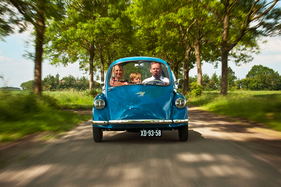
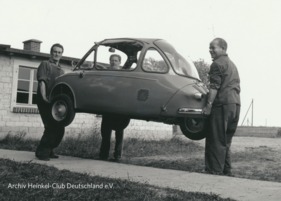
60 years ago, in March 1956, series production of one of the most innovative cabin scooters of the 1960s began - the Heinkel Kabine. Prior to this, the Federal Motor Transport Authority had issued the general operating permit on February 23, 1956. This was the birth of the Heinkel Kabine.

The development
This was preceded by a development that began in March 1954. Inspired by a visit to the Geneva Motor Show in the spring of 1954, where Ernst Heinkel saw the ISO small car (later the Isetta) for the first time, he commissioned his designers to create a small car. The first design drawings of the car were already available on May 17, 1954. Side doors, 2 seats, space for luggage behind the seats, a 200cc scooter engine and 8" wheels were the first key points of the specifications, which were to change several times during the development period.
The sales price was to be between DM 2,400 and DM 2,500 and therefore in the region of a scooter with sidecar.

As early as the second design in 1954, the design was changed to the front door to make it easier to get in and to improve the rigidity of the bodywork. During many test drives, some of which went as far as Italy and Norway, a number of teething troubles were rectified during the two years of development work and the car was finally ready for series production.
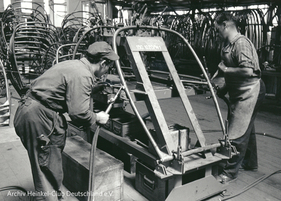
In addition to the Stuttgart Zuffenhausen site (engine production and headquarters of Ernst Heinkel AG) and the scooter production in Karlsruhe, a further plant was purchased in Speyer and the cabin assembly was established there without further ado. Particularly in the initial phase, the company had to contend with enormous start-up difficulties. The number of employees grew from 100 to around 500 within a year, the drying system was delivered late, so that the first cabs had to be painted in a temporary solution. And there were always design changes during the start-up phase of production that hindered the smooth running of production.
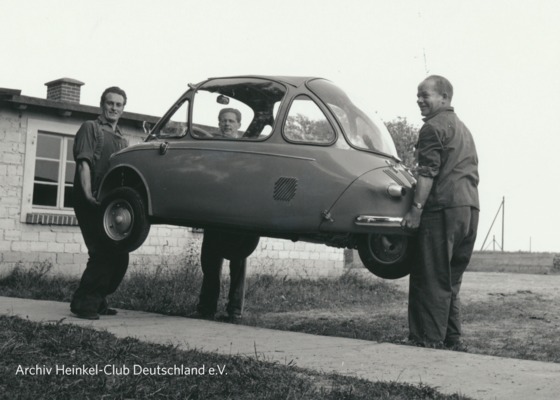
A total of around 11,000 cabs were manufactured at the Speyer plant during the 1 1/2 years of production before production was relocated to Ireland in the summer of 1958. It should not go unmentioned that parallel to the Irish production, cabins were also built under license in Argentina for the South American market from 1958 to 1961 before the cabin was built in England under the slightly modified name Heinkel Trojan from the end of 1961 to 1964.
Features of the cabin
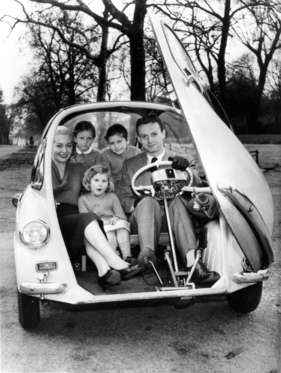
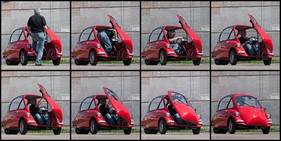
The cabin was equipped with a folding roof and two side hinged windows. The interior was kept rather functional. The individual backrests of the front seats could be folded down to allow easier access to the rear of the cabin (the Heinkel cabin was approved for two adults and two children). A pocket on the door, a small luggage net on the inside right-hand side and the open glove compartment provided some storage space. Plastic-covered cardboard on the sides, a padded engine box and many anti-drumming mats were intended to reduce engine noise and droning.
The handling characteristics of the Heinkel cab were considered good by the standards of the time. The front suspension was a trailed swing arm with spring struts and hydraulic shock absorbers. As with the scooter, the swing arm with a (reinforced) spring strut was responsible for the rear wheel suspension.
The cab engine
The cab was powered by a slightly modified scooter engine. The gear ratio was changed and a reverse gear was fitted. Equipped with 175 cc at the start of production, the engine was later (from October 16, 1956) bored out to 204 cc. At the beginning of the changeover, the engine capacity was deliberately set at over 200 cc, as the cab was thus classified as a car for tax purposes (journeys to the workplace could be claimed for tax purposes at 50 pfennigs). Over time, the engine capacity was reduced again to 198 cc in order to remain in an attractive class for tax purposes.
The four gears and the reverse gear (most vehicles of the 1950s still had a three-speed gearbox) were operated via an easy-to-use splitter gearbox to the left of the driver's seat. The gearshift was operated with a shift rod until October 1956, when the "droning" shift rod was replaced by an adjustable flexi-ball cable.
Production costs of the cab were too high
The Heinkel cab became increasingly popular with buyers despite its high price (DM 2,750 instead of the originally planned DM 2,500). However, the production costs of the Heinkel cabin caused great concern. Heinkel was constantly looking for ways to cut costs, without really being successful. The manufacturing costs amounted to 2,275 DM with a sales price of 2,750 DM. Too much to achieve the necessary profits for further developments.
And so, shortly after Ernst Heinkel's death in 1958, those responsible drew the necessary conclusions and relocated production to Dundalk Engineering in Ireland, a low-wage country at the time. Around 6,500 cabins were manufactured there from October 1958 to August 1961, while the engines were supplied from Stuttgart. Parallel to Irish production, a total of around 2000 cabs were also built under license for the South American market in Argentina from 1958 to 1961.
A further relocation of production took place in 1961, when all plans, machines and rights were sold to the southern English company Trojan. From the end of 1961 until 1964 (three-wheeled vehicles had a tax advantage in the English market), the cabins continued to be built under the name Heinkel Trojan, with slight modifications. Around 6,100 cabs were produced during this period.
Outlook
For over 30 years, the Heinkel-Club Deutschland e.V. has been the home of cabin drivers from all over the world. The spare parts supply is guaranteed by the club's own Ersatzteil GmbH. This ensures that even 60 years after the start and around 50 years after the end of production, the Heinkel cab can still be seen in action at one classic car meeting or another.
The 60th anniversary will be celebrated at the end of May at the annual meeting in Jülich, as well as at the cabin meeting in Marktbreit. Further information about the Heinkel Kabinenroller and the club can be found on its website.