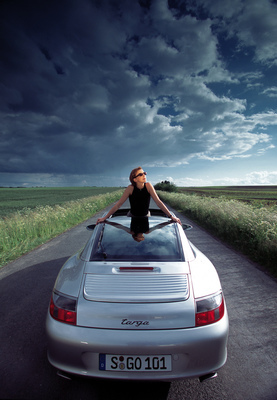
In September 1965, Porsche presented the 911 Targa at the International Motor Show in Frankfurt. This vehicle is neither a convertible nor a coupé, neither a hardtop nor a saloon, but something completely new: the world's first safety convertible with a fixed safety or roll-over bar. A removable folding roof and a fold-down plastic rear window make it possible to enjoy the fresh air in a variety of ways not previously seen in open-top vehicles: completely closed, completely open or only with the roof center section removed or the rear window folded down.

The Targa concept is the starting signal for a new Porsche driving experience and from then on accompanies not only all 911 generations, but later also other vehicles such as the 914 or the Carrera GT.
The Targa Florio as namesake
With the new concept, Porsche is responding to increased safety requirements for open-top vehicles on the American market and countering calls to ban convertibles altogether in the USA. When looking for a model name, a search is made for racetracks where Porsche has been particularly successful, and the "Targa Florio" - the road race in Sicily where Porsche has celebrated great motorsport successes since the mid-1950s - quickly comes to mind. In the short term, "911 Flori" comes to mind, until Domestic Sales Manager Harald Wagner decides the search rather casually with the question: "Why don't we actually just say Targa?"

Legend has it that the Italian term also means "shield", but only the writers of the sales brochure noticed. In August 1965, Porsche filed a patent application for the Targa concept and from fall 1966, the Targa complemented the previous Coupé in the 911, 911 S and 912 and was very well received. From late summer 1967, the Targa models could also be ordered with a permanently installed, heated rear window made of safety glass instead of the folding plastic rear window. This solution became standard equipment the following year and remained practically unchanged on the Targa until 1993.
Targa variety in the G-series models
The Targa also remained an integral part of the product range for the second generation of the 911, the G-series models built from late summer 1973 onwards. For the first time, the body of the 911 was permanently modified and, in accordance with new legislation in the USA, now featured new, box-shaped bumpers with black bellows on the side. They are capable of absorbing impacts up to a speed of 8 km/h without damaging the bodywork.

The technical concept of the Targa roof remains unchanged, but the visual appearance does, as the Targa bar, previously in durable, brushed stainless steel, is now also available in black. Even when the 911 SC Cabriolet, the first Porsche that could be driven completely open-top, rejoined the range in January 1983, the Targa remained a constant - even after the end of the G-series production period in 1989.
Type 964 made of 85 percent new parts, but the Targa remains classic
In the fall of 1988, Porsche presented the 911 Carrera 4 Type 964, the first all-wheel-drive 911 and thus the third generation of the iconic sports car from Zuffenhausen. Porsche retained the classic body shape of the 911, but around 85 percent of all parts were new. As early as the following year, the 911 Carrera 2 is not only available as a variant with classic rear-wheel drive.

All three body variants are now also available: Coupé, Cabriolet and Targa. The 911 Carrera 2 Targa and 911 Carrera 4 Targa, built until 1993, still have the classic Targa bar and the removable roof center section. Within the first three 911 generations, 87,663 Targa models were built.
The move away from the Targa bar - glass roof on the 911 Targa Type 993
The introduction of the fourth generation of the 911 Type 993 in the fall of 1993 was accompanied by a new body design and, from November 1995, a new Targa concept. For the first time on the 911, the front fenders are wider and significantly flatter. The rear fenders are also wider and run straighter towards the rear. In addition to a comprehensive further development of the engine and chassis, the 993 generation takes on the Targa theme in a completely new way and without the Targa bar.

Within a safety structure that now runs lengthways, there is a roof made of tinted heat-insulating glass that extends from the front windshield frame to the rear section. Divided into electrically movable segments, it opens steplessly at the touch of a button and retracts behind the rear window like an extra-wide sliding roof. Reduced wind noise when the roof is closed and a sun-drenched interior are key advantages of the new solution. Another characteristic feature of this Targa: the tapered rear windows. The new Targa concept of the 993 model series combines open-top driving pleasure with the 911 for the first time, without changing the classic roof line of the coupé.
911 Targa Type 996 - the Targa gets a tailgate
With the 911 Carrera Type 996, Porsche presented the fifth generation of the 911 in 1997, which was completely redesigned and relied on water-cooled six-cylinder boxer engines for the first time. From December 2001, the Targa was also available alongside the Coupé and Cabriolet. Like its predecessor, the 911 Targa has an electrically operated glass roof, now with a surface area of more than 1.5 square meters.

There has never been more glass space in a Porsche 911. The new Targa is also the first 911 to offer a folding rear window. The rear luggage compartment with a storage capacity of up to 230 liters is thus easily accessible for loading suitcases, bags or other luggage.
911 Targa 4/4S Type 997 - lighter glass and two variants for the first time
In September 2006, the 911 Targa of the now sixth 911 generation Type 997 followed. In principle, it adopted the design of the Targa roof with an additional practical tailgate from its predecessor.

However, the use of special glass enables a weight reduction of 1.9 kilograms and two high-gloss polished aluminum strips on the side edges of the roof serve as a special eye-catcher. In addition, the 911 Targa is now only available in two all-wheel drive variants - as the 911 Targa 4 and 911 Targa 4S.
911 Targa Type 991 - the return of the legendary Targa bar
In September 2011, Porsche presents the seventh and completely redesigned generation of the 911. The Coupé and Cabriolet body variants are followed in January 2014 by the 911 Targa, which presents itself as a modern classic with its innovative Targa roof. For the first time, the classic Targa idea has been successfully combined with state-of-the-art roof comfort. Like the legendary original Targa, the new model has the characteristic wide bar in place of the B-pillars, a movable roof section above the front seats and a wraparound rear window without a C-pillar.

Unlike the classics, however, the roof segment of the new Targa opens and closes at the touch of a button. The fully automatic roof system makes the roof element disappear behind the rear seat in a spectacular way. The new 911 Targa thus presents itself as a highly innovative new edition of the classic from 1965.

And of course the story doesn't end there, as the 992 Targa was unveiled in May 2020.