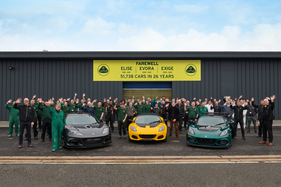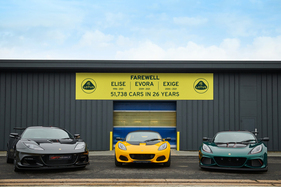
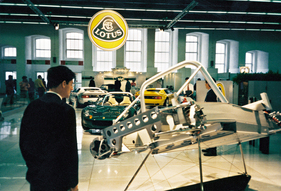
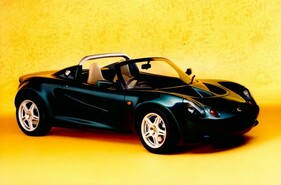


At the end of the Elise/Exige/Evora production at Lotus, the three sports cars were photographed again together with many members of the Lotus team who were involved in the design, construction, assembly and sale of the vehicles.
Great success
Over the course of 26 years, a total of 51,738 vehicles from the three Elise/Exige/Evora model series have rolled off the production line. Taken together, they account for almost half of Lotus' total production in its 73-year history. In addition, 9715 sports cars were built for third-party customers of Lotus, including GM and Tesla.
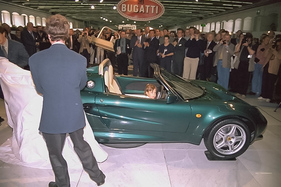
From 1996 to 2000, the first-generation Elise and Exige sports cars were built in a small assembly hall in Hethel together with the Lotus Esprit.
The assembly lines that were installed in 2000 are currently being dismantled and replaced with all-new, state-of-the-art equipment to support the new Emira plant. Full Emira production will commence in the spring, once the current prototype and testing phase has been completed. This will see Lotus sports car production enter an exciting, high-tech and semi-automated era, increasing capacity to up to 5000 units per year in single-shift operation.
Off to the museum
The last examples of the Elise, Exige and Evora models are reserved for Lotus' growing historic collection.
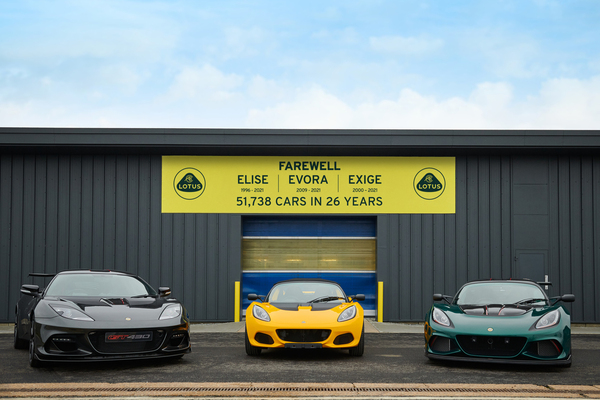
The last Elise, a Sport 240 Final Edition in yellow and the last of 35,124 examples, the last Exige, a Cup 430 Final Edition in Heritage Racing Green - number 10,497 - and the last Evora - a GT430 Sport in Dark Metallic Grey - the last of a series of 6,117 examples - will be added to the collection.
One platform for many cars
The Elise and Exige sports cars were built on the Lotus sports car platform "small cars".
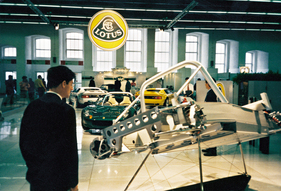
The Opel Speedster / Vauxhall VX220 (7200 vehicles built between 2000 and 2005) and the Tesla Roadster (2515 vehicles built between 2007 and 2012) were built on the same platform and also by Lotus in Hethel. Including the Lotus 340R, Europa, 2-Eleven and 3-Eleven vehicles, the total production volume of the Lotus "small car platform" amounts to 56,618 vehicles.
Matt Windle, Managing Director of Lotus Cars, said: "Firstly, I would like to thank the Lotus team who have worked on the Elise, Exige and Evora over the years and are now moving into Emira and Evija production. I would also like to thank all Elise, Exige and Evora customers over the last 26 years for their passion, enthusiasm and support. These customers have given our E* sports cars a true cult status that normally only applies to long discontinued classics.
As we bid farewell to the final vehicles, we look forward to the Emira and Evija in the all-new factories in Hethel and the pre-assembly plants in Norwich, which offer greater efficiency and automation, higher quality and flexibility and the very exciting next chapter of our Vision80 strategy."
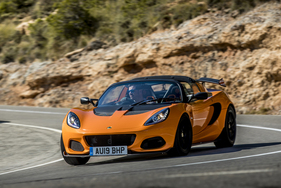
Russell Carr, Design Director, Lotus Cars, added: "These three special cars have not only played a huge part in Lotus' 73-year history, but have also been omnipresent in my daily life. Together with the Lotus design team, I have lived and breathed these cars for over 26 years. We will miss them, but it's a bit like Christmas: As soon as it's over, the anticipation builds for the next celebration - and that's exactly what's happening now at Lotus with the Evija, the Emira and the upcoming Type 132. 2022 is going to be a great year when a new generation of Lotus goes into action.
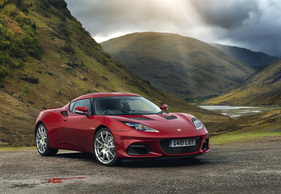
Gavan Kershaw, Director of Vehicle Attributes, said: "The Elise in particular has been a big part of my life. It was conceived when I had just finished my apprenticeship and was working in the vehicle workshops helping to build the first prototypes. The Exige will always be close to my heart, as the development program was the first I worked on as an engineer, and I also won the British GT3 Championship in a racing version. The Evora is also so important because it has shown that you can have high performance and award-winning handling without sacrificing GT capability for longer distances. I know this first-hand, having won the British GT4 Championship in an Evora, and I'll never forget leading the technical program for our Evora Le Mans campaign where we achieved a podium finish."
Richard Rackham, Head of Vehicle Concepts, who was involved in the Lotus Elise as vehicle architect and was part of the team that introduced pressed and bonded aluminum technology to the automotive industry, said: "The impact of these three cars over the years has been spectacular, both technically, structurally and dynamically: "The impact of these three cars over the years has been spectacular, both technically, structurally and dynamically. But all technology and innovation evolves, and if you had asked me four years ago for my proudest moment, I would have named the Elise chassis without hesitation. However, this has been superseded by our new Project LEVA architecture for our new range of electric sports cars, which will start with the Type 135 in a few years' time. This is now the pinnacle of Lotus architectures as it has taken the technology so much further. There's a lot to look forward to."
25 reasons why the Lotus Elise was important
The oldest of the trio, the Elise has been part of the automotive landscape for more than 25 years.
1) With its minimalist design, the Elise embodies "simple but sophisticated" engineering. It is the essence of what a Lotus car should be.
2) Like all Lotus cars, the Lotus Elise is characterized by a taut and precise ride that offers the driver an immediate connection to the road through a positive driving experience and precise feedback.
3) The Elise reminded the world that an outstanding driving experience should be a priority in sports cars. It set new standards for ride and handling and provided a new dynamic benchmark for everything that came after.
4) In August 1996, CAR magazine wrote after a "first drive" with the Elise: "The acceleration, the momentum, the breathtaking ability to change speed and direction, the sheer unbridled sense of motion - that's what makes driving the Elise so special and intense."
5) The pioneering pressed and bonded aluminum chassis was truly ahead of its time. Developed by Richard Rackham - who still works at Lotus today - it was a world first.
6) It became the preferred chassis technology for low-volume production. Cars like the Alpine A110 and the Morgan Aero 8 are examples of how what Lotus did with the Elise influenced others.
7) The Aston Martin Vanquish is another example. Ford saw the foundations of the Elise as the way forward for its European high-performance car brand, and Lotus Engineering was brought in to assist with various aspects of the car's engineering.
8) With an original list price starting at GBP 18,995, the Elise instantly opened up a more affordable route to Lotus ownership. The only alternative 25 years ago was the Esprit, which started at GBP 39,995 for the GT3.
9) The Elise's critical and sales success helped raise Lotus' global profile. When the car was modified for North American regulations in 2004 - adding airbags, traction control and stability control - it put Lotus back on the map on the other side of the Atlantic.
10) The rebirth and enduring popularity of Lotus cars in club motorsport can be traced back to the introduction of the Elise. The Lotus Cup Europe is one of several one-make series around the world, including in Japan, the USA, Italy, Malaysia and Australia. In the UK, there is also the Elise Trophy
11) The popularity of the Lotus Elise was so great that there was even a Lotus Ladies Cup series. It took place in Hungary in 2011 and ran for four seasons.
12) Many a prospective customer got to know the Elise through the Lotus Driving Academy. The LDA was launched shortly after production of the Elise began and continues to enjoy great popularity. It operates in France, Italy, Malaysia, the USA and Hethel in the UK.
13) In 2000, a specially designed motorsport Elise was made available for the Autobytel Lotus Sport Elise Championship, part of the British Touring Car Championship support program. Lotus Design proposed a sketch for a full coupe version, which was made available as a road car ... and the Lotus Exige was born.
14) Other Lotus derivatives that would not have existed without the Elise are the Europa, 340R and 2-Eleven.
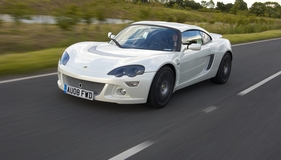
15) The chassis technology of the Elise was further developed for the Lotus Evora. It was a different chassis design, but the principles behind it were exactly the same.
16) Lotus Engineering was also able to capitalize on the "Elise effect" and market the technology behind the car through valuable third party contracts. The Vauxhall VX220 / Opel Speedster is one such example.
17) Without the Lotus Elise, would Tesla be the most valuable car company in the world today? Its adoption as the basis for the Roadster paved the way for Elon Musk and his team.
18) There were also other customers for the Elise. The Hennessy Venom GT and the Pininfarina Enjoy would be very different cars if they weren't based on the Lotus Elise.
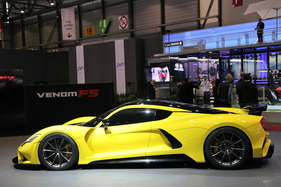
19) The man credited with the design of the original Elise has had a stellar career. After a spell at Volkswagen, Julian Thomson moved to Jaguar in 2000 to become the brand's design director.
20) Norfolk's reputation as a technical center of excellence skyrocketed in the mid-nineties when the Elise made Hethel a serious career destination for world-class engineers.
21) Demand for the Elise was at the heart of Lotus' growth at the end of the last century and into the present. It took the company 47 years to sell a total of 50,000 cars (1948-1995), reaching the 100,000 mark in 2018 - just 23 years later.
22) Between its market launch in 1996 and the turn of the millennium four years later, 10,619 Elise were built. Customer demand made it the fastest-selling Lotus car in history.
23) The Elise became the technical test bed for other environmentally friendly sports car concepts from Lotus. These included the Eco Elise (2008), which used hemp, eco-wool and sisal to make the body panels and interior.
24) Later that year, Lotus introduced the Tri-fuel Exige, a flagship model for alternative and more sustainable fuels. The car ran on gasoline, bioethanol and methanol.
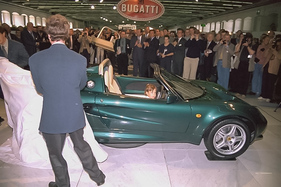
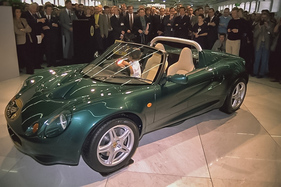
25) It also became an early indicator of how electric vehicle (EV) technology and driving characteristics would suit sports cars. The Zytec-Elise, developed by supplier Zytek, used the original Frankfurt show car and debuted in 1997.