A milestone birthday for the world's best-selling car
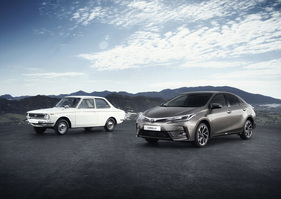
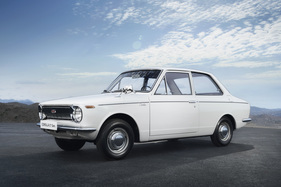
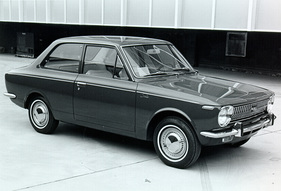
One of the world's most popular cars is celebrating its 50th birthday: half a century ago, Toyota presented the first Corolla in Japan. At the start, it was offered in two body variants - as a saloon with two or four doors and as a two-door estate. Corolla was intended as a "car for everyone", but this did not stop Toyota from producing it in good quality and equipping it with features that were normally only found in higher segments.
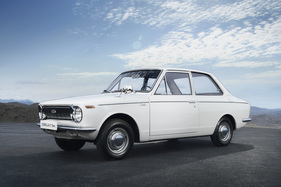
Remarkable for the time was the floor-mounted gearshift. The bucket-like front seats offered excellent support, while there was so much space in the rear that contemporaries compared the comfortable rear seat to a living room sofa. Although the Corolla was classified in the compact class, the comparatively high roof provided an unusually generous feeling of space.
Toyota had chosen the name "Corolla" - the Latin term for flower or corolla - in the hope that the vehicle would blossom on the international automobile market. And that is exactly what happened: Within three years, the first generation of the Corolla rose to become the best-selling vehicle in Japan and also began to gain a foothold in other markets.
Toyota always incorporated the findings of extensive customer surveys into the development of each new model generation. Based on the philosophy of the first model - a vehicle with superior quality, durability and reliability - a new Corolla was created time and again to exceed customer expectations in all key areas.
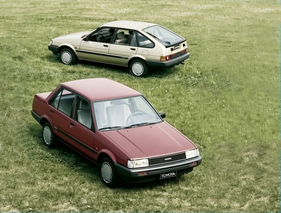
This method of continuous development with the aim of meeting the diverse needs of a global customer base is the goal of the Corolla and this should also characterize the 2016 Corolla. The current model aims to impress on the outside with its high-quality design, while on the inside it aims to score points with a high level of quality, plenty of space and a focus on advanced technology and safety features. The new Corolla continues to build on the virtues of quality, durability and reliability and continues to offer impressive value for money in all markets worldwide.
The 50-year history of the Corolla, characterized by constant further development and full of examples of technical and quality improvements, is also exemplary of Toyota's striving to build better and better cars.
44 million units produced in 16 plants worldwide
In November 1966, Toyota opened a new plant in Takaoka in Aichi Prefecture for the production of the Corolla. Two years later, production began in Australia and Malaysia. Just how much the Corolla contributed to the company's growth at this time can be seen from the following figures: In the period between 1965 and 1968, annual Toyota production grew from 480,000 to more than 1.1 million units.
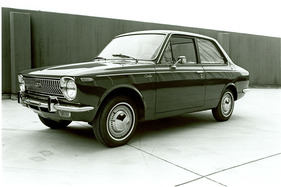
The Corolla was launched in Europe in April 1967. European production at Toyota's Turkish plant in Sakarya started with the seventh model generation in 1994, continued with the eighth and new generation and resumed with the eleventh edition of the Corolla in 2013.
The Corolla was exported to North America from 1968 - and it sold so well there that cumulative global sales exceeded the million mark just four years after its launch. In 1997, the Corolla finally became the best-selling car in the world with 22.65 million units sold at the time; in 2013, at the launch of the current eleventh generation, the best-seller passed the 40 million vehicle mark.
The Corolla currently rolls off the production line in 16 plants worldwide, with more than 44 million units sold. This means that, on average, every fifth vehicle sold by Toyota in its 79-year history is a Corolla. Since 2002, Toyota has sold more than one million units every year, with an average of 3,670 Corollas sold per day last year in more than 150 countries and regions.
First generation (1966-1970)
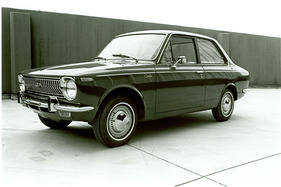
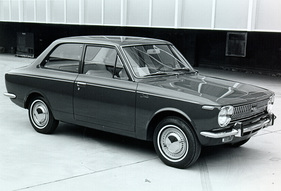
The first Corolla is presented in 1966. Under the direction of development chief Tatsuo Hasegawa, a sporty design was created to capture the hearts of onlookers. The Corolla was offered in various body variants and featured numerous new technologies that had not been seen on the Japanese market until then, such as wheel suspension on MacPherson struts and a four-speed automatic transmission. The model range initially included a saloon with a choice of two or four doors and a two-door estate.
Second generation (1970-1974)
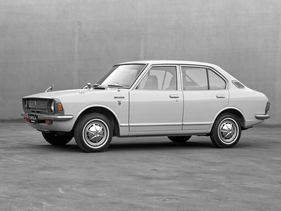
While sales figures were already approaching the million mark, the engineers and designers were faced with the challenge of developing a suitable successor to the successful model. The progress was expressed by gently curved lines on the bodywork, while under the bodywork a larger leaf suspension on the rear axle ensured greater comfort and better handling. In 1972, a coupé was added to the model series: with its 2T-G engine, the Corolla Levin became a collector's item among sports car fans.
Third generation (1974-1979)
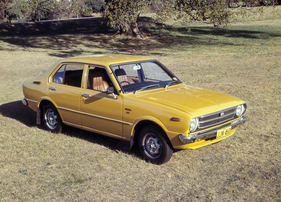
The third generation of the Corolla faced even greater challenges when it was launched in 1974. Strict emissions legislation necessitated the development of new engine and exhaust systems; Toyota took on a pioneering role in the development of catalytic converters - a technology that is still used today. The Corolla therefore becomes cleaner and more efficient and benefits from another new development: The exterior design receives aerodynamic fine-tuning in the wind tunnel. Inside, there are improvements in quality and ergonomics.
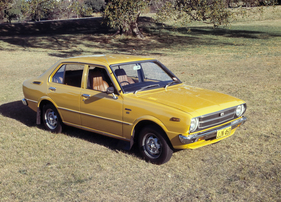
Fourth generation (1979-1983)
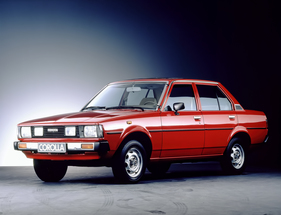
While the Japanese economy was on the road to recovery after another oil crisis, the fourth Corolla presented itself as a luxurious yet economical family car with features that met a variety of different customer needs. Aerodynamics play an increasingly important role in design: the new Corolla therefore spends over 400 hours in the wind tunnel. With an increasingly loyal customer base, the Corolla avoids a radical departure from the previous design, but features sharp lines on the overall more angular body. A new four-link suspension with coil springs increases comfort and stability, while a new 1.8-liter diesel engine meets the increased environmental requirements.
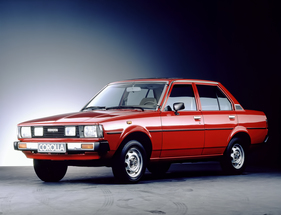
Fifth generation (1983-1987)
As innovative as possible, with technical breakthroughs in all important areas - this was the claim of development boss Fumio Agetsuma for the fifth model generation. It is the first Corolla to be developed with computer support. This saves time and resources in engine and design development. With its flat front end and rounded wedge shape, the new generation is the first Corolla with front-wheel drive.
The sporty coupés continue to have rear-wheel drive and a longitudinally mounted 1.5 or 1.6 liter engine. The latter is the AE86, also known as the "Hachi-Roku", the last Corolla with a front engine and rear-wheel drive. Its countless racing and rally successes and its drifting qualities make it an acclaimed car in modern Toyota history.
Sixth generation (1987-1991)
The new Corolla should not only satisfy customers - it should inspire them. Together with more than 100 parts manufacturers, over 2000 improvements are developed in all areas: from the reduction of noise levels to the use of soft materials on the dashboard and switches. It is the best quality Corolla yet, and this quality can be seen and felt everywhere.
Seventh generation (1991-1995)
Launched in 1991, the seventh Corolla aims to impress above all with charisma and personality in three key areas: stylish design, driving performance and safety and reliability. The engineers concentrated on the small but important details and on creating plenty of space for the family.
Eighth generation (1995-2000)
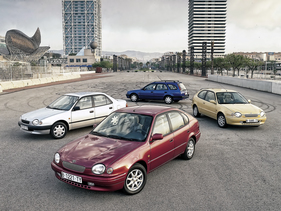
In the mid-1990s, environmental issues and economic concerns play a particularly important role - not least for the developers of the Corolla. The economy in Japan was stagnating when the eighth edition of the Corolla was launched, a car that people wanted: more environmentally friendly, more efficient and cheaper to buy and maintain. It is a car that transcends the boundaries between generations and nationalities and becomes the best-selling car in Japan. A car that promises its customers lower running costs, greater safety and comfort and higher quality.
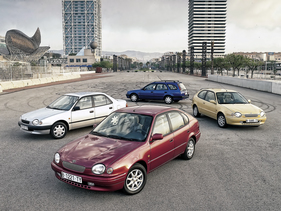
Ninth generation (2000-2006)
Launched in 2000, the ninth Corolla is the first whose design was developed in Europe. It is new from the ground up - because it is intended to cut the ties to the past and define the standards for the new millennium. Its main focus is on affordability - combined with simple operation, high reliability, comfort and improved surfaces.
Tenth generation (2006-2013)
In 2006, the Corolla celebrates its 40th birthday and takes a new design direction with the tenth generation. Head of development is Soichiro Okudaira, who gives the new model a global perspective. In terms of dynamic performance, the new Corolla has its sights set on the best models in Europe, while it has to meet the high demands of North American customers in terms of user-friendliness and space. The guiding principle for the engineers is the five-minute rule: the car must convince the customer of its quality within five minutes.
Eleventh generation (since 2013)
At the market launch of the eleventh generation in 2013, Toyota celebrates the new Corolla as the best-selling car in the world. In the 50 years of the Corolla's history, the company has now sold more than 44 million vehicles in the series. The latest model aims to impress with its high-class design, good quality appearance and advanced technology and safety features. With these characteristics, the Toyota icon is set for a successful future.