

The Renault 5 sparked a real revolution when it was launched in 1972 and made the competition look old in one fell swoop. With its modern design, variable interior, top space on a small road surface and, last but not least, its trendy colors, it marked the beginning of the modern compact class. Its Gallic charm lent it additional appeal and earned it a large fan base from day one.
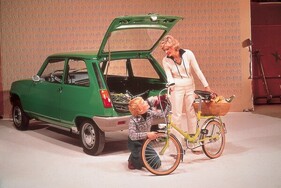
With a length of 3.51 meters, the R5 took up very little traffic space, was easy to handle in the city with a turning circle of just 9.8 meters and easy to park, but still offered enough space for four adults and their luggage.
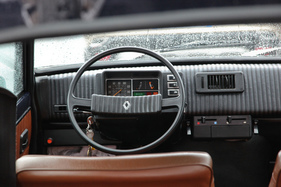
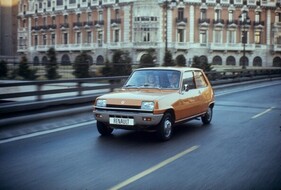
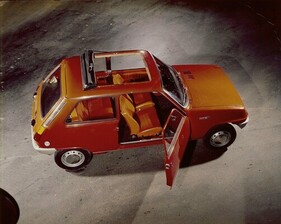
The design was also convincing: with large headlight eyes, surfaces smoothed in the wind tunnel without frills and a tidy interior, the Renault 5 skillfully combined functionality and form. The color scheme of the avant-garde body was entirely in keeping with the spirit of the times, with Renault sending the newcomer out onto the road in poison green and bright orange.

Thanks to its successful technical basis and careful model updating, the Renault 5 remained at the cutting edge until the end of its production run. In 1990, Renault introduced its designated successor, the Clio, and the two models were built in parallel for four years. In 1994, after 22 years and a total of 9,008,912 units produced, it was "au revoir" for the long-running model.
Plastic bumpers as a world first
More than just a design gimmick, the large plastic bumpers used for the first time on a production vehicle replaced the rather impractical bumpers that had been common up to that point. Renault thus created a new industry standard that was later adopted by the entire sector.
The upright rear lights of the Renault 5 were no less innovative and also served a practical purpose: they enabled the wide, low-slung tailgate to be installed, making it easier to load and unload the trunk. This had a capacity of 215 liters suitable for everyday use, but could be extended to 900 liters by folding down the rear bench.

Engines for every requirement
Renault has something for everyone when it comes to engines. The spectrum ranged from 25 kW/34 hp in the entry-level model to 79 kW/108 hp in the Renault 5 Alpine Turbo launched in 1981. The radically designed Renault 5 Turbo, widened by 20.2 centimetres, which rolled into dealers' showrooms in 1980, went one better: its 1.4-litre turbo engine with intercooler, housed longitudinally behind the front seats, mobilized an impressive 118 kW/160 hp.
Almost at the same time as the debut of the Brachial model, Renault launched the four-door Renault 5 with a six centimeter longer wheelbase in 1980, which further stimulated the already excellent sales figures: in 1980, over 660,000 Renault 5s rolled off the assembly line. This corresponded to 44.6 percent of the manufacturer's total production.

1984: Debut of the second model generation
The 1984 model year marked the end of the career of the first-generation Renault 5. After 5,544,695 vehicles had been produced in 13 years, the "Supercinq" ("Super 5"), a completely redesigned successor, was ready for the Paris Motor Show. The design was based heavily on its predecessor, but appeared smoother and more mature overall. The length of the 5 Series increased by 8.5 centimeters to a still compact 3.59 meters, and the width by 3.5 centimeters to 1.58 meters. Right from the start, Renault also offered the "Supercinq" in a variant with four doors that was stretched by a further six centimeters to 3.65 meters.

Despite all the similarities, there were also fundamental differences to the predecessor. For example, the engines with between 30 kW/41 hp and 85 kW/115 hp were installed transversely in front of the front axle instead of longitudinally behind it to provide more space in the interior. From 1986, the new R5 was environmentally conscious and the first variants with lambda-controlled three-way catalytic converters in accordance with the US standard were launched, the ultimate in exhaust gas purification at the time. Also in 1986, the Renault 5 TD (three-door) and GTD (four-door) introduced the diesel under the hood of the 5 Series.
Renault 5 Prototype: Looking back and into the future
But no farewell is forever: at the beginning of 2021, the French car manufacturer will present the Renault 5 Prototype study. It pays homage to the cult vehicle of the same name from the 1970s and 80s and at the same time takes a look into the future of the brand. The concept car with the reinterpreted R5 design shows how Renault wants to democratize the electric car in Europe and make it desirable. The production vehicle derived from the prototype is due to be unveiled in 2024, ensuring that "number five lives on" in the future too.