


In 1968, the Renault 4 Plein Air made its debut as a vehicle that took minimalism to the extreme and thus captured the spirit of the times.
Without a fixed roof, windows and doors, the low-cut model met the flower power movement's need for great freedom and turned out to be the ideal vehicle for summer, sun and beach. The Frischluft four-seater was in the range until 1971 and is a sought-after collector's item today.
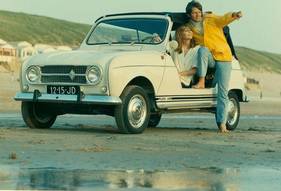
Conversion at Sinpar
The conversion of the Renault 4 into a convertible was carried out by the French specialist Sinpar (Société Industrielle de Production et d'Adaptation Rhodanienne). The company from Chassieu near Lyon, which belongs to Régie Renault, removed the roof and doors from a total of 563 Renault 4s from series production. As a further measure, the fresh-air vehicle was also fitted with a full-length bench seat at the front instead of individual seats. The only rudimentary safety precaution against the driver and passengers falling out was a plastic-coated chain, which the Plein Air owners usually removed.
Airy, fun
The canopy made of simple, single-layer canvas was better suited as a sunshade than as protection against wind and weather. It took skill and patience to stretch the textile roof with its parasol-style poles. At this point at the latest, it became clear that the Renault 4 Plein Air was primarily designed for hot summer days on the Côte d'Azur.
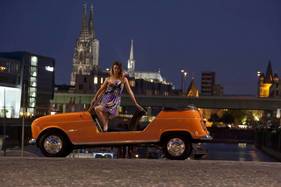
In contrast to its beach buggy competitors, the airy Frenchman relied on front-wheel drive like all Renault 4s. The 845 cubic centimeter petrol engine with 26 hp was also rather modest in comparison. Nevertheless, with its flair of liberté and savoir-vivre, the Renault 4 guaranteed its owner exclusivity and a huge popularity bonus.
For the whole world
Renault exported the charming minimalist to Mexico, Germany, Finland, the Netherlands, the United States, the United Kingdom and Canada. There, in 1967, 20 examples drove visitors around the grounds of the World Expo in Montreal to great public acclaim.
Successor Rodéo
The Renault 4 Plein Air was already discontinued in 1971.
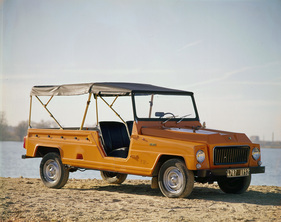
However, a worthy successor was already ready: the no less uncompromising "Rodéo" with an open plastic body, also based on the Renault 4.


