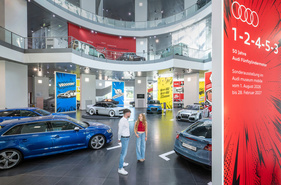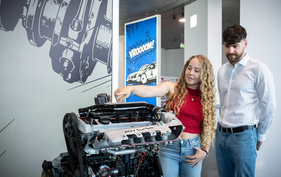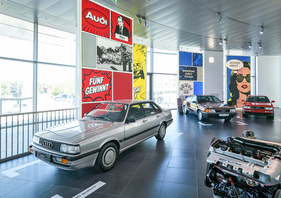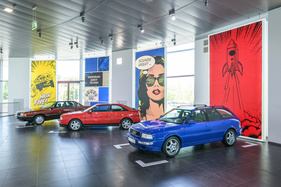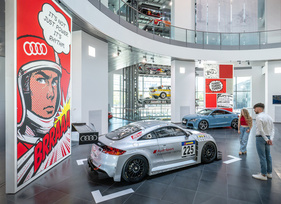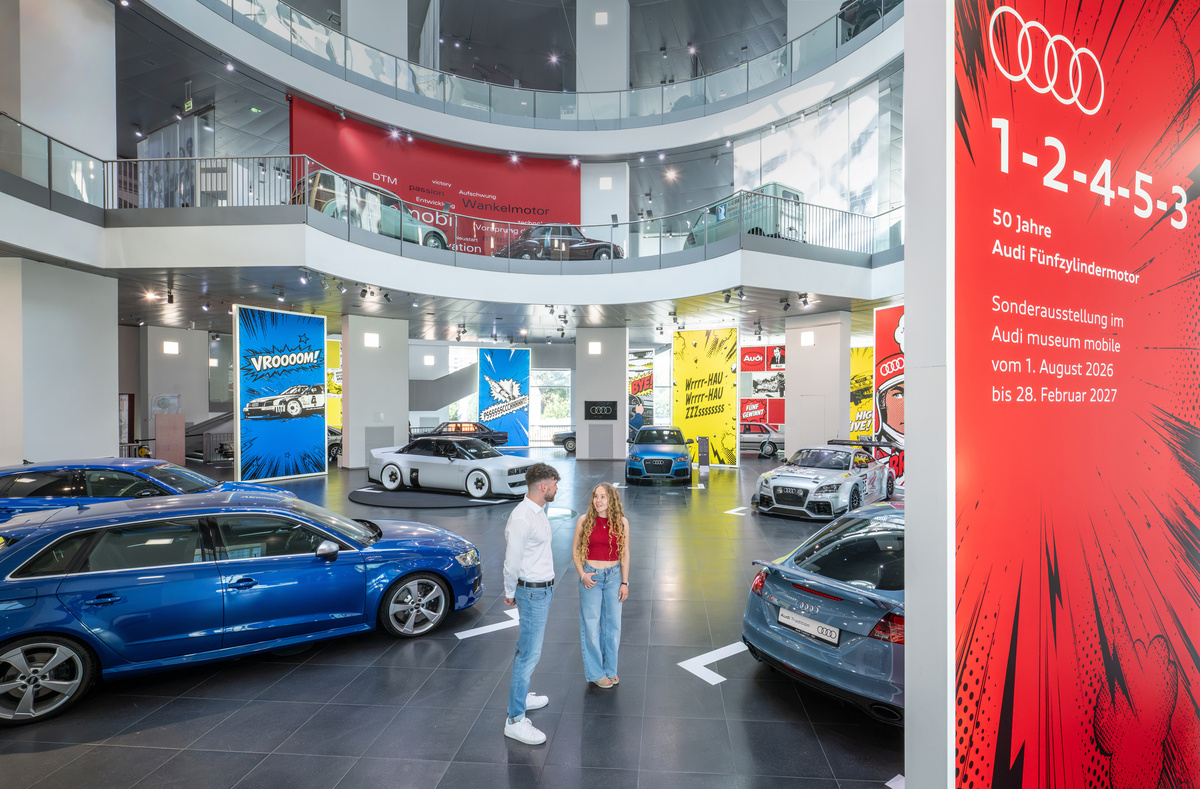
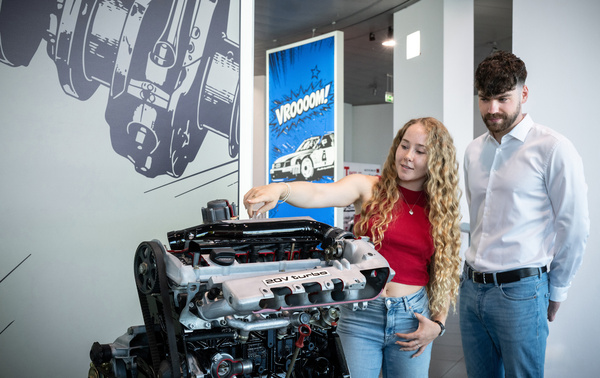

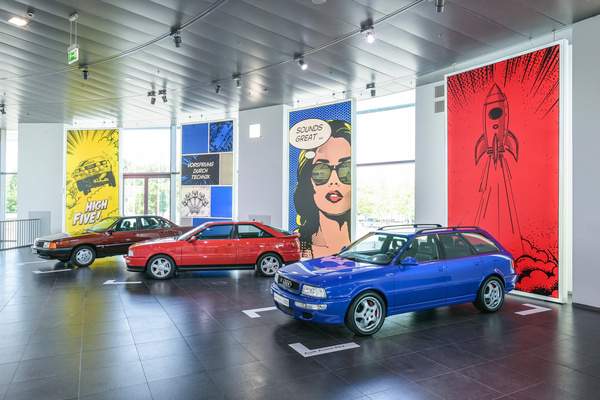
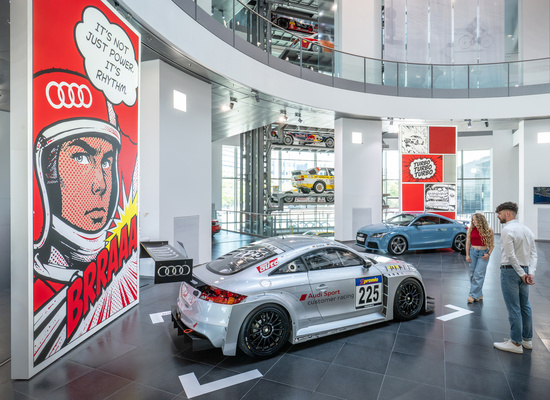
“50 Years of Five-Cylinder Engines” is a very special anniversary for Audi: Few technologies evoke such strong emotions or have shaped the brand’s image so profoundly over the past five decades. “That’s why many Audi fans and museum visitors have asked us if we would organize a special exhibition to mark this anniversary—a request we are, of course, happy to fulfill,” says curator Stefan Felber. For the special exhibition “1-2-4-5-3: 50 Years of the Audi Five-Cylinder Engine,” he has arranged seven engine exhibits and 14 vehicle exhibits that exemplify the history of five decades of five-cylinder engine development.
An overview of the vehicle exhibits in the new special exhibition:
- Megola motorcycle
- Audi 100 5E (C2)
- Audi 100 5D (C2)
- Audi 200 5T (C2)
- Audi 90 quattro
- Audi 100 TDI (C3)
- Audi S2 Coupe
- Avant RS2
- Audi S6
- Audi TT RS
- Audi TT Motorsport
- Audi RS Q3 Concept
- Audi RS 3
- Audi GT50 Concept
The history of Audi’s five-cylinder engines began in August 1976 with the unveiling of the second-generation Audi 100. Intended to be positioned higher in the lineup than its predecessor, Audi engineers debated the use of five-cylinder and six-cylinder inline engines during the development phase. The latter were ruled out due to the required installation space and unfavorable weight distribution. Consequently, the decision-makers opted for the five-cylinder inline engine—a powertrain concept that, while already known, had scarcely been used in mass-produced automobiles up to that point.
From Four to Five Cylinders
Based on the four-cylinder inline engine (EA 827) first introduced in the Audi 80 in 1972—which was in use throughout the entire Volkswagen Group at the time—the five-cylinder gasoline engine EA 828 was developed. It gave the second-generation Audi 100 a boost in power and prestige and—in various configurations—would shape engine technology at Audi in a very special way over the next few decades.
Numerous design features could be carried over from the four-cylinder engine, such as the overhead camshaft driven by a timing belt, the 88-millimeter cylinder spacing, the cylinder bore, and the arrangement of valves, spark plugs, and fuel injectors. In contrast, the longer crankshaft requires a larger main bearing diameter; in addition to numerous other changes compared to the base engine, the stroke is also increased to 86.4 millimeters. The distinctive sound of the five-cylinder engine is produced by the odd number of cylinders and the special firing order of 1-2-4-5-3. In this configuration, cylinders that are directly adjacent and those that are far apart fire alternately at an ignition interval of 144 degrees of crankshaft rotation, a setting chosen to ensure the smoothest possible operation. A modern fuel injection system enhances power, efficiency, and power delivery in the top-of-the-line model.
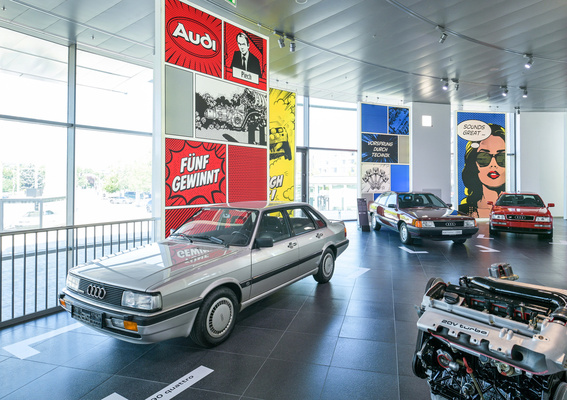
The first Audi five-cylinder engine, with a displacement of 2,144 cm³ in the Audi 100 5E, delivers 100 kW (136 PS). It accelerates the car to 100 km/h in 9.5 seconds and enables a top speed of 190 km/h.
Also available as a diesel
As early as 1978, Audi introduced the first five-cylinder diesel version: a naturally aspirated diesel with a displacement of two liters and 51 kW (70 PS). A year later, the first turbocharged five-cylinder gasoline engine made its debut in what was then the top-of-the-line model, the Audi 200 5T (125 kW / 170 PS). Since the displacement cannot be significantly increased, turbocharging is the only way to substantially boost the engine’s power.
The Showpiece of the quattro
The year 1980 proved decisive for the public perception of the five-cylinder engine: In March, the brand with the four rings unveiled the Audi quattro at the Geneva Motor Show. Its turbocharged five-cylinder engine delivered 147 kW (200 PS) at launch. This powerful technical package—combined with intercooling and the quattro permanent all-wheel-drive system—enabled Audi to achieve numerous successes in motorsports in the years that followed, including two Manufacturers’ World Championships and two Drivers’ World Championships in the then-very-popular sport of rallying —titles that strengthened the brand’s image and fueled the “five-cylinder legend.” In the later Group B rally cars, the final version of this powerful engine—now featuring four-valve technology—delivered well over 500 PS, and in the Audi IMSA GTO, which shook up the American touring car scene in 1989, it even produced 530 kW (720 PS).
Ever More Powerful
Audi also treated the popular engine to a few performance upgrades in its production models: In the Avant RS2 introduced in 1994—which debuted toward the end of the Audi 80 (B4)’s production run—the engine produced 232 kW (315 PS) from its still modest 2.2-liter displacement.
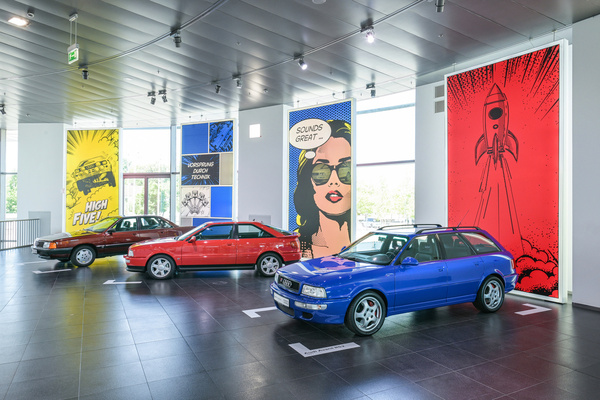
At the time, the Avant RS2 was the world’s most powerful production station wagon and established Audi’s tradition of high-performance RS models. Almost simultaneously, the five-cylinder engines made their exit from the B-segment with the introduction of the Audi A4 (B5) in 1994. The new V6 engines gradually replaced them in the mid-1990s. The last five-cylinder engines of the original series—the 2.5 TDI in the Audi A6 and the 2.2-liter 20V Turbo in the Audi S6 (also on display in the new special exhibition)—were phased out in 1997.
A Turning Point
For fans of the five-cylinder sound, this meant a waiting period until quattro GmbH launched the Audi TT RS in 2009 with a transversely mounted 2.5-liter TFSI engine —a high-performance engine developed based on the Group’s EA 855 engine, featuring a reinforced engine block and 250 kW (340 PS) of power—onto the roads in 2009.
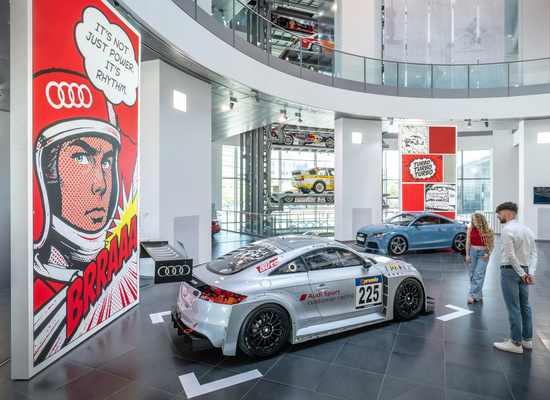
In the RS models of the A-series—for which Audi Sport GmbH has been responsible since 2016—this popular engine, in various configurations, revived the cult status of the five-cylinder engine in the years that followed and was named “Engine of the Year” a total of nine times in a row.
The special exhibition can be visited at Audi Tradition from August 1, 2026, through February 28, 2027.