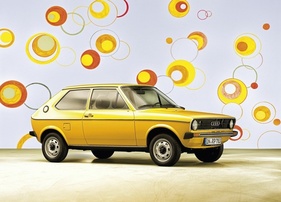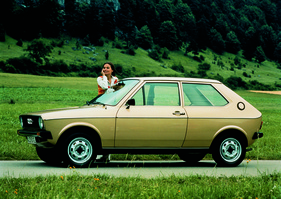


It came at just the right time: the Audi 50 was the first small car from a German manufacturer to be launched in 1974, immediately after the 1973 oil price crisis. It was fuel-efficient and its design was pioneering: front-wheel drive with a transverse engine, a two-door estate car with a large tailgate and folding backrest, compact exterior dimensions and appealing performance and driving characteristics. The Audi 50 is also a blueprint for the almost identical VW Polo, which the Wolfsburg-based company launches seven months later: Utilizing synergies within the Group family - a recipe for success even 50 years ago.

Rounding off at the bottom
The new Audi 50 was to be up-to-date and versatile - and round off the Audi 80 and Audi 100 model range at the bottom end. As early as 1970, the engineers at Audi NSU Auto Union AG set to work, led by Chief Technical Officer Ludwig Kraus: a successor was needed for the tried-and-tested NSU small cars, the end of production of which was in sight. The developers always have the following goal in mind: "A contemporary car must also be true to size", as can be read in the concept for the Audi 50. The key to success is the transverse engine. With it, the Ingolstadt-based company creates a car that offers a relatively large interior with an overall length of just 3.49 meters. The "little Audi", which weighs just 685 kilograms, is launched in two versions: the Audi 50 LS with 50 hp and the Audi 50 GL with 60 hp, both with a 1.1-liter engine.

The Audi 50 LS has a top speed of 142 kilometers per hour, the Audi 50 GL a top speed of 152 kilometers per hour. While the 50 hp version runs on regular gasoline, the 10 hp more powerful unit requires premium fuel. In 1977, this variant was replaced by a newly developed 1,300 cubic centimeter engine that ran on regular petrol.

Hartmut Warkuß, who also designed the Audi 80, is responsible for the design of the Audi 50. Warkuß draws a timeless, filigree form around Ludwig Kraus' package.
Presentation in Sardinia
Ingolstadt presents the Audi 50 to the international media in Sardinia in the summer of 1974.

It arrives at the dealers for the first time on October 26: the Audi 50 LS at a price of 8,195 marks, the Audi 50 GL costs 8,510 marks.

The "little Audi" was initially planned and developed in Neckarsulm, later in Ingolstadt Technical Development, and finally built at the Volkswagen plant in Wolfsburg. By March 31, 1975, exactly 43,002 Audi 50s had rolled off the production line there, after which the series production of the almost identical VW Polo also began. Production of the Audi 50 ends in the summer of 1978, with a total of 180,828 units produced. From then on, Audi concentrates increasingly on mid-range cars and segments above. Even though the Audi 50 was only on the market for a few years, it established the small car segment in the Volkswagen Group: Millions of the VW Polo were built in its various generations.
Editor's note: Incidentally, the new car announcement appeared in Automobil Revue on September 12, 1974, so Audi is still quite early with this anniversary.