


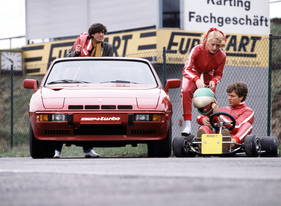


For some, they are perfect sports cars, for others they are an aberration in Porsche history: the transaxle models. In 1976, Porsche introduced the transaxle design with the Type 924, breaking new ground: the engine is at the front, but the transmission is on the rear axle. With the 924, 928, 944 and 968 models, Porsche built a generation of sports cars between 1976 and 1995 that departed from the proven principles of the 911. To mark the 40th anniversary, the Porsche Museum is dedicating a special exhibition entitled "The Transaxle Era. From the 924 to the 928."
On display are 23 special exhibits, over half of which are being shown to the public for the first time.

Commercial success with the 924
The transaxle models were a great commercial success for the sports car manufacturer at the time. Porsche was able to convince almost 400,000 customers around the world of the new design. This success was ultimately based on a philosophy that is typical of Porsche: the perfect combination of sportiness and suitability for everyday use.

In addition to a selection of production and racing cars, the Porsche Museum is presenting selected prototypes and studies that have never left the museum's collection hall before. For example, various derivatives of the Porsche 924, which initially served as an entry-level model, will be on display. The 924 Turbo Targa prototype from 1979, which was never produced in series but whose design was incorporated into the development of the 944 Cabriolet, will be shown for the first time.
The eight-cylinder sports car
The Porsche 928, which celebrated its premiere at the Geneva Motor Show in March 1977, was originally intended to replace the 911. It broke completely new ground as a Gran Turismo and luxury sports car with significantly more driving comfort and a large luggage compartment. Just one year later, in 1978, the 928 became the only sports car to date to be awarded the title "Car of the Year".

As part of a potential expansion of the 928 model series, work began in spring 1987 on a convertible version of the Gran Turismo. The result was the 928 S4 convertible study, which was not produced in series despite its harmonious design. This one and only prototype built is also part of the special exhibition alongside five other 928 models.
More Porsche with the 944
The 944 followed in September 1981. With its 163 hp four-cylinder engine, it was positioned as the link between the 924 and the 911.

Not least due to its Porsche engine derived from the 928, the 944 was accepted as a "genuine" Porsche from the very beginning. No other Porsche model had previously sold as well and as quickly as the 944. 163,302 944 sports cars were produced by the end of production in 1991. The special exhibition will include the convertible study from 1985 on display for the first time. The model, painted in flamingo pink, is characterized by a 183 hp four-valve engine with catalytic converter, airbag and ABS.
The first study of a 944 convertible was presented at the International Motor Show (IAA) in Frankfurt am Main in 1985. Other 944 models presented in the special exhibition include the "Luna" project, with which the Austrian long-distance specialist Gerhard Plattner completed an endurance test from North America via Europe to Asia within 258 days and 384,405 kilometers in 1987 - thus covering the distance from the earth to the moon.
The end of the era with the 968
The end of the transaxle era was marked by the Porsche 968, which in 1991 was the result of 15 years of technical evolution. At its heart was a 240 hp 3-liter engine with 305 Nm of torque, making it the world's most powerful naturally aspirated four-cylinder engine.

Under the direction of the then chief designer Harm Laagay, a roadster study of the Porsche 968 was created in 1992, which visitors can also look forward to seeing. The main features of this prototype are the soft and muscular shape of the fenders, a dynamic cockpit cut-out and a highly emotional interior. At the end of 1992, however, the 968 Roadster project was discontinued in favor of the Boxster study presented at the beginning of 1993.
Task for Porsche Classic
The sports car manufacturer from Zuffenhausen also demonstrates its expertise in the field of vehicle restoration with the transaxle series. Porsche Classic takes care of all vehicles whose end of production is usually more than ten years ago. This covers all aspects from maintenance and technical literature to the supply and reproduction of original parts and complete restoration. A total of over 52,000 original parts are currently available worldwide. Porsche is thus integrating the care and value retention of classic and vintage cars into an innovative service concept that closely interlinks Porsche tradition and innovation. Further information and the parts program can be found at www.porsche.de/classic.
Tranxaxle Day on May 22, 2016
On May 22, "International Museum Day", the Porsche Museum invites you to "Transaxle Day". In addition to free admission on this Sunday, there will be several guided tours of the special exhibition. In addition, private owners have been invited to display their transaxle vehicles in various parking areas around the museum. These can be viewed on the forecourt in front of the museum and in front of the branch. One of the highlights will be the Transaxle Talk, in which key contemporary witnesses will look back on the development and successes of the 924, 928, 944 and 968 models in the museum's own workshop.
The Porsche Museum is open Tuesdays to Sundays from 9 am to 6 pm. Further information is available on the museum's website.
