




The history of the Suzuki Swift goes back to the late 1970s, when an agreement was reached between General Motors and Suzuki. Suzuki subsequently invested half a billion DM in a new plant in Kosai, where 850 employees together with 137 robots produced 10,000 SA 310s every month from 1983 onwards. A large proportion of these should have gone to the USA, but regulations prevented such large numbers.

The Swift was originally called the SA 310, but the first "full-grown" Suzuki was also called the Cultus. The initial version had a three-cylinder engine and produced around 50 hp from 993 cm3. According to the ams test, this was enough for a top speed of 145 km/h and a time of 17.1 seconds for the sprint from 0 to 100 km/h.
This 3.58 m long compact car was actually intended to be presented at the IAA in Frankfurt in the fall of 1983. However, the car was only presented at the 25th Tokyo Motor Show on October 28, 1983.
In Europe, the Suzuki SA 310 / Cultus could be purchased from 1984, which means that the 40th anniversary will be celebrated here in 2024.
A four-cylinder engine was added to the range in the fall of 1984, and from then on the car was called the "Swift" in Europe.

While the Japanese could already buy a slightly longer four-door model, only the two-door version was offered in Europe. From 1324 cm3, 67 to 74 hp could now be produced. According to the ams test, with 74 hp the hatchback compact ran at 170 km/h and accelerated from a standstill to 100 km/h in just 11.2 seconds. It only needed 7.8 liters of normal petrol. Thanks to its low price, it was a worthy rival to the Fiat Uno, Honda Civic, Opel Corsa and VW Polo.
The first generation was built until 1989 and was also launched on the market with five doors and an injection engine.

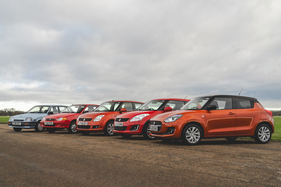
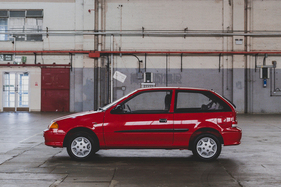
The second generation followed in 1989 (after the presentation in Japan in 1988) and it ran off the production line for over 13 years. The most powerful version had almost 100 hp.
The third generation was then built until 2010, appearing modern and combining Japanese quality with European driving dynamics.
The fourth and fifth generations were introduced in 2010 and 2017.

The latter was then replaced by the current variant (internally called AOL) in 2023.
Only very few examples of the first generation Suzuki Swift have survived.
