




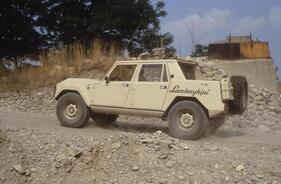
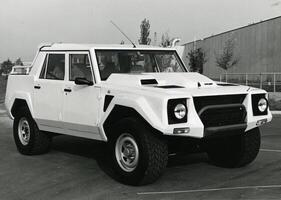

40 years have passed since Lamborghini presented the LM002 at the Brussels Motor Show in January 1986 - a vehicle that fundamentally redefined the concept of a high-performance off-road vehicle. The LM002 is far more than an extreme machine: it embodies a bold statement that combines the DNA of the super sports cars from Sant'Agata Bolognese with a previously unattainable off-road capability.
"The LM002 represents one of the roots of Lamborghini's vision today," says Stephan Winkelmann, Chairman and CEO of Automobili Lamborghini "Far ahead of its time, it anticipated the concept of the super SUV and inspired not only our product philosophy, but also design elements that are still found throughout the Urus family today."
The origins of the LM002 can be traced back to the experimental Cheetah and LM001 projects developed between the late 1970s and early 1980s. They led to the decisive technical insight of engineer Giulio Alfieri: the relocation of the legendary Lamborghini V12 engine to the front in order to achieve greater balance and control even in the most demanding terrain. After years of intensive testing under extreme conditions in the deserts of Saudi Arabia, the final LM002 was finally created.
Powered by the V12 from the Countach Quattrovalvole, equipped with specially developed Pirelli Scorpion BK tires and designed for use on sand, rocks and steep climbs, the LM002 reached speeds of over 200 km/h - an exceptional performance for an off-road vehicle of its time. Produced in just 300 examples until 1992, plus a unique right-hand drive example now on display at the Lamborghini Museum in Sant'Agata Bolognese, the LM002 is now considered the true forerunner of Lamborghini's modern super SUV concept and the technical and philosophical basis for the later development of the Urus.
Today, the LM002 continues to be preserved and enhanced by the Lamborghini Polo Storico, including through projects dedicated to preserving its technical authenticity. These include the collaboration with Pirelli, which has recently brought the historic Scorpion BK tires, originally developed specifically for this model, back into production. These tires are now once again available to Lamborghini customers through the official Lamborghini dealer network and the Pirelli Collezione catalog.
The LM002 is one of the permanent highlights of the exhibition at the Lamborghini Museum in Sant'Agata Bolognese, where a specially designed installation will be dedicated to the 40th anniversary of Lamborghini's first super SUV from June 9.

Lamborghini Cheetah - the origin of the project
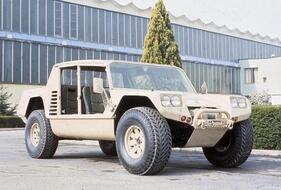
Automobili Lamborghini's entry into the world of high-performance off-road vehicles began with a visionary idea that challenged automotive conventions at the 1977 Geneva Motor Show. There, the manufacturer from Sant'Agata Bolognese presented the Cheetah - an all-wheel-drive prototype that represented a radical break with the Gran Turismo sports cars produced up to that point, both stylistically and technically.
Developed in collaboration with the American company Mobility Technology International (MTI), the project was originally designed to meet tactical and military mobility requirements and to attract the interest of both the US armed forces and the Middle Eastern markets. Technically, the Cheetah features a tubular steel chassis combined with an open aluminum body with inspection hatches, exposed tubular elements and an open cockpit.
The drivetrain has a rear-mid engine arrangement that is unusual for an all-wheel drive vehicle of this type. At its heart is a 5.9-liter Chrysler V8 with 183 hp at 4000 rpm and a torque of 362 Nm at 2500 rpm. The engine is mated to a three-speed Chrysler A727 automatic transmission and permanent all-wheel drive.
The suspension features double wishbones, coil springs and a stabilizer bar at the front, while a similar design is used at the rear, complemented by an adjustable torsion bar suspension. The braking system uses ventilated front disc brakes taken from the contemporary Lamborghini Countach.
The Cheetah is capable of tackling gradients of 60 to 85 percent and reaches a top speed of 167 km/h on the road and around 140 km/h in the sand. Acceleration from 0 to 100 km/h is achieved in just 9.0 seconds - despite a stated dry weight of 2042 kilograms.
Although production never went beyond a single prototype, the Cheetah became a crucial experimental platform for Lamborghini. The boldness of this first project laid the technological foundation that would later shape the brand's approach to high-performance SUVs. The Cheetah also demonstrated the Sant'Agata Bolognese-based manufacturer's determination to push conventional boundaries on any terrain.
From LM001 to LM002 via LM003 and LM004 - the development
The LM001 - Lamborghini Militare 1 - marks the second decisive chapter in the development of Lamborghini off-road vehicles. It represents the transition from the experimental nature of the Cheetah to a more ambitious and structured engineering vision.
Unveiled at the 1981 Geneva Motor Show, the LM001 is the first tangible result of the Lamborghini era under the leadership of CEO Patrick Mimran. During this phase, the company pursued the goal of expanding its product range and tapping into the market for both luxury off-road vehicles and tactical vehicles. Under the technical direction of engineer Giulio Alfieri, the project was specifically designed to appeal not only to private enthusiasts but also to government and military customers - particularly in the Middle Eastern markets.
In contrast to the Cheetah, the LM001 has a closed four-door body with clear, angular lines, which was designed from the outset to allow an armored version to be created if required. One of the most defining innovations of the project is the use of the legendary Lamborghini V12 from the Countach: the 4.8-liter engine of the LP500 S delivers 332 hp at 6000 rpm. However, the first and only prototype is initially being experimented with a 5.9-liter V8 derived from AMC.
Drive was provided by permanent all-wheel drive in combination with a three-speed Chrysler A-727 automatic transmission, with power distribution clearly favoring the rear axle. With a length of 4790 millimetres and a width of 2000 millimetres, the LM001 offers an impressive ground clearance of 425 millimetres in the central area. Despite an unladen weight of around 2100 to 2400 kilograms, the vehicle reaches a top speed of around 180 km/h and accelerates from 0 to 100 km/h in around 12.0 seconds.
During desert test drives, however, a fundamental design weakness quickly becomes apparent: the rear-engine design. Under heavy acceleration and on steep climbs, the front axle is overloaded - a problem that is further exacerbated by the lack of power steering - and has a negative effect on steering precision and driving stability.
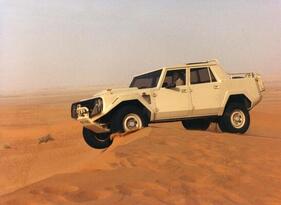
Although the project never progressed beyond the prototype stage, the LM001 is becoming an important technical test vehicle for Lamborghini. The vehicle introduces advanced chassis solutions for extreme terrain, including independent suspension with double wishbones, torsion bar springs and telescopic shock absorbers. The challenges in the areas of weight distribution, driving dynamics and engine cooling ultimately force the engineers to fundamentally rethink the vehicle architecture. This led directly to the development of the Lamborghini Militare Anteriore - LMA for short. In this vehicle, the engine was positioned at the front for the first time, creating the basis for the later production LM002.
To overcome the weaknesses of the LM001, Giulio Alfieri and his team completely redesigned the vehicle architecture. The new front engine arrangement not only improves the weight distribution, but also results in a more balanced three-box design.
The LMA represents far more than a mere relocation of the drivetrain. It combines engineering solutions derived from motorsport with robust off-road capability. The 4.8-liter V12 with 332 hp familiar from the Countach is retained, while the previous Chrysler automatic transmission is replaced by a significantly more robust five-speed manual transmission from ZF with reduction ratio. In contrast to the permanent all-wheel drive systems of earlier prototypes, the LMA also made it possible to disengage the front axle and switch the vehicle to rear-wheel drive as required.
At the 1982 Geneva Motor Show, the LMA appeared as a genuine engineering laboratory on wheels. With a length of almost 4.9 meters and a total weight of around 2600 kilograms, it embodies a significantly advanced, complex vehicle architecture.
Testing takes place under extreme conditions - in the deserts of Saudi Arabia. There, the vehicle impressively demonstrates its performance: it can cope with gradients of up to 120 percent and reaches top speeds of almost 190 km/h. These results impressively confirmed the performance of the new technical configuration and made the LMA the decisive basis for the development of the legendary LM002, which was finally launched on the market in 1986.
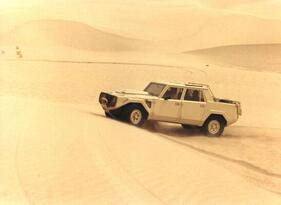
Parallel to this development path, Lamborghini is also exploring alternative technical approaches. The LM003 marked the only chapter of the original Lamborghini Militare program that was consistently dedicated to testing a diesel engine. The prototype, developed in 1983, was created with the clear aim of investigating the feasibility of a high-performance off-roader, which would be more efficient and more suitable for everyday use than the powerful but fuel-intensive V12 petrol versions.
Lamborghini is cooperating with the Italian specialist VM Motori for the implementation. The LM003 is equipped with a five-cylinder turbodiesel with 150 hp. Despite the promising approach, it quickly becomes apparent in practice that the available power is not sufficient for a vehicle weighing almost three tons. As a result, the LM003 remained a one-off prototype and did not develop any further.
In 1985, Lamborghini presented an even more extreme experimental concept vehicle, the LM004, which used a propulsion system from the marine sector. The project was intended to further explore the technical limits of the LM series by taking drives from water racing and transferring them to an off-road vehicle.
At the heart of the LM004 is the Lamborghini L804 - the competition version of the in-house V12 engine, originally developed for use in high-performance offshore boats. With an output of over 420 hp and a torque of 589 Nm at just 2000 rpm, the mighty 7.0-liter engine requires an extended chassis that exceeds the proportions of the later LM002 production model.
Despite its extraordinary performance potential, the LM004 project was eventually discontinued. The high weight of the engine, which had its origins in the marine sector, and concerns about reliability proved to be disadvantageous overall. In comparison, the 5.2-liter V12 selected for the production version of the LM002 impresses with its more balanced performance and better suitability for everyday use.
The LM002 - the final version
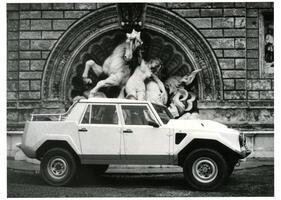
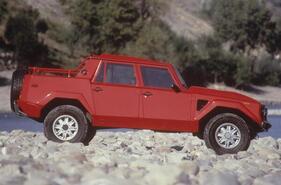
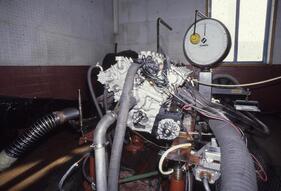
The Lamborghini LM002 marks a unique chapter in automotive history. Produced between 1986 and 1992, it is regarded as the world's first true super SUV - a vehicle that combines the performance of a super sports car with unprecedented off-road capability. Right from its premiere at the 1986 Brussels Motor Show, the LM002 attracted everyone's attention with its imposing appearance and uncompromising character.
It owes its legendary status not least to its engine, which is derived directly from the legendary Countach Quattrovalvole. The 5167 cubic centimeter V12 engine with a 60 degree bank angle and four valves per cylinder develops around 450 hp (420 hp according to SAE-NET specification) and gives the off-roader, which weighs over 2700 kilograms, impressive performance up to a top speed of 210 km/h. Initially equipped with six Weber carburetors, the engine was further developed in 1989 into a version with electronic fuel injection - a step that ultimately enabled the vehicle to be approved for the US market and underlined its technical maturity.
The LM002 is equipped with a five-speed manual gearbox from ZF with gear reduction and a selectable all-wheel drive, which enables the vehicle to master gradients of up to 120 percent with ease. The drivetrain integrates three self-locking differentials, with locking values of 25 percent on the front axle and 75 percent on the rear axle. The center differential also has a locking effect of 75 percent and can be fully locked mechanically up to 100 percent - a technical solution that is a direct result of the findings of the LMA prototypes.
However, the LM002 not only impresses with its impressive driving performance, but also with a design that is consistently geared towards extreme operating conditions. The reinforced tubular steel frame chassis can withstand forces of up to eight times the acceleration due to gravity. At the same time, the sophisticated independent wheel suspension with double wishbones ensures generous spring travel of 130 millimetres during compression and 110 millimetres during rebound. In addition, the LM002 can safely cross waters with a depth of up to 82 centimetres without any special preparation.
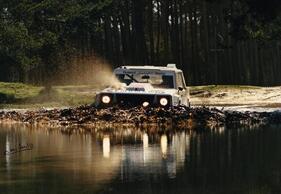
The exceptional capabilities of the LM002 are largely due to the Pirelli Scorpion BK, a tire developed specifically for this vehicle in the early 1980s. Its characteristic feature is the distinctive lateral "ears", which are specifically designed to optimize handling on sand dunes while ensuring precise directional stability. Even in pressure-reduced runflat mode, the tire remains fully functional and is capable of reliably absorbing high lateral forces.
Pirelli designed the Scorpion BK with a particularly robust carcass, which is reinforced with cut-resistant aramid materials. The tread pattern is directly based on rally tires, in particular the Pirelli Intermedio Montecarlo, which is used in international rallying. The result is one of the earliest and most impressive examples of the transfer of motorsport technology to a production vehicle.
Off-road luxury and special versions
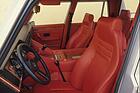
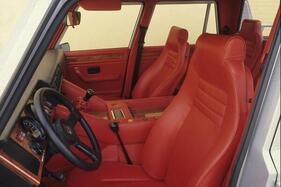
Despite its angular body and imposing dimensions, the interior of the LM002 represents the pinnacle of luxury craftsmanship of its time. High-quality leather upholstery and fine wood inlays characterize the interior, while features such as air conditioning, blue-tinted windows, a high-fidelity sound system integrated into the roof and even TV reception on request underline the vehicle's exclusive aspirations. The interior comfortably seats four people, while the generously dimensioned load compartment in the rear emphasizes the exceptional versatility of the LM002.
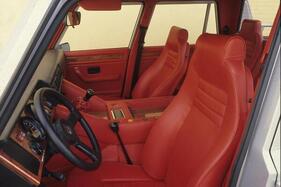
In 1987, the price was around 169 million Italian lire - a reflection of both its technological exclusivity and the fact that there was no comparable competitor model. Production ended in 1992 after a total of 301 units had been built, including vehicles for the North American market, where the LM002 was officially offered from 1989.
The LM/American represents the consistent further development and technological maturity of the LM002. Produced in a limited series of just 60 units, this variant was specifically redesigned to meet the strict emissions regulations of the United States - in particular the demanding regulations of California.
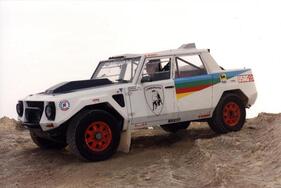
In 1989, the LM/American impressively demonstrated its performance: legendary rally driver and then Lamborghini PR manager Sandro Munari took part in the prestigious One Lap of America endurance event. The approximately 10,000-mile route through several US states is considered one of the toughest challenges of its kind. Remarkably, a near-series LM002 is used, which technically corresponds exactly to the version homologated for the American market.
The most significant further development of the LM/American concerns the fuel supply of the 5167 cubic centimeter V12 engine. Lamborghini is developing an advanced electronic multi-point injection system to meet the increasingly stringent emissions regulations, which the classic Weber carburetors can no longer satisfy.
The Lamborghini LIE 52/12 system, developed in-house, is being implemented with the support of the Bologna-based company EFI, after more complex external solutions have been tested and rejected. In addition, catalytic converters are introduced to reduce pollutant emissions and ensure compliance with all US regulations. In this configuration, the V12 with injection system achieves a homologated output of 420 hp according to SAE-NET.
In addition to the engine management system, the LM/American also features numerous modifications resulting from both regulatory requirements and the revised technical configuration. Due to the changed installation space requirements of the new injection components and stricter safety requirements, the tank volume is reduced from 280 liters in the carburetor versions to 180 liters.
Today, the LM002 is regarded as one of the purest expressions of Lamborghini's uncompromising philosophy: an extraordinary and unconventional vehicle that impressively anticipated the world of high-performance SUVs decades before this segment achieved global significance.

A living legacy: from the LM002 to the Urus
Paving a path that did not exist in its day, the LM002 is considered the true forerunner of the modern high-performance luxury SUV. Decades later, this legacy is reinterpreted with the presentation of the Urus concept car in 2012 - a powerfully designed SUV that clearly references the LM002 while translating Lamborghini's DNA into a modern and versatile form.
With the launch of the series Urus in 2017, Lamborghini redefined the segment and established the current concept of the super SUV. With best-in-class figures such as a top speed of 305 km/h - making it the fastest SUV in the world at its launch - the Urus confirms the brand's legitimacy in a category that the LM002 boldly entered decades earlier.
Today, the LM002 is preserved and maintained by the Lamborghini Polo Storico - the department dedicated to preserving the brand's historic heritage. Through restoration services, authentication certificates and the research, recovery and reproduction of original spare parts, the Polo Storico supports LM002 owners worldwide and helps to preserve one of the most distinctive models in Lamborghini history.
One of the most significant initiatives is the collaboration with Pirelli to reissue the historic Scorpion BK tires, which were developed specifically for the LM002 in the early 1980s and are now available again worldwide through Lamborghini's official dealer network.