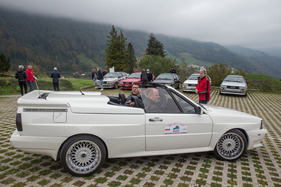
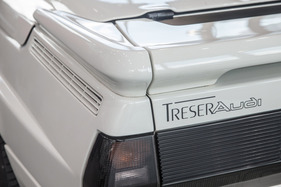
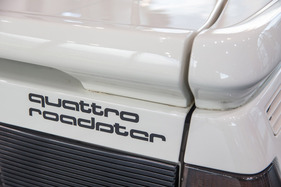
It was exactly 40 years ago, namely on May 15, 1984, when the German Federal Motor Vehicle Authority declared "Treser" to be an independent automobile manufacturer, officially documented with key number 7673. The parts developed by Walter Treser himself for his Audi Quattro Roadster had simply become too many, and the Treser Quattro Roadster thus became an independent automobile.

This car was not cheap, Walter Treser charged DM 42,157.70 for the conversion, the basis, i.e. an Audi quattro, had to be supplied by the customer. At the IAA in Frankfurt, the open Quattro became a crowd favorite and with its retractable folding roof, the Treser Quattro Roadster was a predecessor to the Mercedes-Benz SLK or BMW Z4.

Wolfgang Haug wrote in the magazine "auto motor und sport" about the open Quattro: "If you can play with the investment of 140,000 marks, the Quattro Roadster gives you more than an open car that goes faster than 200 km/h. Treser's Quattro, with its standard 'progress through technology', offers the opportunity to make even the most spoiled audience turn their heads."
Walter Treser, who had already founded his company in 1982, did not stop at the Quattro conversion, however; he offered refinement and tuning for various cars.
Own car
But Walter Treser did not stop at conversions and tuning. On September 11, 1987, his own sports car celebrated its premiere. The T1 was a two-seater open sports car with a retractable hardtop and a transversely mounted four-cylinder mid-engine from the VW Golf GTI 16V.

An aluminum composite construction under the plastic body provided stability. The T1 was 4.05 meters long and had a wheelbase of 250 cm.

It should be possible to reach 100 km/h in 8.7 seconds, with a top speed of 210 km/h according to the manufacturer. At the presentation, the base price was said to be DM 55,000. Six months later, however, the sales price for the 1100 kg roadster was already DM 64,850.

The Treser T1 was also available as a coupé.
400 firm purchase contracts and 600 options were signed in a short time, but then one of the investors suddenly withdrew, forcing the Treser company, which had already made advance payments with production facilities and 137 employees, into bankruptcy in August 1988. Even a guarantee from the state of Berlin could not save the T1, and cooperation with Oettinger was also unsuccessful.
In the end, exactly 27 Treser T1s had been built. And the end.
Today, the surviving Treser designs are coveted classics and stand out wherever they appear.