


On October 26, 1994, the world premiere of the Škoda Felicia took place on the famous Charles Bridge in Prague. Škoda had already started series production at the Vrchlabí plant in September and from October 17, 1994, the Felicia also rolled off the production line in Mladá Boleslav. After the Volkswagen Group acquired shares in Škoda in 1991, the Czech manufacturer was able to draw on technologies and components from the parent company for the first time when developing the Felicia. The use of equipment components and units from the Group as well as modern safety and comfort features contributed significantly to the remarkable sales success of the Felicia.
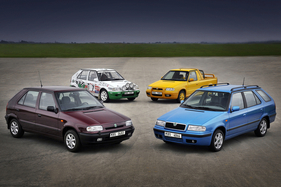
The beginning of a new era
The Felicia model family represented a comprehensive modernization of its predecessor, the Škoda Favorit. The Felicia had a fresh design and the five-door hatchback was 40 millimeters longer and 15 millimeters wider than the Favorit. The trunk capacity increased by 21 liters to 272 liters.
As an entry-level engine, Škoda offered a 1,289 cc four-cylinder petrol engine with a choice of 40 kW or 50 kW output. This was followed in 1995 by the more powerful 1.6 MPI petrol engine with 55 kW and the naturally aspirated 1.9 D diesel with 47 kW. Thanks to the close cooperation within the Volkswagen Group, the Felicia featured modern equipment options such as ABS, up to four airbags, power steering, air conditioning, onboard computer, heated front seats and leather upholstery. In its Czech homeland, the Škoda Felicia was awarded the title "Car of the Year" in 1994.
Body variants: practical derivatives and fun version "Fun"
In June 1995, Škoda added the practical estate to its range, which offered 447 luggage space in a length of 4.205 meters. From August 1995, the commercial vehicle variants Pickup and Vanplus also rolled off the production line at the Kvasiny plant. Based on the pick-up, the manufacturer also produced more than 4,000 units of the Škoda Felicia Fun for everyday use and leisure. This unusual vehicle in bright yellow had an unconventional seating concept: by moving the rear wall, two additional seats were created on the loading area in addition to the front and front passenger seats.

In February 1998, the manufacturer presented a comprehensive redesign of the Felicia, adapting the model to the then new Škoda design language, which was first introduced in the Octavia, produced since 1996. With this update, the Felicia gained 28 millimeters in length, while the Felicia Combi was 32 millimeters longer. The upgrade also included new paint finishes and additional equipment options.
Special editions and motorsport successes
Škoda offered the Felicia in a variety of special editions. In 1995, the top-of-the-range Laurin & Klement edition rounded off the top end of the model range. This was followed a year later by the Atlanta variant, designed in the style of the Summer Olympics. Other special versions included Sport Line, Color Line, Excellent, Magic, Family and Mystery. The Prague Town Hall clock served as inspiration for the latter. Škoda produced a total of 1,401,489 million Felicia, the last of which left the production line in June 2001.
The Felicia also proved its robustness, reliability and versatility in motorsport. From 1995 to 1997, it competed in the World Rally Championship, where it achieved several podium finishes in the F2 category as a so-called kit car. The Škoda Felicia Kit Car relied on four-cylinder engines with an initial displacement of 1.3 and 1.5 liters. This was later followed by a 1.6-liter version, from which the Škoda Motorsport team coaxed 174 hp. During its rallying career, the Škoda Felicia kit car proved to be extremely reliable and impressed with its excellent handling - just like its production model, which continues to provide loyal service to this day.


