


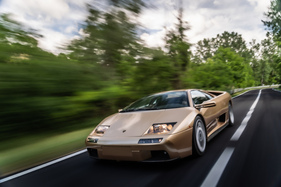


One of the most legendary vehicles in the history of super sports cars is undoubtedly the Lamborghini Diablo, which came onto the market in January 1990. The history of the Diablo began in 1985 under the codename Progetto 132. The aim of this project was to develop a successor to the Countach, the top model in the Lamborghini product range at the time. The clear and aggressive lines were designed by Marcello Gandini and later partially revised by the Chrysler design team - now the majority shareholder of Automobili Lamborghini.

The fastest back then
The Diablo captured the hearts of Lamborghini fans right from the start. With a top speed of 325 km/h, it was officially considered the fastest production car in the world at the time. Its fantastic handling was due not least to the intensive development work involving rally champion Sandro Munari. The Diablo's engine, positioned longitudinally at the rear, produced 485 hp and 580 Nm of torque. It featured the classic Lamborghini twelve-cylinder design, with a displacement of 5.7 liters, four overhead camshafts and four valves per cylinder and was equipped with electronic multi-point injection.

Despite its luxurious interior (leather interior, air conditioning, electric windows, electrically adjustable seats), the Diablo, which was available with rear-wheel drive, was a real racing machine. Electronic driver assistance systems were not provided, and power steering was only offered from 1993.

Slight revision and more power
The Diablo VT was launched in 1993. This first all-wheel drive Granturismo from Lamborghini brought with it a series of mechanical improvements and stylistic changes, which were soon adopted for the two-wheel drive version. Also in 1993, to celebrate the company's 30th anniversary, the special SE30 model was introduced, with its power increased to 523 hp.

The Diablo SV with adjustable rear wing, which was only available with two-wheel drive and a maximum output of 510 hp, made its debut at the 1995 Geneva Motor Show. In December of the same year, the Diablo VT Roadster came onto the market: this first series-produced Lamborghini twelve-cylinder with an open roof featured slightly revised lines and was offered exclusively with all-wheel drive.
Four rings bring the turning point
From September 1998, when Automobili Lamborghini was taken over by the Audi Group, development resources and technologies were available that had previously only been dreamed of. Designed by Luc Donckerwolke, Lamborghini's first in-house designer, the Diablo SV "Restyling" (soon followed by the Diablo VT and the Diablo VT Roadster) was launched in 1999 and showed clear signs of modernization with its revised lines and interior. Mechanically, the now 529 hp engine with 605 Nm of torque was equipped with the variable valve lift system, and for the first time in a Lamborghini, the brakes were supplemented by the ABS system. The Diablo, which was also built in various special and racing series with 6-liter engines, remained in production until 2001, when it was replaced by the Murciélago.

The Diablo occupies an important place in Lamborghini's history - not only because it was and still is a fast and very pleasant car to drive, but also because it gave the brand a boost during a difficult phase in its history. The Diablo was such a "robust" model that it survived four changes of ownership during its lifetime, evolving from a fast sports car to a sophisticated supercar to meet changing customer demands in the last decade of the last century. Confirming the success of the Diablo is the fact that it was the Lamborghini with the largest production run at the time production ceased, with a total of 2903 units.
Number of units produced (main versions only):
- Diablo: 1990-1998: 873
- Diablo VT: 1993-1998: 529
- Diablo SE: 1993-1994: 157
- Diablo SV: 1995-1999: 346
- Diablo VT Roadster: 1995-1998: 468
- Diablo SVR: 1996: 34
- Diablo GTR: 1999-2000: 32
- Diablo 6.0: 2000-2001: 337
- Diablo 6.0 SE: 2001: 44
- Diablo GT: 1999-2000: 83
