


The Electronic Stability Program (ESP) is a key invention in automotive engineering. It prevents the vehicle from skidding by selectively braking individual wheels and can therefore prevent accidents. The vehicle thus remains more controllable in adverse road conditions.

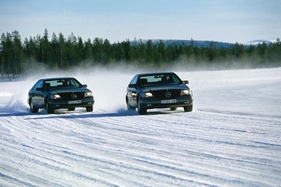
The ESP celebrated its world premiere on February 6, 1995 in northern Sweden in the S-Class coupés of the 140 series. The comparison clearly showed that a vehicle equipped with ESP maintains a stable course on a snow-covered road, while its counterpart without the assistance system constantly swerves.

The ESP was a joint development by Mercedes-Benz and Bosch. The breakthrough in large-scale production followed around three years later, when the revised A-Class was equipped with ESP as standard in 1998. This measure was Daimler-Benz's response to the rollover in the "moose test".

The introduction in the A-Class had a signal effect: almost all car manufacturers followed suit. 30 years after its invention, ESP is now on watch in the background in most vehicles on the market, defusing dangerous driving situations at lightning speed.


