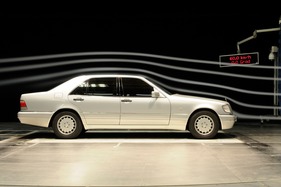
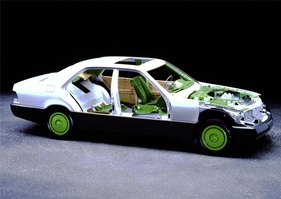
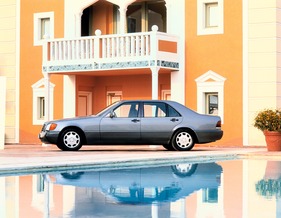
The S-Class 140 model series is a Mercedes-Benz of superlatives. It made its debut 25 years ago at the Geneva Motor Show in 1991. Its developers focused on maximum comfort, for example through generous dimensions and double glazing for optimized acoustic insulation. There are also numerous systems to support the driver. It is also the brand's first series-produced passenger car to be available with a twelve-cylinder engine. The 140 series is also at the service of a future that is now the present: a technology demonstrator was already testing autonomous driving in the 1990s.

The best car in the world
"With the new S-Class, Mercedes once again demonstrates its claim to have invented the car and to build the best car in the world. In view of a 400 SEL, one cannot help but say: the claim is probably justified." So wrote the German trade magazine "mot" in 1991 on the occasion of the then newly introduced 140 series, thus summing up a widespread assessment. Once again, this S-Class embodied the entire corporate knowledge of the automobile that only its inventor could have.
In the home market of Germany, however, the size and presence of the saloon initially caused irritation. Other markets love the new S-Class precisely for this reason - after all, a luxury-class vehicle is often also used for representation. However, 25 years after the launch of the 140 model series, the criticism has been forgotten. This generation of the Mercedes-Benz S-Class has long since joined the illustrious history of the brand's luxury-class models and earned its merits. This is precisely why it is a sought-after youngtimer today. Because then as now, you get a Mercedes-Benz that embodies the brand values to perfection.

The list of innovations in the S-Class 140 model series is long. On the electronics side, for example, there is the CAN bus (Controller Area Network) for networking, the Auto-Pilot-System APS navigation system (from 1995), the PARKTRONIC parking aid (from 1995), the LINGUATRONIC voice control system (from 1996) and the TELE-AID emergency call system (from 1997). Groundbreaking safety systems such as the ESP® Electronic Stability Program (from 1995) and BAS Brake Assist (from 1996) are also included. The seatbelt system with automatic height adjustment, sidebags for the driver and front passenger (from 1996) and xenon headlights with automatic headlight range control (from 1996) provide further safety benefits.
Maximum comfort
The solutions for maximum comfort - a special domain of the Mercedes-Benz S-Class - are also outstanding. The space on offer is extremely generous, especially in the long-wheelbase versions. The suspension offers the optimum of what is technically feasible, with the finest ride and suspension comfort, only surpassed by the optional ADS adaptive damping system. The newly developed double-wishbone front axle is mounted on a suspension stool and decouples the body from audible and perceptible vibrations. The double insulating glazing of the side windows ensures first-class noise insulation. Further comfort features are the electrically folding exterior mirrors and the power closing system for the doors and trunk lid.

A technical highlight is the completely newly developed 6.0-liter V12 engine in the 600 SE/600 SEL models: with a rated output of 300 kW (408 hp), they are the brand's most powerful passenger cars to date. In general, the petrol engines in the series are state-of-the-art with four-valve technology and variable intake camshafts. The 300 SD marks the start of the performance spectrum, making the luxury-class turbodiesel available on markets outside North America.
Award for environmental friendliness
From the outset, the Mercedes-Benz S-Class 140 model series was consistently designed for comprehensive recyclability and the use of recycled materials. It was also the first CFC (chlorofluorocarbon)-free automobile. This earned the S-Class the "Stratospheric Ozone Protection Award" from the US Environmental Protection Agency and the title "The World Car 1992".

Three years after its premiere, a facelift brings a subtle stylistic overhaul. The new version is presented at the Geneva Motor Show in March 1994. By then, the model nomenclature had already been following a new pattern for around a year: in June 1993, the model designations were changed, with the "S" now preceding the three-digit number.
By the end of production, a total of 406,717 saloons of the 140 series were produced at the Sindelfingen plant, 28,101 of which were diesel-powered. This figure also includes the special protection versions and the Pullman saloons, which are produced until mid-2000 after the end of mass production.
With "VaMP" into the future of mobility
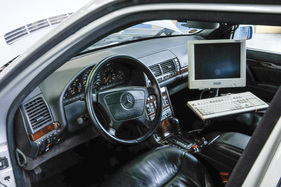
A good 20 years ago, the S-Class became a pioneer for autonomous driving. A 500 SEL from the 140 series serves as a test vehicle for testing the technology under everyday conditions, converted so that the control computer can actuate the steering, throttle and brakes. Powerful computers evaluate image sequences of the journey in real time, which are captured by two wide-angle cameras. "VaMP" ("Test Vehicle for Autonomous Mobility - Passenger Car") is the name of the research project that the Bundeswehr University Munich, Institute of System Dynamics and Flight Mechanics, is conducting with Mercedes-Benz. The 500 SEL provides proof of the technology's functionality: in October 1994, it covers more than 1,000 kilometers on a three-lane freeway in normal traffic at speeds of up to 130 km/h, demonstrating lane changes in both directions and - after receiving clearance from the safety driver - autonomous overtaking.

The tests are part of the European joint project PROMETHEUS (short for "Program for European Traffic with Highest Efficiency and Unprecedented Safety"), in which Mercedes-Benz is playing a leading role. It represented a hitherto unique collaboration between all major European car manufacturers, suppliers and numerous scientific institutes. The aim of PROMETHEUS is to pave the way for the car of the future. The results are presented to the public in October 1994. Many technologies have long since gone into series production and have become an integral part of everyday life.