


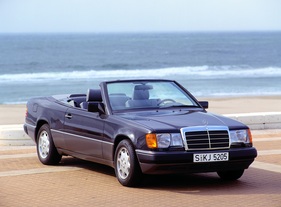
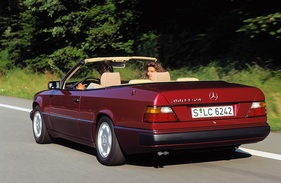
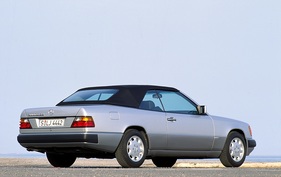

Mercedes-Benz offers sunny prospects in the upper mid-size class at the 1991 International Motor Show (IAA) in Frankfurt am Main. An elegant convertible made its debut there 25 years ago in September. The four-seater vehicle with a fabric top was part of the 124 model series, which from 1993 was known as the E-Class.
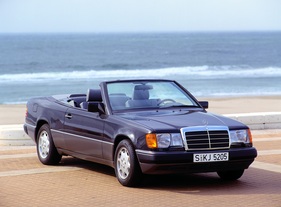
The IAA debut also picks up on a success story of the Stuttgart-based brand, as Mercedes-Benz is offering a four-seater convertible again for the first time in 20 years. This body shape is prominently represented in the current range of the brand with the three-pointed star with the open-top versions of the C-Class, E-Class and S-Class in various engine versions.
Hybrid of saloon and cabriolet
Mercedes-Benz has skillfully combined the lightness of open-top driving with the virtues of the saloon in this model series in the new upper mid-range Cabriolet. The new body variant of the 124 model series is also characterized by innovative technology, modern elegance and an absolutely harmonious overall concept. All this gives the open-top four-seater with the internal designation A 124, which is initially available from spring 1992 as the 300 CE-24, the potential to become a classic right from the start. The 124 model series is also available as a saloon (W 124), estate (S 124), coupé (C 124) and saloon with a long wheelbase (V 124). The engineers used the Coupé as the technical basis for the new Cabriolet.
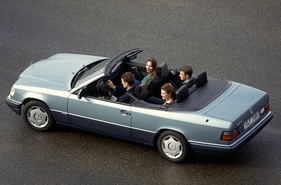
The 300 CE-24 Cabriolet picks up on the long tradition of four-seater open-top vehicles in the history of the Mercedes-Benz brand after a break of two decades: The S-Class forerunners 280 SE Cabriolet and 280 SE 3.5 Cabriolet (W 111) were last built in this body shape until 1971. In between, Mercedes-Benz continued to cultivate the culture of open-top driving with the two-seater SL sports cars. The success of the A 124, of which a total of 33,952 were built up to 1997, was seamlessly followed up by the CLK Cabriolet of the A 208 (1998 to 2003) and A 209 (2003 to 2010) model series and the E-Class Cabriolet of the A 207 model series (since 2010).
Excellent technology for maximum comfort and safety
The engineers developed the Cabriolet from the Coupé with a great deal of design effort. In particular, they stiffened the body to make the open-top four-seater as comfortable and safe as the other members of the model series family. To this end, around 1,000 parts are completely redesigned. Load-bearing structures are made from thicker or high-strength sheet steel.
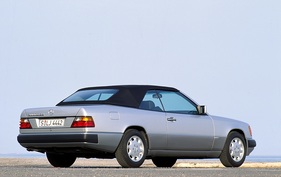
All highly stressed areas receive additional reinforcements in the form of doublers, gusset plates or struts. These include the diagonal struts familiar from the SL sports cars of the R 129 series. There are also vibration dampers in the left-hand damper leg, in the roof frame and in the side luggage compartment recesses. They reduce disruptive body vibrations, which can occur in open-top vehicles due to the lack of a roof structure.
Comfortable and safe
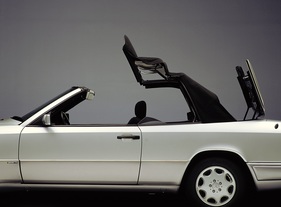
The overall package of bodywork measures makes the Cabriolet not only comfortable, but also as safe as a saloon, estate or coupé in the event of a frontal, rear or side impact. In the event of a rollover, the A-pillars welded together to form a stable unit in the area at risk of buckling and the automatic roll bar also ensure safety. The 43-kilogram soft top construction is based on a 27-part linkage with 34 joints. When folded, the soft top has a volume of only 80 liters and leaves enough space in the trunk.
Built from 1992 to 1997
The Cabriolet was built at the Mercedes-Benz plant in Sindelfingen from 1992. Initially, only the 300 CE-24 Cabriolet with a 3-liter six-cylinder engine (162 kW / 220 hp at 6,400 rpm) was available. A total of 6,343 units of this model were built up to 1993.
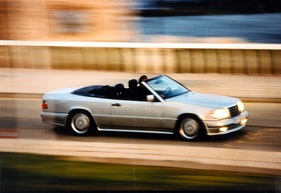
In June 1993, the Stuttgart-based brand presented the updated generation of the 124 model series. Like all other variants of the model series, the Cabriolet now bore the name E-Class. The open-top four-seater is significantly revised in terms of style and is now offered in a wider range of models. The four-cylinder E 200 Cabriolet (100 kW / 136 hp, prior to 1994 only as an export version) and E 220 Cabriolet (110kW / 150 hp), the six-cylinder E 320 Cabriolet (162 kW / 220 hp) and the top-of-the-range E 36 AMG Cabriolet (200 kW / 272 hp). The electro-hydraulic convertible top operation, previously only available at extra cost, is now standard, and the convertible top also has a new interior cover with even better heat and sound insulation.
The first E-Class Cabriolet is built until 1997. 15,380 customers opt for a four-cylinder version, 18,572 choose a model with a six-cylinder engine. Many buyers come from export markets. The export share is particularly high with around 75 percent for the E 320 Cabriolet.

