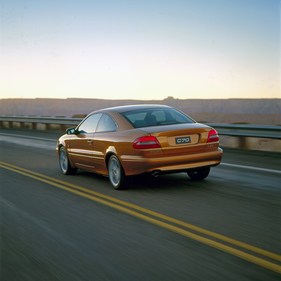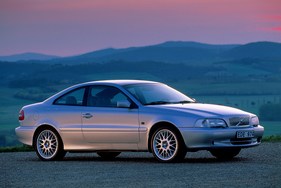
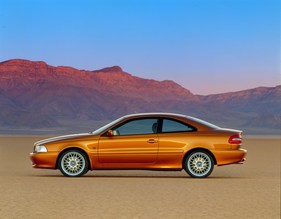
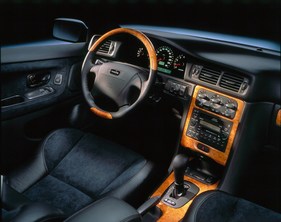
At the beginning of the 1990s, Volvo had already decided to add a coupé and a convertible to its model range in order to occupy a new market niche. Both body variants were to be developed in parallel and technically based on the Volvo 850. A small development team was therefore put together at the beginning of 1994 and Håkan Abrahamsson was appointed project manager.
Right at the start of work on the future coupés and convertibles, a number of challenges had to be overcome: Volvo could only draw on very limited experience in the development of such niche models; on the other hand, the new models were to be presented after only two and a half years of development. In this situation, Volvo decided to cooperate with TWR. After all, the British company had already prepared the Volvo racing entries in the British BTCC series and also had many years of experience in the development and production of sports cars.
Developed by enthusiasts - Volvo C70 Coupé and Volvo C70 Cabriolet
"Without a doubt, this was the car project I enjoyed the most," Håkan Abrahamsson still remembers his time as project manager for the Volvo C70 Coupé and Volvo C70 Cabriolet models. At the time, Volvo was looking for a project manager who was still under 40 years old when the vehicles were launched. Abrahamsson's team only had a few months to draw up the initial specifications in 1994, which is why the project group immediately set to work and carried out a comprehensive analysis of the competitive environment in the coupé and convertible segment. The team members had to cancel their summer vacation and instead traveled to the south of France. There they rented and tested coupés and convertibles from all the major competitor brands. As it was the regular vacation time, the team members were also allowed to bring their families with them, which proved to be a stroke of luck. As a result, many critical comments about the competitor vehicles tested were recorded and the design development of the Volvo C70 was advanced accordingly. Throughout the development work on the Volvo C70, the team members were always happy to refer to the experience gained through their families. Much of the design and engineering development of the new Volvo coupés and convertibles was carried out at TWR in England, near Oxford. While Volvo was responsible for the vehicle technology and determined the vehicle characteristics, TWR was responsible for the design and production preparation. The working location for the entire development team was unusual: a huge barn in which Tom Walkinshaw, the TWR owner, also kept his personal vehicle collection.
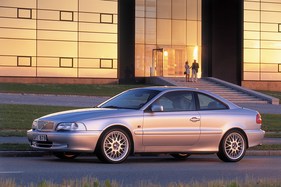
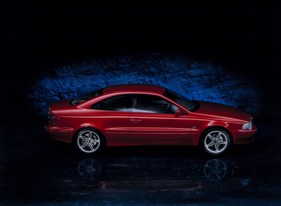
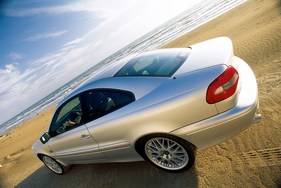
For the design development of the new Volvo models, the then Volvo head of design Peter Horbury gave the project team a largely free hand, because Horbury wanted to get away from the idea that a Volvo had to look angular and boxy. After the first design drafts still resembled the traditional Volvo lines too closely, TWR designer Ian Callum presented sketches of a coupé with an arched roofline and sculpted flanks and fenders. This decided the matter and this design draft went into series production almost unchanged.
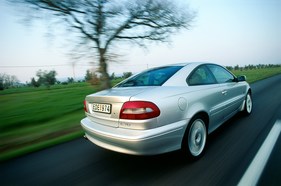
Although the wheelbase and length of the Volvo C70 corresponded exactly to the Volvo 850, the coupé gave the impression of more elegant lines. As it was clear from the outset that the Volvo C70 would also go into production as a convertible, the design team developed a design language that was equally fascinating with the roof closed or open. Only 30 months were available from the first design sketches to the start of production of the Volvo C70 at the new Uddevalla plant. The cooperation with TWR was therefore decisive for the realization, which at the same time reduced the development costs for the Volvo C70 to an acceptable level.
New design for Volvo
Peter Horbury commented on the new design language introduced with the Volvo C70 with the words: "We threw away the box, but kept the toy inside", after he drove onto the stage at the press launch with an intensely bright mango metallic-colored Volvo C70.
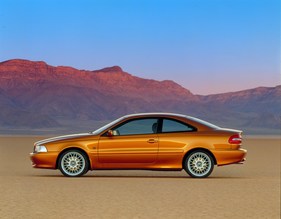
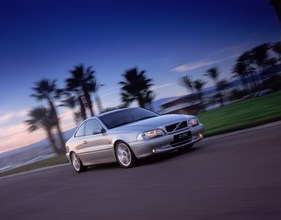
Only the brand-typical front end of the Volvo C70 firmly anchored the coupés and convertibles in the Volvo family, while the body was much more rounded than all other Volvo models. In fact, the Volvo C70 heralded a completely new design line that was to become characteristic of future Volvo models.
Exclusive equipment configurations
Individualization is a top priority in the coupé and convertible segment. The Volvo C70 was able to score points here with a wide range of equipment, materials and unusual paint finishes. Everything could be configured almost freely according to the customer's personal taste, as each Volvo C70 was intended to be practically unique. In fact, Volvo only built the coupés and convertibles to customer order. There were 17 different exterior paint finishes alone, ranging from solid to metallic to pearl effect, which could be combined with 40 different interior colors and materials.
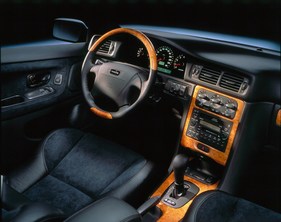
A powerful engine is crucial for the success of sporty coupés and convertibles. For this reason, the Volvo C70 was equipped from the outset exclusively with five-cylinder turbo engines, which promised outstanding driving performance with low fuel consumption. The Volvo C70 T5 Coupé model with a 2.3-liter five-cylinder engine was powered by the 204 hp high-pressure turbo from the Volvo 850R and reached a top speed of 250 km/h (155 mph). In the Volvo C70 2.4T, on the other hand, a somewhat milder low-pressure turbo with 193 hp provided propulsion, and for markets with taxation based on engine capacity, there were also 2.0-liter engines with power ratings from 163 hp to 225 hp.
Pioneering safety technology for coupés and convertibles
Despite a very emotional focus, in which design determined function, the Volvo C70 offered plenty of space for four passengers and their luggage. In typical Volvo fashion, revolutionary safety systems were also a must. The coupés and convertibles were equipped with the unique SIPS side impact protection system including side airbags and the new WHIPS whiplash protection system.
As a special safety system for the Volvo C70 Cabriolet, the Swedes developed the rollover protection system ROPS, whose sensors deployed two roll bars integrated behind the rear seats in the event of a rollover. ROPS also included a windshield frame made of high-strength steel firmly anchored in the floor panel. In addition, the Volvo C70 was the first convertible ever to offer seat belt tensioners as standard on all seats. Volvo thus took the safety equipment for convertibles to a new level of maximum protection, which had been a prerequisite for the development of the open Volvo C70. In fact, with the exemplarily safe Volvo C70 Cabriolet, the Swedish premium brand continued an open-air tradition that had been paused since the Volvo P1900 from the 1950s.
Production in a new plant with innovative manufacturing processes
The Volvo C70 was built in Uddevalla, Sweden, by AutoNova, a joint venture between Volvo and TWR. Volvo had previously produced in Uddevalla, but had discontinued production a few years previously. The plant, with an annual capacity of 20,000 units, therefore had to be completely redesigned for the production of the niche model, which was not built on assembly lines but in group production. The work teams accompanied each vehicle through several production stages before other teams took over the further production processes.
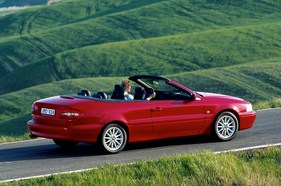
The design of the Volvo C70 proved to be timelessly elegant, so that it was hardly modified during the nine-year production period of the first generation. The coupé remained in production until 2002, but the last convertible was not delivered until April 2005. A total of 76,809 first-generation Volvo C70s were built, of which 27,014 were coupés and 49,795 were convertibles.
The second generation of the Volvo C70 celebrated its world premiere at the Frankfurt Motor Show in September 2005 - a fascinating combination of coupé and convertible thanks to a three-part hardtop. The new Volvo C70 was developed in collaboration with Pininfarina.
Ten little-known facts about the Volvo C70:
1. the Volvo C70's audio system was among the world's best of its time. The loudspeakers were built by the Danish prestige brand Dynaudio; Dolby Surround and 4 x 100 watt amplifiers ensured a perfect sound experience even in the open convertible.
2 The 17 different exterior colors were developed under designer José Diaz de la Vega. He was also responsible for the interior design of the Volvo C70, while Anders Gunnarsson led the design work for the exterior.
3. in Sweden there is a special association for Volvo C70 owners, the Swedish Volvo C70 Club. To mark the 20th anniversary of the Volvo C70, the club organizes a motorcade from the factory in Uddevalla to the Volvo Museum in Gothenburg.
4. the world premiere of the Volvo C70 in Paris could be followed online. This was the first online premiere of a new car in Europe.
5. in the J.D. Power customer satisfaction study, the Volvo C70 came first in 1998 as the best Volvo and fifth overall.
6. the Finnish manufacturer Valmet produced the prototype of a steel folding roof for the Volvo C70 Cabriolet. Although this hardtop did not go into series production, the second generation of the Volvo C70 was equipped with such a retractable hardtop from 2005.
7) Tom Walkinshaw, the man behind TWR, was a successful racing driver who won three World Touring Car Championships as well as two victories at the 24 Hours of Daytona and Le Mans.
8 In 1999, Volvo took over TWR's shares in Autonova and continued production of the Volvo C70 in-house. Volvo later founded a company with Pininfarina.
9 In the action film "The Saint", master thief Simon Templar, played by Val Kilmer, drives a garnet red Volvo C70. As the film was produced before the world premiere of the Volvo C70, filming took place in the strictest secrecy
10. the advance advertising brochure for the Volvo C70 was taciturn. It consisted only of elegant pictures, a few technical specifications and a quote from Peter Horbury: "I didn't want to create a car that people need, but an automobile that they want".