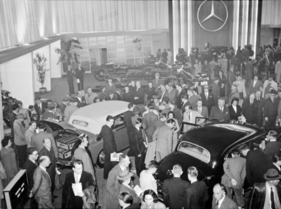
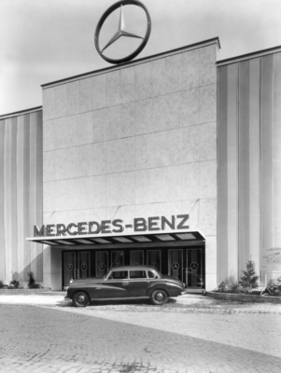
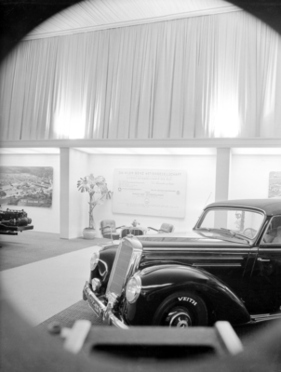
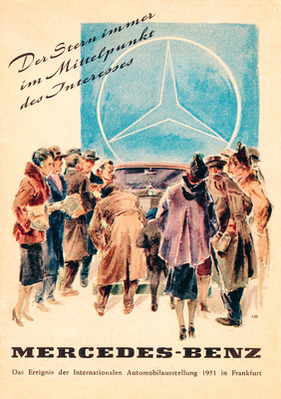

In 1951, Mercedes-Benz made its return to the international automotive industry after the end of the war with two new passenger cars. Seventy years ago, the 300 (W 186) and 220 (W 187) marked a genuine new beginning. At the International Motor Show (IAA) in Frankfurt am Main from April 19 to 29, 1951, the then Daimler-Benz AG presented both new models and made an impressive comeback with two newly developed top-of-the-range automobiles. Until then, the company had produced pre-war vehicles, some slightly updated, such as the 170 S (W 136), which appeared in 1949.
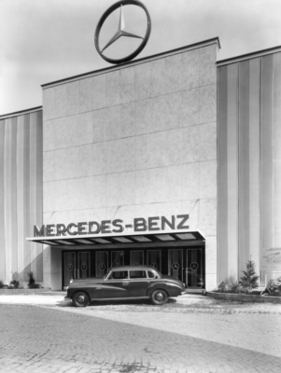
The construction of both vehicles begins in 1948 and is a considerable feat. Since the end of the war in 1945, the company had already completed the roughest steps to get the plants and production facilities up and running again. Important managers were also able to resume their activities after the so-called denazification, such as CEO Dr. Wilhelm Haspel, Chief Development Officer Prof. Dr.-Ing. h. c. Fritz Nallinger and Head of Passenger Car Development Rudolf Uhlenhaut. However, this should not be seen as a rosy time: New production machines, materials from sheet steel to drawing paper and pencils as well as vendor parts are still in short supply. In winter, the employees keep warm in poorly heated offices and factory halls, mainly with woolen clothes and hard work.
Back in the luxury class with a six-cylinder model
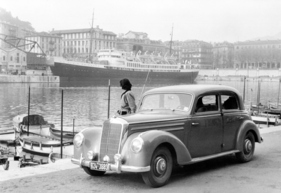
The Mercedes-Benz 220 (W 187) sets an important example: With it, the brand is once again present with a six-cylinder model and is successfully asserting a leading position over other manufacturers that dates back to the pre-war era. Performance and prestige are two important characteristics.
What is also exciting is that the success is achieved with a vehicle that is still based on pre-war designs, for example with its underfloor frame and body concept. However, Mercedes-Benz was well aware that only a completely new design would fully meet the expectations of discerning customers in terms of spaciousness. This new era would begin as early as 1954, three years after the premiere of the 220 in the form of the "Ponton" model 220 (W 180).
In 1951, Mercedes-Benz achieved its performance target with a completely new engine. It bore the internal designation M 180 and was developed from 1948 under the aegis of Wolf-Dieter Bensinger, Head of Engine Design. 59 kW (80 hp) from a displacement of 2.2 liters, i.e. a liter output of 26 kW (36 hp), and a usable speed range of up to 6,000 rpm are the hallmarks of the engine: Such key data is new territory for the brand. Bensinger's concept is a complete success and delivers superior performance in the 220. The engine's elasticity enables effortless gliding over long distances. It also delivers impressive performance, such as a top speed of 140 km/h or acceleration from 0 to 100 km/h in 21 seconds - roughly on a par with the legendary 540 K from before the war, albeit without the supercharger activated.
Extensive range of bodywork
The high standards of the Mercedes-Benz 220 (W 187), also in terms of prestige, were underlined by the brand with an extensive range of body styles. It was not only available as a saloon (16,066 units until May 1954, from DM 11,925), but also as a Cabriolet A (1.278 units until August 1955, DM 18,860), Cabriolet B (997 units until May 1953, DM 15,160) and Coupé (85 units, December 1953 to July 1955, DM 20,850). In addition, 41 open touring cars were produced as police patrol cars and 47 chassis for special bodies.
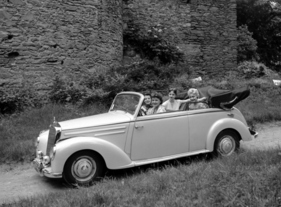
The trade press is enthusiastic. A representative quote from the "Automobil Revue", Bern, in issue 5/1952: "This outwardly inconspicuous and unobtrusive family car, whose peculiarity is concealed behind its resemblance to the well-known 170 S, transforms the admiration it initially arouses into lasting enthusiasm in the course of closer acquaintance. Its roadholding seems to adapt to the driver's wishes; it only gives its all to those who demand it. It strolls along with the slowpoke, pulls away with the speedy driver, but only reveals itself to the connoisseur. All this without demanding either exertion or excessive concentration on the part of the driver. Even at the fastest speeds, sensitive occupants in need of care feel comfortable."
Representation at the highest level: Mercedes-Benz 300 (W 186)
If the 220 is already a noble vehicle - where does the Mercedes-Benz 300 (W 186) fit in? Quite simply: with its presentation at the IAA 1951, the brand once again offered a representative vehicle for an effective appearance. And that is exactly what it was immediately accepted as: Heads of government, business leaders and big names in the entertainment business ordered their 300, and as a matter of course it also became the official vehicle of the German Federal President and the Federal Chancellor. This remained the case for Chancellor Konrad Adenauer for a decade and a half. During this time, he used various Mercedes-Benz 300s, leading to the nickname "Adenauer-Mercedes", which is still used today. The Chancellor was aware of the importance and impact of a befitting appearance. In 1955, for example, he had his Mercedes-Benz 300 taken on a special train for the state visit to Moscow so that he could be properly presented in the Soviet capital. Today, one of Adenauer's representative limousines, together with a saloon car from the special train, is one of the outstanding exhibits at the "House of the History of the Federal Republic of Germany" in Bonn. The last Mercedes-Benz 300 official vehicle of the first Chancellor of the Federal Republic of Germany can be seen in the Mercedes-Benz Museum, in the Collection 4: Gallery of Names room.
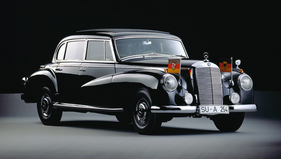
The W 186 adopted the concept of the X-oval tubular frame and the basic dimensions of the chassis of the Mercedes-Benz 230 (W 153) from 1939 with a wheelbase of 3050 millimeters. The tubular dimensions were reinforced due to the higher vehicle weight. The expected total weight required an engine output of at least 74 kW (100 hp), as was determined at an early stage. Due to existing production facilities, the 2.6-liter M 159 engine with 44 kW (60 hp), which had been developed before the war, was to serve as the basis and therefore had to be given a power increase of almost 67 percent. Head of engine design Bensinger brought the engine up to the desired level with far-reaching measures. It is initially called the M 182, but the 74 kW (100 hp) from a displacement of 2.8 liters is not enough for the vehicle weight, as it turns out. Only further modifications, such as increasing the displacement to 3 liters and using an overhead camshaft, brought the developers to their goal of 85 kW (115 hp). The engine is now called the M 186.
Independent body and spacious interior
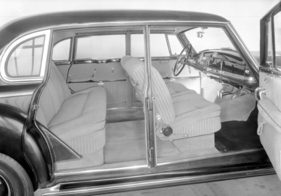
Compared to the Type 230, the engine is installed significantly further forward and above the front axle. This provides a not inconsiderable gain in space for the vehicle occupants. The decision to design an independent body without using pre-war components was not an easy one. This meant, for example, new and expensive pressing tools. Hermann Ahrens takes on the body development as a special task. This is because he actually only works on truck and bus bodies. Ahrens has extensive experience; after all, many of the brand's pre-war car bodies, including the top models, can be traced back to him.
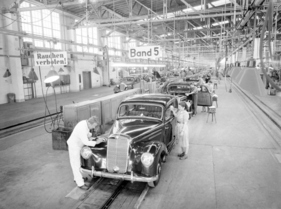
The prestigious Mercedes-Benz 300 was produced in its original form for around three years (4563 saloons, DM 19,900; 455 Cabriolet D, DM 23,700; 2 chassis). In spring 1954, the revised 300 (internally called "b") replaced it with a more powerful engine (92kW/125 hp) and reinforced brakes (1639 saloons, DM 22,000; 136 Cabriolet D, DM 24,700; 10 chassis). This was followed in the fall of 1955 by the 300 (internally "c"; 1367 saloons, from DM 22,000; 51 CabrioletD, DM 26,200; 3 chassis) with single-joint swing axle and three-speed automatic transmission from BorgWarner as standard. German Chancellor Konrad Adenauer requested a special version of this generation of the Mercedes-Benz 300 with a 100-millimetre-longer windscreen and a 140-millimetre-longer rear footwell - this was included in the range.
As the launch of the new Mercedes-Benz 600 (W 100) representative vehicle was delayed, the 300 was extensively revised once again. In 1957, the final expansion stage of the Mercedes-Benz 300 (internally "d") was created with its own model series number W 189. Among other things, it had petrol injection and, at 118 kW (160 hp), a considerably higher output as well as a significantly modified body with a lighter superstructure. In 1960, three special long-wheelbase versions were built in Sindelfingen: two Landaulets and a saloon. All three vehicles are ten centimetres higher than the normal saloons and can be recognized by their higher windows. One Landaulet was given to the Vatican for Pope John XXIII. The vehicle is now in the Mercedes-Benz Classic collection. The second Landaulet and the limousine are made available to the German government for state visits. This last version of the Mercedes-Benz 300 is also successful: by spring 1962, 3073 saloons (from DM 27,000), 65 Cabriolet D (DM 35,500) and a W 189 chassis are produced.