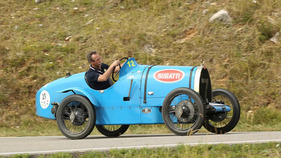
The "Gran Premio delle Vetturette" is underway. The racing cars race back and forth between the cities of Montichiari and Brescia on the Circuito di Montichiari. Tires squeal, dust swirls through the air. 60 laps of 17.3 kilometers each. An enormous strain on man and machine - and a legendary race to this day: The Bugatti Type 13 took the first four places in the Voiturettes Grand Prix - and cemented the French luxury brand's motorsport expertise. The nickname of the Type 13 to this day: Brescia.
To mark the anniversary, the Bugatti Club Italia organized a special event from 12 to 16 September: 40 historic Bugatti vehicles, including the Types 13, 22 and 23 from all over the world, celebrated the historic victory on the beautiful tracks around Lake Garda. The start and finish was, of course, always in the city of Brescia. The Bugatti Club Italia has been keeping the history of the French luxury car manufacturer alive for over 35 years - even before the second era of the brand began with the EB 110 and Bugatti's first super sports car of modern times was created in 1991.
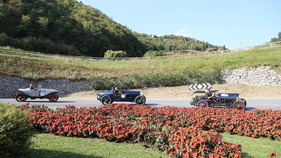
With the Type 13 "Brescia", Bugatti heralded a trend reversal in motorsport in 1921. The open-top sports car, the first of its kind, put an end to large and heavy racing cars just a few years later. Thanks to its lightweight body, superior chassis and powerful engines, the Type 13 outperformed its competitors from 1921 onwards.
Like Ernest Jules Friedrich. The French racing driver and mechanic had been relying on the Type 13 for some time, winning the famous Le Mans race a year earlier. In Brescia, at the race in the Voiturettes class, he drove concentrated lap after lap, circled the bends precisely and quickly and crossed the finish line first - ahead of his teammates Pierre de Vizcaya, Michel Baccoli and Pierre Marco.
Voiturettes are lightweight and agile racing cars. With the Type 13, Bugatti offered just such a vehicle: 490 kilograms light, 1.45-liter four-cylinder engine with initially 40 hp, later 50 hp. The open-top two-seater could reach speeds of up to 150 km/h and, thanks to its lightweight construction and precise chassis, was capable of high cornering speeds. In the Type 13, built from 1910, Ettore Bugatti combined his ideas, continuously refined the technology over the next few years and consistently focused on lightweight construction and high-quality workmanship.
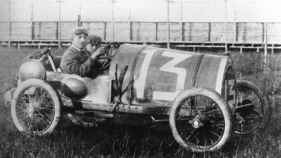
First four-valve engine in a car
From 1914, the engine was given a displacement of 1.35 liters, and from 1919, for the first time, a four-valve cylinder head for faster gas exchange. This gives the four-cylinder engine an output of 30 hp. Bugatti used white metal for the crankshaft bearings and pistons for the first time, as well as a fuel pump and a pump that sprayed oil onto selected components. An easy-to-shift four-speed gearbox made frequent gear changes easier for the driver.
From 1921, Bugatti increased the engine capacity to 1.45 liters, and the later racing car used new ball bearings for the crankshaft, which ran even more smoothly and with less friction. At the same time, Bugatti increased the compression ratio of the engine and the carburetor throughput and opted for a twin magneto ignition with two spark plugs per combustion chamber. As a result, the racing engine ensured powerful combustion at high engine speeds of up to 4,500 rpm. Lightweight wire wheels instead of heavy wooden wheels reduce the unsprung masses and increase agility. In short: the Type 13 becomes the measure of all things in motorsport. Strong, fast, sinewy. Like a racy thoroughbred, a "Pur Sang".
In the 1920s, Bugatti cars won almost all the competitions in which they took part. The lightweight, powerful and reliable sports cars from Molsheim were particularly superior in tough road and mountain races.
After the quadruple victory in Brescia, the French manufacturer sold 711 Type 13 "Brescia" vehicles with the four-valve head, as well as 388 vehicles with engines featuring a smooth-running crankshaft with ball bearings. All subsequent four-valve vehicles even officially bear the name Brescia in memory of this unique success. Bugatti continued to implement the Type 13 concept with other vehicle lengths, such as the Types 15, 17, 22 and 23. The Type 13 was produced in Molsheim until 1926, and Bugatti sold a total of around 2,000 of these vehicles.
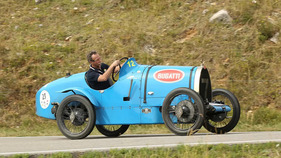
Bugatti Type 35 continues its racing successes
From 1925, the employees assemble the Type 35, which continues Bugatti's series of successes. Over the next few years, it becomes the most successful racing car of all time with over 2,000 victories. Between 1925 and 1929, it won the Targa Florio in Sicily, one of the toughest races of its time, five times in a row - following in the footsteps of its predecessor with this impressive success story.