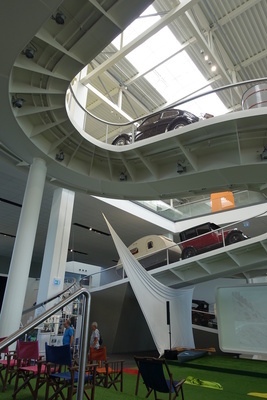
Should we talk about a museum that bears the name of a manufacturer of caravans and motorhomes here? - Absolutely! Because the Erwin Hymer Museum in Bad Waldsee in Upper Swabia that we are talking about is not just a camping museum, nor is it a factory museum. It was opened in 2011, is run by the Erwin Hymer Foundation and is dedicated to mobility from a special perspective, including the classic cars that go with it.

Let's start with the impressive two-part museum building. The rectangular main building, visible from afar, is undoubtedly striking, with its red frame and rounded corners reminiscent of a caravan window. Inside, an area of around 6,000 square meters houses the permanent exhibition, the administration and rooms for conferences and special exhibitions. The adjoining building covers around 2,650 square meters and houses a large event hall, the museum restaurant and the museum store. The museum follows a convincing didactic concept: the so-called Dream Route leads us to nine walk-in places of longing, each of which is represented by oversized symbols. For example, a red wigwam denotes the North American route and the large mocha pot symbolizes the Moroccan route. The visitor learns a lot about the development of caravanning, from the once simple caravan to modern luxury. At the same time, visitors embark on a journey through time.
At the entrance to the permanent exhibition, visitors are greeted by a portrait of the founder Erwin Hymer, complemented by a picture of Giacomo Casanova, to whom a special exhibition is currently dedicated. However, a journey should be planned as carefully as possible. This is why the "Departure Tunnel" initially accompanies the travel preparations of a young family with children and an older couple. But then the journey begins and you can live out your wanderlust on the dream road with its differently color-coded sections.
The mountain is calling
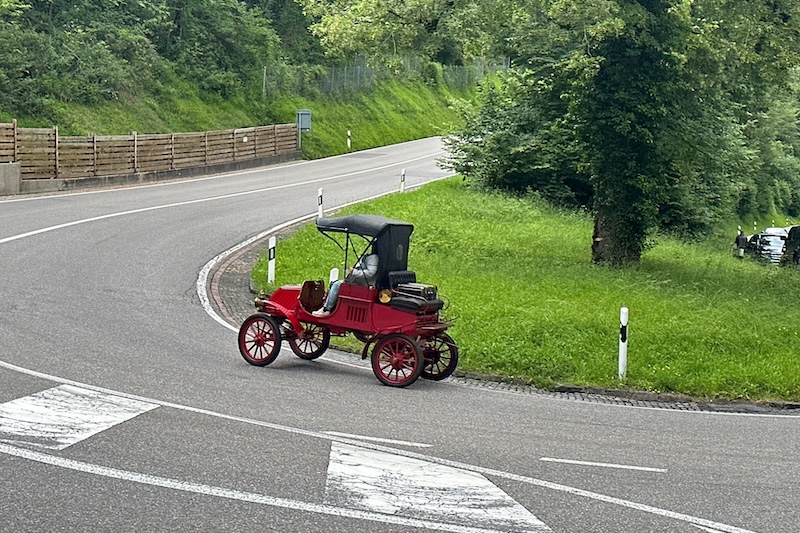
The journey begins in the 1930s and with the Alpine route. Several contemporary carriages wind their way up the mountain to an extensive Alpine panorama and a summit cross. Back then, this type of journey was a real challenge, as you first had to conquer the mountain passes - perhaps the reader will have experienced this for themselves in a classic car. In any case, back then you had to contend with boiling radiators and diminishing braking power. The author experienced this as a child on vacation with his parents.

In the Hymer Museum, you can also hear curious things. For example, the story of the "washing machine" in one of the oldest caravans. This was a metal tub filled with water into which stones were placed. It is said that this was used to wash diapers after a long journey.
The tour continues to the undisputed dream destination of the Germans in the 1950s, "Bella Italia". This place of longing is symbolized by a large yellow shell and conveys the vacation feeling of the post-war generation. However, you can't help but smile when contemporary travel guides recommended that tourists to Italy should definitely take potatoes etc. with them, as the country's typical cuisine was too unfamiliar for German palates.
For the citizens of the former GDR, on the other hand, the Baltic Sea coast was both a border region and a place of longing. A Trabant 601 Universal with roof tent and the Würdig 301 caravan, also known as the "Dübener Ei", are reminders of this time.

Dream journey through half the world
Further stages of the dream route lead to India, Morocco, North America, Scandinavia and surfing on the Atlantic. The Far Eastern route is represented by an original auto-rickshaw ("tuk tuk") and the Volkswagen T1 bus of the so-called "Oberhippie" Jürgen Schultz, in which he traveled to India, Nepal and Sri Lanka, among other places. On the North American route, we encounter a gleaming Airstream caravan pulled by an Edsel Ranger. The museum-like dream route ends with the Hymer VisionVenture, a "concept car" on the chassis of a Mercedes-Benz, which, with its design, the materials used and the equipment (including a rear terrace with BBQ station), is intended to show what a camping vehicle could look like in the near future.
Let's summarize briefly: On their journey along the dream road, museum visitors can get to know a wide variety of vehicles made from diverse materials. They range from tent caravans to luxury motorhomes. There are clever designs and long-distance self-built vehicles as well as caravans that can be extended in width or height. There are exhibits where parts of a caravan can be used as a boat and even a floating caravan with an outboard motor can be discovered.
Special vintage cars in the Hymer Museum
In this universe of automobile travel, classic cars are not neglected either. In addition to pre-war vehicles (such as the Praga Piccolo, DKW F8 Reichsklasse or Opel Kadett), there are also several Mercedes-Benz cars from different model years, a Borgward Isabella Coupé and an NSU Ro 80.
However, two vehicles in particular should be mentioned here. Firstly, there is the Dornier Delta from 1954, the prototype of a four-seater small car from the aircraft manufacturer Dornier from the era of "scooter cars" such as the Isetta, Heinkel Kabine or Goggomobil. The Delta owes its origins to the fact that aircraft construction was initially banned in post-war Germany and alternatives were sought for production. The arrangement of the seats is typical of the small car: the passengers sit back to back, with access through a front and rear door. Does that sound familiar? The Delta was later made ready for series production and then built as the Zündapp Janus. On the exhibit, however, the doors are still connected by a large spring stretched over the roof, which is why it is better not to open both doors at the same time.


The Mikafa Motorhome de Luxe from 1959 also deserves a special mention. The bus, which was immensely expensive at the time, had extensive equipment for the highest demands and even had a roof terrace. It was powered by a V8 engine from BMW.

Conversation with museum director Sascha Fillies
At the end of our visit, we have the opportunity to talk to Sascha Fillies. The likeable cultural scientist and podcaster ("Motor Cultur") was exhibition director at PS.Speicher for over 13 years and has been director of the Erwin Hymer Museum since March 2024. He points out that in addition to the permanent exhibition, a varied program of events will be offered. In addition to a camping flea market and changing special exhibitions, there is also the "Live Reportages" event series. Here, experienced speakers report on their extraordinary travel adventures. The museum workshop also offers free practical sessions on relevant topics.
The museum director then shows the author around the workshop, where an Opel Astra Heku Car Camp from 1994 is parked. This is a six-wheeled mobile in which a detachable living unit has been mounted on an Opel Astra. Nevertheless, tax and insurance only have to be paid once for the ensemble, which is registered as a motorhome. The Hymer Caravano 3 from 1961, Hymer's first motorhome, is also currently being restored there. Unfortunately, only three examples of this type were built on the basis of the Borgward B 611 van, after which Borgward went bankrupt.

Further information on the museum's website