

Corona has also kept things quiet in the Belgian Ardennes for a long time. But now the time has finally come again. The organizers of the SPA SIX HOURS got the green light from the government for their traditional long-distance race. Not only the athletes, but also the spectators were already suffering from withdrawal symptoms and were longing for revving racing engines, the smell of hot rubber and high-octane fuel. The organizers had chosen the subtitle of the event well. The motto for the entire weekend was "SPA SIX HOURS - THE SOUND OF HISTORY".
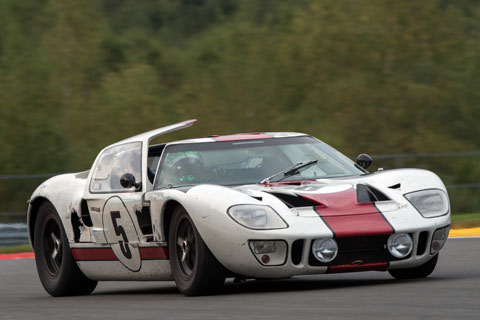
And the orchestra was well prepared. There were 12 Ford GT40s and 10 Ford Cobras/Daytona Coupes, which were responsible for the bass frequencies with their large-volume, rumbling V8 engines. The mid-range was covered by 9 Jaguar E-Types with their beautiful 6-cylinder racing engines. 12 Porsche 911s with their high-revving boxer engines provided the bright to shrill tones. Not forgetting, of course, the soloists such as Gilbern, Marcos, Ginetta, Elva, TVR, Lotus, Triumph, MG, Austin and Aston Martin. All 86 registered starters together made for an impressive sound experience.

The endurance legend dominates
As in previous years' races, the armada of Ford GT40s was in a class of its own. The only question was who had done the best preparatory work and could drive at race pace for 6 hours without major interruptions. Of course, the necessary bit of luck must not be missing.
With a time of 2:39:827, Markus Graf von Oeynhausen, who shared the car with Frank Stippler, put their GT40 in pole position. Next to them was the GT40 of Farley/van der Poele with a best practice time of 2.41.093. The GT40s on the second row of the grid belonged to the driver trio of Daniel and Oliver Hart and Nicky Pastorelli, as well as the number 21 GT40 of O. Bryant and James Cottingham. Starting rows 3 to 6 also went entirely to GT40 drivers.

The first Cobra, driven by C. van Riet and F. Bouvy with a qualifying time of 2:47:916, was on row 7 of the grid. Next to the Cobra was the first Jaguar E-Type with a best time of 2:48:307. Let's take a look at the last row of the grid. Here were two MG B Roadsters, which posted their best times of 3:25:069 and 3:27:088 respectively. With a 46-second time difference between first and last place on the grid, numerous overtaking maneuvers and low, dark clouds promised an uncertain race.
Hot race
The race was opened on time at 16:00. The GT40 driven by Eric van der Poele won the start ahead of pole setter Frank Stippler. But after the first lap, the number 30 dropped back significantly and the GT40 of Hart/Pastorelli was in second place, behind the number 98, the leading GT40 of Farley/van der Poele. At the end of the third lap, the lead had changed again and the GT40 of Hart/Pastorelli, which had started from third on the grid, was in front.
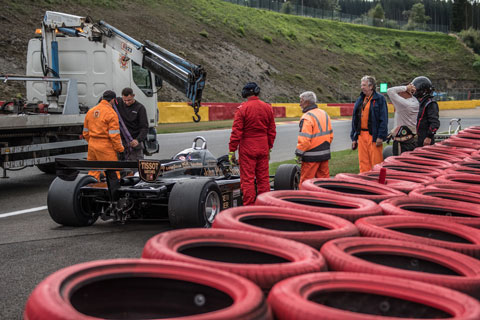
The team of Graf Oeynhausen/Frank Stippler with starting number 30 was unlucky from the start. Presumably, the snap lock of the left fuel filler cap had not been closed correctly, so that in tight right-hand bends such as La Source after the start and finish straight, a gush of fuel always escaped and flowed over the left side of the vehicle. At some point, the leaking fuel reached a hot part of the vehicle and flames flickered across the left door. Fortunately, this happened just after the car had passed La Source and the burning GT40 was able to turn into the old pit lane, where it was immediately extinguished.

On lap 26, the GT40 of Hart/Pastorelli, which was in second place, had to be parked in the pits. Over the next four hours and as darkness fell, several GT40s took turns at the front, partly due to the necessary refueling stops, which have to be carefully considered at Spa. As communication with the pits by radio is prohibited, only the classic pit boards may be used.
Refueling, the big tactical factor
If the driver is shown the "Refuel" sign by the pit, he must turn into the upper "new" pit lane on the next lap, pass the pit area at the speed limit, drive downhill through the old pit lane and then turn right into the filling station area. If he is lucky, he will immediately be allocated a free fuel pump, otherwise he has to wait until the others have finished. The driver is also largely on his own when refueling. They have to get out and fill up themselves. He is only assisted by the service station staff when getting in and buckling up. The driver then drives from the service station back to the pit lane exit, which is located at the Eau Rouge/Raidillon corner combination.

The final third of the race, which was driven in complete darkness, was dominated by the number 21 car, the GT40 of Oliver Bryant and James Cottingham, who were already in the lead from lap 79. They were waved off as deserved winners after 114 laps.
The GT40 of T. Woods and M. Griffiths, which started the race from 5th on the grid, was particularly unlucky. They also led the field for a long time, dropped back to second place on lap 79 and came off the track just a few minutes before the end, allowing the GT40 with the number 7, driven by Davies/Newall/Jordan, to move up and take second place. Third place on the podium went to drivers Meins/Lillingston/Price. The Ford Cobra of Christophe Van Riet and Fred Bouvy was the first "non-GT40" to finish sixth overall. The Ford Mustang, driven by Van Laenschot/Milner/Greensall, won the touring car class.
When the "Sound of History" fell silent after six hours, the teams pushed their vehicles into the pits while heavy rain showers swept over the Ardennes forests. Let's hope together with the active participants that next year everything will be back to normal and Corona will have become history.

A brief excursion into corners:
Numerous accidents have given the spectacular Eau Rouge/Raidillon corner combination a spectacular image in recent years. There is no uniform desire for change among the current top drivers, including those from Formula 1. Apparently, however, the circuit owners are now ready and are planning some structural changes, which will include larger run-off areas, more gravel beds and new grandstand facilities. The first signs of this can already be seen in the wooded areas next to the track. Perhaps the next SPA SIX HOURS will be run on a slightly less busy course.
(The name Eau Rouge - French for red water - comes from the small river located there, which is fed by the iron-rich water of nearby springs. Raidillon refers to a steep road).