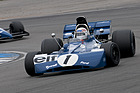
To feel like Jackie Stewart for once. This wish came true for a little girl. She proudly sat behind the wheel of the blue Tyrrell Ford 003 of constructor Derek Gardner.
The huge difference between the historic racing series and the current Formula 1 can already be seen here. Fans want to be able to feel, smell and, above all, see the closeness to the sport at moderate prices.

At the Monaco Grand Prix Historique, which took place on May 14 and 15, 2016, the numerous fans took full advantage of this offer. The grandstands were packed with spectators and the races were thoroughly exciting, even if not all the drivers were driving at the highest professional level.
Large Formula Junior field
Even the Formula Junior field with its 49 cars was impressive. Even the nobility was part of the Formula Junior. Prince Joachim of Denmark was at the start in a Volpini. Even Prince Albert was tempted to have a chat.

"One ahead of the rest" was the motto of Jonathan Hughes in his Lola Mark ll. None of his rivals were able to slow him down or keep him ahead. Christian Traber gave his all in his pursuit and thanks to his courageous, faultless drive, he was able to climb the podium in second place.

Arthur Mallock's "Bundesheer-Kanister", piloted by his son Ray, crossed the finish line in third place.
The race had to be held in three heats, so the even and odd numbers each drove one heat and at the end the fastest of the two heats competed in the final.
Thrilling drifts in the sports cars
As was the case two years ago, the sports car field was dominated by the Jaguar C-Type with Chris Ward at the wheel. His extreme driving skills thrilled the audience once again. Always drifting, even various battle tracks could not upset him and he drove home an unchallenged start-finish victory.

His victory was aided by the serious accident involving John Ure in the Cooper-Bristol T24. In practice, John shone more with his times than with the paintwork on his Cooper. The car, still in its original condition, had lost all its shine due to patina and various battle scars.

But the times were fast, very fast, until he fell victim to a careless, slower competitor at the tunnel exit. The two cars came into contact before the braking point for the harbor chicane and the Cooper-Bristol ended up in the crash barriers. A repair was no longer an option.
No race for the pre-war cars
Unfortunately, the pre-war field was degraded to a parade. The racers were allowed to do their laps behind the pace car. The whole thing was not really slow, but the racing appeal was completely lost. This was certainly one of the reasons why there was not a field of really first-class pre-war monopostos.

After all, various Bugatti cars were present and even former Pink Floyd drummer Nick Maison did his laps in an Aston Martin. But compared to 2014, the parade on show wasn't really worth the effort, especially as the costs for the start are just as high as for the other participants.
David versus Goliath in the front-engined monoposti
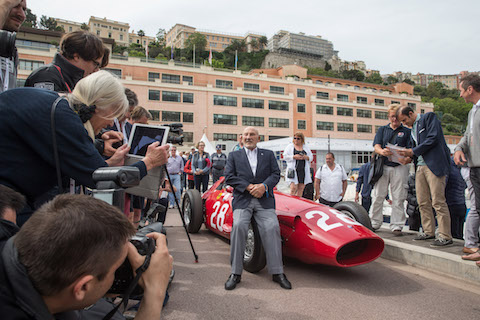
The original Maserati 250F, in which Stirling Moss won the 1954 GP in the Principality, was at the start in the field of front-engined monopostos from the 1950s.

It was a feast for the eyes to see the heavy big Italian cars from Maserati and Ferrari battling against the small British cars from Lotus and Cooper. What a fascination these races must have had for the fans back then.
Graceful sound machines
In the field of F1 racing cars with 1500cc engines from 1961-65, two cars stood out from the field both visually and in terms of performance. The winning Lotus 25 with Andy Middlehurst at the wheel was just as impressive as the highly complicated Ferrari 1512 V12 with twin ignition, driven by Joseph Colasacco.

Both started from the front row and delivered a strong race. The sound of the Ferrari reverberated through the rows of houses and put many a symphony or the best tracks from the Pink Floyd album "Wish you were here" to shame.

It's hard to imagine today that these small and graceful cars were competing for the highest honors in motorsport back then. This Ferrari would probably look like a child's pedal car next to Vettel's modern SF16-H.
Motorsport celebrities behind the wheel
Despite the Spanish GP in Barcelona, Adrian Newey was at the start in Monaco. He did not drive a Red Bull, but a Lotus 49, ex Hill and Rindt.

Former Swedish F2 driver Eje Elgh was also absent in Spain as Marcus Ericsson's manager and sat in a March 711. The son of Jean-Pierre Beltoise, winner of the 1972 Monaco GP, drove the beautiful Matra MS 120C.

As far as the cars were concerned, the Eifelland 21 certainly stood out from the field of F1 cars from 1966 to 1972. The car was based on the March 721, was designed by Luigi Colani and was driven by Rolf Stommelen at the time, albeit without success, which was probably not due to Stommelen.

The F Series race was won by Stuart Hall in the McLaren M19A.
Flashy and spectacular Formula 1 of the seventies
The main race of the weekend was undoubtedly the battle of the Formula 1 cars from 1973 to 1976, which competed in Series G.

Over 40 monoposti from one of the most spectacular eras of Formula 1 came to the Principality to the delight of the spectators. Visually, these cars with their high intake funnels, also known as air scoops, are among the most creative creations in F1 history.
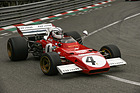
These years were also characterized by wild street battles and duels. The duel between Lauda and Hunt is legendary and was recently the subject of a Hollywood film. Both automobile protagonists from the resulting film "Rush" were there, the McLaren M23 on the one hand and the Ferrari 312 T2 on the other.

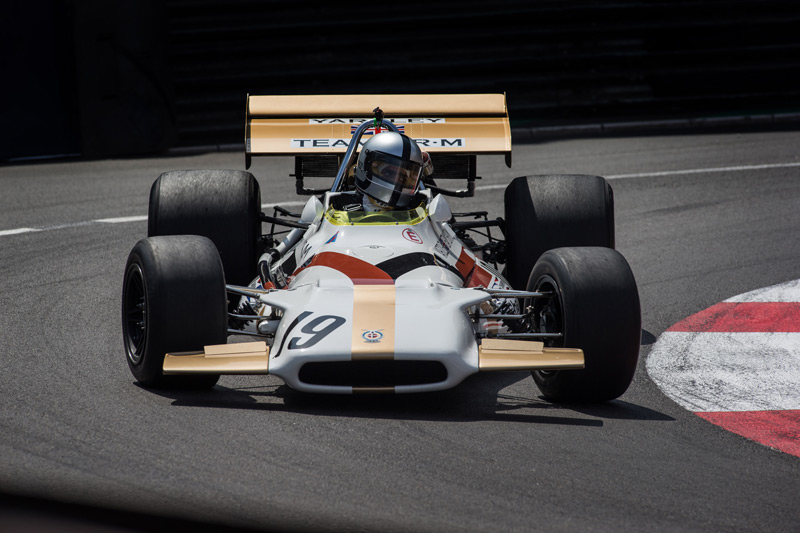
The 18-lap race was no less boring. As a result of Stuart Hall's McLaren M23 in the Yardley colors stopping in front of the casino on the warm-up lap, the field started behind the safety car. The marshals were busy removing the broken McLaren from the track with the crane. When the car was hanging from the crane, the race was released.

The safety car was already turning into the pit lane, but at that moment the McLaren fell off the hook and back onto the track. Red flags flew, race leader Alex Caffi slowed with his hand raised, and the safety car sped back through the pit lane into the field. The result was a mess that could hardly have been better invented. A short traffic jam on the fast uphill section led to a few more minor jostles.
The race was stopped and restarted later. The McLaren became a total loss after what was actually a minor technical problem. Who is responsible for this will certainly lead to various discussions.
An Ensign as race winner
The ex-Regazzoni Ensign N176 with ex-GP driver Alex Caffi at the wheel started from pole position.

For the first time, this car was able to pick up laurels. The Caffi-Ensign duo was by far the fastest combination in the field and won the race ahead of Japanese driver Katsuaki Kubota in the March 761.

Another Regazzoni car that was unsuccessful in its time, the Shadow DN8, finished third with Joe Twiman. Emanuele Pirro finished a frustrated fourth in the second Ferrari 312 B3. Marco Werner drove the sister car with great caution. They weren't really sure whether the engine would withstand the rigors of the weekend, but lo and behold, the car ran like Swiss clockwork.