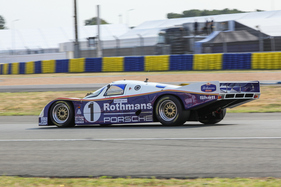


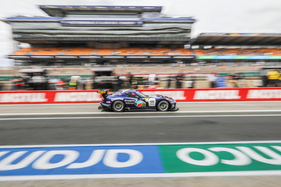
Four days were just enough to properly celebrate the past 100 years of motorsport on the Sarthe. This year's Le Mans Classic from June 29 to July 2, 2023 was dedicated to the big anniversary and therefore took place outside of the usual biennial cycle. Of course, great efforts had been made to make everything a little bigger, more spectacular and more impressive than it already was. Because of the centenary, the normal biennial cycle had even been abandoned.
Nevertheless, it was not possible to have more than 750 racing cars on the track - because 75 cars per starting field is the maximum permitted. The other 50 cars were therefore divided between exhibition runs and demonstration laps.

The most impressive of these was the parade of Le Mans-winning cars from 1923 to 2010: Bentley 4 1/2 Litre, Jaguar D-Type, Ferrari 250 LM, Ford GT 40, Porsche 917, Mazda 787B, Audi R8 - all the celebrities of the last century were there, occasionally behind the wheel. Henri Pescarolo personally drove his Matra MS 680 B around the circuit, just as he did 50 years ago.

But there were also the lesser-known cars in popular culture, such as a Rondeau M 379 B or a Chenard & Walcker 3 Litres Sport. Although the latter does not deserve its shameful existence in the shadow of gulf-blue Porsches and Fords, as it was the first overall winner of the 24 Hours of Le Mans 100 years ago.

As usual, the six open racing classes were divided according to year of construction and era. In addition, there was a separate classification for Group C racing cars, a field for young endurance racing cars from ten years before and after the turn of the millennium and a separate Porsche class, as the record-winning brand from Stuttgart is also celebrating its anniversary this year. New to this eleventh edition of the Le Mans Classic was Benjafield's Racing Club with over 70 Bentleys from the period between the two world wars.

A further 210 one-make and classic car clubs from all over Europe gathered with a total of 8,500 cars at the side of the track to witness the spectacle among like-minded people. A total of 235,000 spectators filled the steel and natural grandstands around the Circuit de la Sarthe - more than ever before at the Le Mans Classic. Many of them arrived in style in historic camper vans, most of them VW-based, of course.

Of course, hardly anyone was careless enough to actually go to sleep at night. Because that's when things really get going at the Sarthe. When the whole of France goes to bed, the ambient noise is turned down and the cool summer night air is filled with nothing but the roaring, screaming and barking of racing engines at the limit - only then do you realize what really sets the Le Mans Classic apart from other historic racing events.

Of course, there were also a few winners. The 1937 Talbot AV105 (Gareth Burnett/Michael Birch) won Grid 1. Grid 2 was won by the 1954 Jaguar D-Type (Niklas and Lukas Halusa). A former Le Mans winner, Emanuele Pirro, won Grid 3 together with Hans Hugenzoltz in the 1959 Lister Jaguar Costin. Grid 4 was dominated by the Ford GT 40; in the end, Diogo Ferrao had the better end for himself and a '65 model. In Grid 5, you had to drive a Lola T 70 to be victorious. David and Olivier Hart did this with flying colors. Maxime Guenat had more luck in Grid 6 with his 1976 Lola T 286 than his opponent in the Toj. The Group C class was won by van Vercoutere and Ralf Kelleners in the 1990 Porsche 962 C. And Emmanuel Collard won the Endurance Racing Legends series in the 2006 Pescarolo C60.