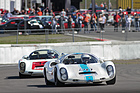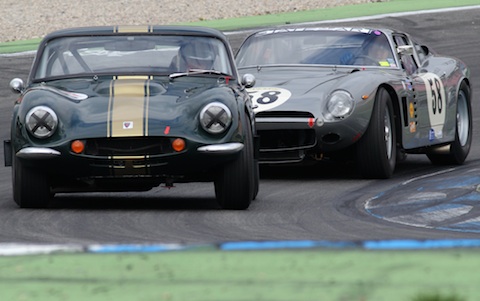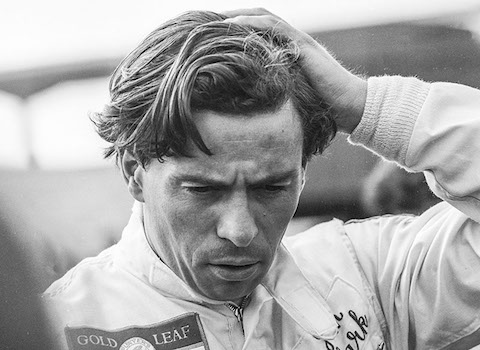
This year's "Hockenheim Historic" was dedicated to Jim Clark, the Scotsman who died mysteriously at this venue 50 years ago. His tragic death led to an immediate tightening of safety measures at the race track at the time. Guard rails then shielded the cars from the trees. Unfortunately, everything came too late for Clark, but it certainly helped other colleagues.
Early summer at last
After years of wet and cold weather, the annual spring event finally benefited from summer temperatures on April 20-22, 2018.

Various race categories were at the start, so that even Saturday ended up as a twelve-hour day with all the little delays. The marshals and all the other helpers were happy when the final chequered flag finally fell shortly after 20:00.
The program offered plenty of "action" and variety, but was perhaps a little overloaded overall.
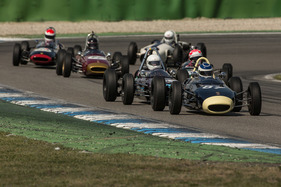
Formula Junior in Swiss hands
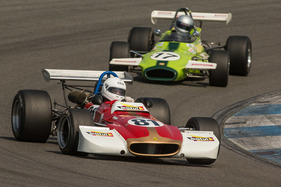
Formula Junior was entirely in Swiss hands. Bruno Weibel won both races with the Lotus 22. In fact, the podium was occupied twice by the same three drivers. Pierre Tonetti came second in the Brabham BT6 and Philipp Buhofer third in the Lola Mk5 A.

Tonetti was unable to maintain his lead after the start in both races. Weibel was able to improve lap after lap to such an extent that he moved up from fourth to first place. Tonetti probably lacked the stamina to take advantage of his lead from the first two or three laps.
Better agile than super strong
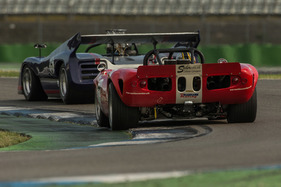
In the CanAm Challenge Cup, it was not one of the high-displacement V8 cars that set the tone, but the Lola T294 with Felix Haas at the wheel drove away from the heavy and wide racing cars like a wild wasp. The two McLaren cars of Henry v.d. Amalien and Peter Schleifer were left behind in the first race.

In the second race, the Wespenach stopped on the ninth of 12 laps in the lead, allowing Georg Hallau in the Lola T310 to cross the finish line ahead of the two McLaren cars driven by Schleifer and Amalien.

Another Swiss victory
The Swiss anthem was played again in the Formula 2 race. Peter Hans drove to two unchallenged start-finish victories.

As in the Lurani Trophy, he relegated the Frenchman Robert Simac in the March 712M and the Swede Torgny Johansson in the March 782 BMW to second place both times.
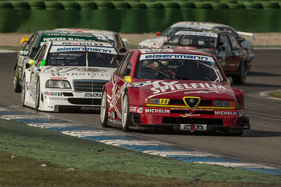
Mercedes ahead of Alfa in the Touring Car Classics
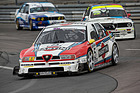
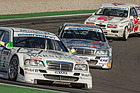
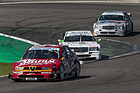
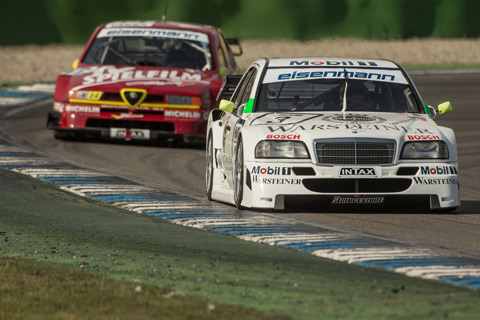
The first round of the Touring Car Classics was won by Jörg Hatscher in the Mercedes AMG C-Class DTM ahead of Stefan Rupp in the Alfa Corse Alfa 155 V6 ITC.

Third place went to a car from the British Touring Car Series, the Renault Laguna BTCC with Alexander Schmidt at the wheel.

This car came from Williams and was currently driven by Alain Menü.
Stefan Rupp secured pole position with the Alfa Romeo in a time of 1:45.605, which meant an average speed of 155.92 km/h.
Christian Menzel's M3 was unable to take part in the race as an engine problem had occurred during practice and unfortunately the cause could not be determined in time. To prevent engine damage, the team decided not to take part in the race. This meant that none of the old hands got behind the wheel for the first race.

Neither Christian Danner, Ellen Lohr nor Roland Asch were in the cars. But that will certainly change in the upcoming races.
Fast Formula 1
The fastest man of the weekend was by far Ingo Gerstl in the Toro Rosso F1-STR1 Cosworth. His pole time was 1:19.664min, which means an average speed of 206.7 km/h.

By comparison, Nico Rosberg set a time of 1:14.363 min in the Mercedes in 2016. Hats off to Ingo Gerstl. Gerstl was able to beat Phil Stratford's Benetton B197 Judd to the podium in the BOSS GP.
Fiercely contested podiums in the touring cars
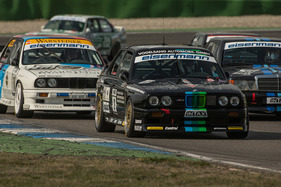
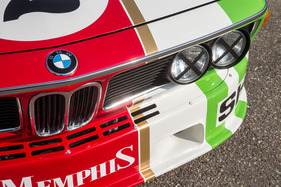
In the Touring Car Revival, Jörg Koslowski won both races in the BMW E46 WTCC, once ahead of Kuno Schär in the Porsche 964 Cup and Thomas Feierabend in the BMW M1 Procar and once ahead of Marcel Höltschi in the Porsche 964 Cup and Diethelm Hornbach in the Porsche 911 2.8 RSR.

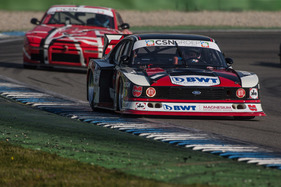
In the Youngtimer Touring Car Challenge, Peter Mücke won all three races with the Ford Zakspeed Turbo "Super-Capri"!

Achim Heinrich in a BMW M1 came second three times and third place went twice to Daniel Schrey in a Porsche 935 and once to Udo Rienhoff in a Shelby Cobra 427.
Extensive supporting program
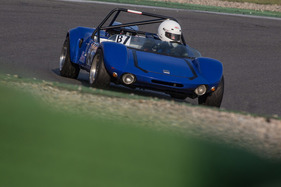
The field of Brixner NSU racing sports cars, which completed several demo laps to mark the 50th anniversary of the Brixner Spyder and the 80th anniversary of Kurt Brixner, was interesting. On April 20 and 21, 1968, an NSU Brixner Spyder, driven by the designer himself, competed in the 4th Heilbronn ADAC Bergpreis for the first time.

Kurt Brixner was 30 years young at the time. You can hardly celebrate an anniversary more precisely than that. In total, Kurt Brixner built around 70 kits of these 450 kg lightweight racing sports cars on the NSU Prinz/TT floor assembly during his career.

They are also powered by the air-cooled four-cylinder engine of the NSU Prinz. He built the cars from scratch 50 years ago and today, at the age of 80, he still restores and maintains his now old cars every day.