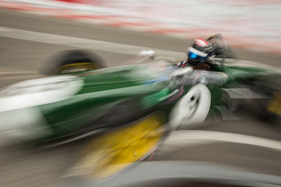
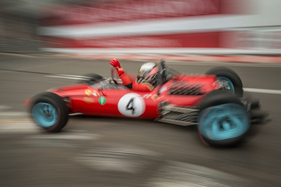
As already mentioned in the picture story , Monte-Carlo has always been worth the trip for me over 50 times, regardless of the fact that a latte macchiato now costs between eight and twelve euros. Since the first race in 1929, the circuit has always been an unparalleled photographic playground. No other circuit offers as many photo spots on just 3.3 kilometers as the Principality. Of course, a lot has changed here too in the last two decades.
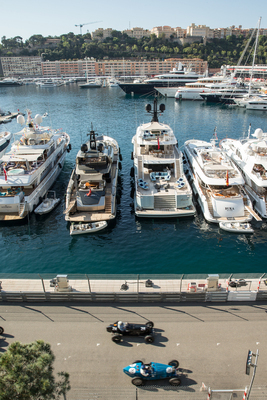
But Monte-Carlo is not only exceptional from a photographic point of view, it is also exceptional from a driving point of view, because nowhere else is every lap a dance between being super fast and getting stuck. Driving between the guard rails is a feat of strength and requires concentration, and not just with the current cars, no, the pre-war category also has to get very close to set times.
The track record is currently held by Charles Leclerc in a Ferrari with a time of 1:12.656 minutes.
In comparison, the Frenchman Thierry Stapts drove the same lap in the 100-year-old Bugatti 35 in 2:27.223 and the Englishman Stuart Hall in the 1982 March 821 needed 1:30.537 minutes. This clearly shows how the technology improved and the cars became faster as a result.
The following explanations show which eras the eight races from April 24 to 26, 2026 covered and who won.
Louis Chiron - All pre-war racing cars
The Louis Chiron series started with 21 cars from the 1928-1939 model years. After the Formula Internationale era from 1926 to 1927, which was still limited to 1500 cm³ displacement, car races were held more frequently as free formulas even then, allowing a larger number of vehicles to participate. This was particularly true of the first Monaco Grand Prix, which took place between 1929 and 1933.
From 1934, the Fédération Internationale laid down new regulations for Grand Prix racing cars.

Grand Prix Sport, which had now become an international competition at the highest level, prompted the Third Reich to use it as a propaganda tool with Mercedes and Auto Union. Other hitherto dominant companies such as Bugatti and Alfa Romeo were quickly robbed of their victories by the German superiority and their Silver Arrows.
In order to survive in the world of motor racing, only small displacement races, the so-called Voiturette, remained, which developed in parallel and often provided the framework spectacle. The emergence of the ERAs, the development of the Maserati 4CLT and the birth of the Alfa Romeo 158 were the result of the dynamics of this category.

The race was won in 1929 by "Williams" (a pseudonym - editor's note) in the Bugatti 35B, 97 years later Patrick Blakeney-Edwards in the Frazer-Nash now surprisingly took the laurel wreath after Richard Bradley's Maserati 4CL, which had long been in the lead, dropped back to 5th place. Swiss driver Fritz Burkard narrowly missed out on the podium in fourth place in the 1933 Alfa Romeo 8C Monza.
Juan Manuel Fangio - From the end of the war to 1961
This series commemorates the Monaco Grand Prix, which was held between 1948 and 1960. This era was initially characterized by the dominance of front-engined monopostos and later, in 1957, by the emergence of the first mid-engined cars. These then gained the upper hand from 1958, with the monumental victories of Sir Stirling Moss in Argentina and Maurice Trintignant in Monaco.

The California-born Scarab of Mark Shaw was unbeatable in this series, driving home a clear start-finish victory from pole position. The Scarab was presented as the first American F1 semi-finished car at the 1960 Belgian Grand Prix, but never raced and now it won the historic version of the Monaco Grand Prix.
Graham Hill - F1 1961-1965 and F2 1956-1960
Graham Hill's name barely appears in most lists of top drivers. But not only was he the first to win Monaco five times (1963, 1964, 1965, 1968 and 1969), he also became a two-time F1 World Champion and is the only one to date to have achieved the Triple Crown, which means that he won the Monaco Grand Prix, the Indianapolis 500 and the 24 Hours of Le Mans. In addition, his son Damon also became F1 World Champion in 1996. It is only right that Graham Hill gets his own series in Monaco.
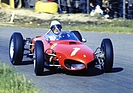
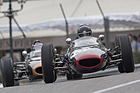
At the beginning of the sixties, the great era of the 1500cc monoposti began. Small, lightweight racing cars, which from today's perspective almost looked like children's cars, were on the grid. In 1960, a Lotus racing car won a Grand Prix for the first time. Sir Stirling Moss left nothing to chance with the Type 18, privately entered by Rob Walker, and distanced the entire competition.

Behind the 12-cylinder Ferrari 1512, driven by Joseph Colasacco and victorious in 2026, there were also two Lotus cars on the podium, albeit Type 21s. And once again, a Swiss driver narrowly missed out on the podium: Philipp Buhofer finished fourth behind the American Colasacco and the two Britons Mark Shaw and Stuart Hall.
Vittorio Marzotto - 1952-1957
In 1952, the FIA pushed through its efforts to abolish versatile racing cars with and without fenders, which could be used in both Grand Prix races and sports car races. In order to achieve this, it was stipulated for international sports car races that the fenders had to be an integral part of the vehicle frame.
In the same year, the organization in Monaco dispensed with the race with the monoposti for a single time. Instead, sports cars with an engine capacity of over 2000 cc started the Grand Prix on Sunday. This was won by Vittorio Marzotto in a Ferrari 225S, while vehicles under 2000 cc competed for the Monte Carlo Trophy the day before, with the winner Robert Manzon in a Gordini 15S.

This year, a large field of 29 sports cars started the race. Despite the limited space, the 1948 to 1957 models were very well-mannered. The fastest driver was number 48, the American Franco Valobra in a Ferrari 750 Monza built in 1955.
Jackie Stewart - 1966-1972
In the second half of the sixties, the "schnapps class" of 1500 cm³ was increased again to three liters. In 1966, the later three-time world champion Jackie Stewart won his second of a total of 27 Grand Prix in the Principality in the BRM P261 with the 2-liter V8.

An ex-GP driver should have been on the grid in this series, but a slip-up in the first practice session prevented Jean Alesi from taking part in the 1969 Ferrari 312. Although the car was made ready for use again overnight, it was decided not to qualify and start the race after a few warm-up laps.

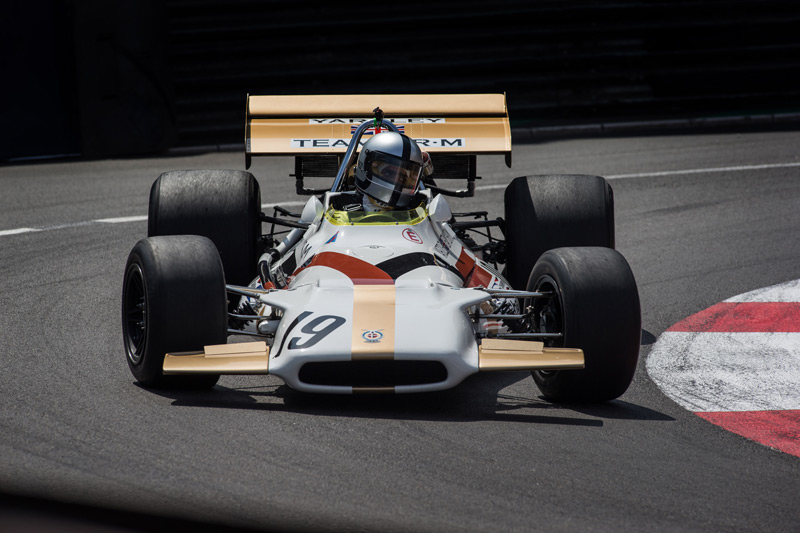
This cleared the way for the Surtees with Michael Lyons at the wheel. Philipp Buholzer was now able to secure a podium place after all and finished a strong third after a solid drive in the 1970 Brabham BT33.
Niki Lauda - 1973-1976
The unforgettable Austrian Niki Lauda, like the Scot Jackie Stewart before him, was also able to climb onto the podium twice (1975 and 1976) with the then Prince Rainier.

This year, however, Ferrari was unable to shine. British driver Stuart Hall won in a 1973 McLaren M23, while the Ferrari 312 T2 that won 50 years ago with Lauda at the wheel finished eighth with American Chris Macallister. The best Swiss driver was ex-GP driver Jean-Denis Deletraz in the 1974 Shadow DN3 with a sixth place.
Gilles Villeneuve - 1977-1980
In 1981, the crowd favorite and completely fearless Canadian Gilles Villeneuve won the Grand Prix in a Ferrari 126C, for the first time with a 1.5 liter turbo engine. Back then, the so-called turbo-hole was still so brutal that Nelson Piquet once said: "Just a millimeter too much throttle before the car straightens out and you immediately go in the opposite direction. 1977 was the year when F1 racing cars developed in a completely new direction due to the ground effect, which is still the measure of all things today. March took the first small step with the 701 in 1970, which Colin Chapman then took up and pushed to the extreme. The Lotus 78 was the first real "wing car", with the wing profiles under the sidepods inverted in comparison to the airplane.

One of the biggest surprises of 1977 in the Principality was when the South African Jody Scheckter in the Wolf WR1 was able to greet the Prince as the winner. A team competing for the F1 World Championship in its first year of existence was unique.
In 2026, the Wolf did not quite make its mark again, finishing 21st with the German Christian Kirk.

Instead, Michael Lyons won with the Hesketh 308E from 1977. Only the Frenchman Frederic Rouvier had any chance of keeping up with the Brit with the Tyrrell 010 from 1980.
Ayrton Senna - 1981-1985
Who doesn't remember the unforgettable Brazilian steering wheel virtuoso who came out on top six times (1987, 1989, 1990, 1991, 1992 and 1993) in the Monegasque street battle. He would actually have won in his first F1 year in 1984 in the inferior Toleman, had the race in the rain not been unnecessarily stopped in favor of Alain Prost. With the exception of Tyrrell and Arrows, everyone was already racing with the 1.5-liter turbo engines, which didn't make things any easier on wet roads. The German Stefan Bellof in the Tyrrell-Ford V8 was able to keep up with Senna in the lighter, but also weaker car. Two new heroes were born in this race, both of whom unfortunately later died in accidents.

In 2026, Stuart Hall won the last and therefore fastest race over 15 laps with the March 821 from 1982, with a car that could only be classified as a "distant second" at the time.
The historic Monaco event with no fewer than 149 F1 cars from 1950 to 1985 is absolutely unique in the world. Of course, the races are not a sensation, as the drivers' driving skills mean that the fields line up early on and hardly change. Whoever takes pole position always wins the race without any technical problems, often even with cars that were severely inferior during the active period. Of course, not all cars are as meticulously and perfectly prepared as those that end up fighting for the podium.

In the previously published picture story, a completely different kind of weekend is shown. Monte Carlo is and remains the photographic hotspot of racing, even though so much was lost due to all the fences. The sea view has also been severely restricted today. Ten years ago, half of the track ran directly past the sea, but the sea has now been filled in and pushed away from the track. Numerous new apartments have now been built and occupied in the Portier corner, where Ayrton Senna gave away an important Monaco victory in 1988, not entirely through his own fault. If the Brazilian had also won in 1988, when he was slowed down by the team and thus lost his flow and concentration, all the victories from 1987 to 1993 would have gone to him. But the mishap happened on this corner.

Unfortunately, the track layout was not routed around the new settlement back along the sea as originally planned. It is debatable whether the Grand Prix is still justified today, as it is no longer possible to overtake with the current cars and the races have become a procession. However, the tightrope act of shooting through this bottleneck with the 1000 hp monster is "simply brilliant", at least in qualifying. You can only take your hat off to these guys.