"Tipferlscheissen" is what four-time Monte Carlo Rally winner Walter Röhrl calls the classic car rallies that sprout up like mushrooms after a summer downpour. Event companies - often blessed with neither historical nor current motorsport knowledge - are often the organizers. With fancy-pants offers and lots of celebrities, they vie for the favor of classic car owners. In brochures advertising the event, the glittering white pages tell of culture and social ambience, of a breathtaking "up and down" cultural trip according to the road book, of drivers' briefings, Kempinski hotels, of celebrities and gala evenings and of sinfully expensive luxury cars.
Which owner of a classic car who has been personally contacted does not feel flattered, pay a few thousand euros or Swiss francs entry fee - including a welcome aperitif - and can then finally count himself among the exclusive scene of classic car rally fans.
Decorated with lots of clocks, twin and speedmasters - electronic ones, of course - they then stand covered in white dust caps at so-called special stages in the center of the spectators, who are either pale with envy or in awe. After 100 meters of driving, a specified target time must be met. To the nearest 1/100th of a second. Crawling over the tube that triggers the time measurement with a front wheel in the right blink of an eye is the difference between victory and defeat. The special "Blind Man's Buff" test also demonstrates a bold pioneering spirit. Blindfolded and following the loud commands of the co-driver, the "blind cow" is also part of the repertoire that commands respect.
As we all know, taste is debatable! But still. There is also driving. From high-class pub to high-class pub, from 5-star hotel to 5-star hotel, where disgusting plastic trophies are brandished in species-appropriate uniforms, fogged by the champagne mist. This historic rally scene knows how to celebrate!
A rally in Styria for die-hards
But then, in the middle of winter, an organizer from Styria in Austria appears on the scene, talking about a 700 km long Winter Classic, a very sporty event, deliberately simple regulations, maximum driving fun and lots of enjoyment on absolutely wintry roads, classic car sport without the usual seconds. The race should be measured in minutes and seconds. A speedometer and stopwatch will suffice. GPS is responsible for the official time. Good nerves and vehicle control are required, as is meticulous preparation of the vehicle for snow and ice. And special stages will be held on historic routes of the former "Austrian Alpine Drive": Hiaselegg, Lonschitz, Eibeggsattel, Salzstiegl ... where the former aces Paddy Hopkirk, Sobieslaw Zasada, Rauno Altonen, Björn Waldegaard, Hakan Lindberg, Hannu Mikkola, Per Eklund, Bernard Darniche, Alcide Paganelli, or the very young Jean Todt - as co-driver alongside Achim Warmbold - wrote history.
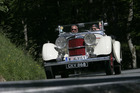
This competition appealed to me. My last winter rally - the "Monte" - was 30 years ago. It still covered over 2,000 km and the 350 starters tried to qualify for the "Night of the Long Knives" in a merciless elimination race. I wanted to get to know this Aflenzer Winter Classic and decided to sign up. The vehicle - an Alvis Speed 25 from 1936.
"Start into the white hell"
Aware of the fact that this unlicensed rally is subject to the Road Traffic Act and stipulates target times of under 50 km/h - which means that fastest times are not an issue - I nevertheless believed that the organizers were right to call it a very tough rally. Maintaining a 50 km/h average speed on steep and nervous mountain roads in places doesn't sound like a coffee run, and certainly not in a 75-year-old car with rigid axles, cable brakes, weak lights, no differential lock, no roof and no heating. Not to mention ABS, ESP ..... Of course, there are also plus points: The 3.6-liter Alvis engine with high torque - superbly overhauled by Edy Schorno from Küssnacht - the 19-inch wheels with a tire tread width of only 10 cm, the screwed-in spikes, the solid underbody protection.
A few days before the start, I drove routes from last year's Aflenzer, familiarized myself with the geography of Styria - thanks to 3D - and the most important trump card: the weatherproof Manfred Tragner, a local co-driver from Styria, had already agreed to join me a long time ago. Although he was sitting in the hot seat for the first time - in the Alvis it would be more accurate to call it a cold seat - Manfred navigated practically flawlessly.
On February 18, we confidently faced the starter in Aflenz, additionally equipped with cold-resistant clothing. Helmets and an intercom system were also part of the equipment. We did without a Twinmaster. The logbook consisted of 10,000 and 20,000 maps. Two mechanical stopwatches were sufficient. The mileage counter didn't promise much help - Alvis is English - and we gratefully declined the "floor heating" offered by our colleague Edy Schorno.
One more thing about the space in the Alvis: it was cramped, very cramped. Manfred could hardly find room for his tickets. The folder and shrink-wrapped tickets provided by the organizer were too big. Joseph Prein's efforts were in vain. Our clothes simply took up too much space and somehow I had to turn the steering wheel, which was at least possible with my right hand! On the other hand, Manfred had to endure many an elbow bump when counter-steering. Incidentally, the Alvis is right-hand drive. And this too: It has no trunk. The two batteries took up the small storage space behind the backrest, the chains found space in the passenger footwell, as did the jack. We stuffed a few tools under the seats. We had to do without the spare canister for fuel, as well as such "useless" items as high-visibility vests, a first-aid kit and a thermos flask filled with hot tea. There was room for a few energy bars in the windbreakers. But we didn't find the time to eat them!
We still had an assistant on call. A Puch G with driver Christian. But this additional help was useless. The all-terrain Puch had no chance of following us and we had no time for strategic discussions on our cell phones. So we started as number 001 - on our own - in front of the Hotel Karlon in Aflenz. The trip into the "White Hell" began. This about the start number: That Joseph Prein only assigned us the number one to play the snow plow for Maserati, Porsche, Ford Escort, Volvo, Mini Cooper turned out to be a rumor!
As soon as the race had started, the Föhn winds swept across Styria, turning the snowy roads at lower altitudes into puddles and ruts. The black-ploughed Pretalsattel between Turnau and Veitsch offered neither driving nor navigational problems and the subsequent 1099 meter high Alpl from Murtal over to St. Kathrein am Hauenstein was probably intended more as a warm-up route. But then things really got going.
From the Roseggerhof to the Rettenegg on the Pfaffensattel
The route on a beautifully ploughed alpine path from Roseggerhof near St. Kathrein am Hauenstein to Rettenegg am Pfaffensattel was a real treat. Here, in the homeland of the Styrian poet Peter Rosegger, we felt the greedy, hot maw of a Porsche 911 for the first time. Such things on my neck stressed me out when I was young. So I gave him the road, only to realize immediately that this sports car, over 35 years younger, was also looking for adhesion. We followed him and were able to experience from the "comfortable armchair" how the rear-wheel drive car danced from one side of the road to the other, while the Alvis held the lane calmly in 4th gear thanks to its high torque. At a junction, the Porsche co-driver made a mistake and we had a clear, less stressful drive to Rettenegg and on to the finish of the 26.3-kilometre special stage in St. Jakob im Walde.
Drifting on "ball bearings"
A very varied route started in the north of the town of Weiz. From Naas - at the entrance to the famous Weizklamm (gorge) - the snow-covered route wound up to Gschaid in the forest, ran over snow-covered alpine pastures and a little later led down to Arzberg in fast passages.
In the meantime, the Föhn storm had continued to wreak havoc. The roads and little streets that had been snow-covered just two days ago had become bare. There were tons of grit on the roads around the 1445 m high Schöckl in the Graz mountains. Grit and spikes for a change. In any case, it was easy to drift on these "ball bearings" - with a lot of feeling and respect, of course. I don't remember any dicey situations.
Unfortunately, on the way back to Hochsteiermark, the Teichalm on the Hochlantsch had to be bypassed via Gradengg and the 1161-metre-high Strassegg. Snow drifts blocked the crossing.
After around 300 kilometers, we reached the finish of the first stage in Aflenz, slightly frozen. A hot bath beckoned and then many conversations around the table. Everyone had their own personal stories to tell, just as the organizer wanted: "The Aflenz Winter Classic is perfect for sporty riders who want to experience and ride a lot and maintain friendly contacts".
At the Eckwirt
The second stage, or the 400-kilometre ride, really began with the ascent on the northern side to the 1001-metre-high Eibeggsattel. Both the evening before from the south and now from the north, we missed the target time by a few seconds. Allerheiligen im Mürztal is the starting point, St. Jakob-Breitenau the finish. A super special stage that has everything a license-free rally can offer. Completely off the beaten track, narrow, tight bends, fast twists and turns, a spectacular pass crossing, a highly demanding descent, with little edge protection, icy. Thank spikes!
Another highlight was a 15-kilometer-long, narrow lane covered with packed snow. We set off from Rothleiten an der Mur via Altenberg and via the Arzwaldgraben to Waldstein on the E57. While the uphill sections were really fast and easy to drift thanks to the controlled load changes, the character of this 20-kilometre-long special stage changed abruptly on the downhill sections. Steep without edge protection. Pointed bend after pointed bend. The Alvis understeered as expected. I couldn't use the handbrake as a cornering aid. The wire ropes caused all four wheels to lock. So I entered the bend slowly, pressed the clutch and waited until the front tires gained grip and thus determined a drivable curve radius. But even such ramps had their end and then it was back to the finish in Waldstein. We missed the target time by two minutes - but what the heck.
From Waldstein, the Aflenzer then moved north of Köflach into the well-known rally area around Geisthal, Kainach, Graden and Salla. The crossing at Eckwirt is particularly spectacular. From Kainach, the narrow road leads about 10 km uphill and turns sharply to the right at the Eckwirt across a wide square, immediately leading into a right-left combination and then steeply downhill towards Graden.
The innkeeper couple must have been advertising the Winterclassic. In any case, it felt like the Turini crossing on the "Monte". Not thousands, but a large number of fans welcomed us - cheering us on, driving us on.
After a hearty snack, I memorized the ideal line and the Alvis drifted across the course into the narrow descent thanks to spikes, grit, snow and its 150 hp. For once, an older gentleman is allowed to relive his youthful years by fractions of a second! At least that's how I apologized to Manfred.
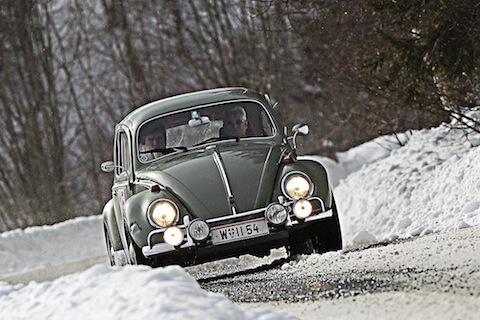
And once again it got very exciting: at the Obdachsattel south of Weisskirchen. The organizer had found a deep snow-covered lane here in Kleinprethal. The 14% gradient unsettled us. But we took on this challenge too. And it worked. The deep tread of the retreaded tires really clawed their way into the soft snow. Only the VW, driven by four-time Klausen racer Erik Skreiner, had to let us go.
Snowstorm on the Hiaslegg and Lohnschitz
When I heard the rumor in advance that the Hiaslegg and Lonschitz passes known from the time of the "Österreichische Alpenfahrt" were to be ridden, I was looking forward to these two routes and took a close look at them. Needless to say, I did not write a prayer book. Those days are over, apart from the fact that the target time here should also be 50 km/h.
In Trofaiach near Leoben, we changed the batteries - the alternator had died - so that we would have enough energy to start into the Rötztal. But after less than 10 minutes of riding, a vehicle came towards us, followed by others. All with plenty of lights. No doubt about it - they were rally cars. We stopped and were told that the narrow road at the top of the pass had become impassable due to wind drifts. We had no choice but to turn around and drive to the finish in Aflenz. The route following the Hiaslegg over the so-called Lonschitz with the start in St. Katharein was also blown over. We felt like we were at the 1973 Monte Carlo Rally when the German Klaus Fritzinger flew out with his Ford Capri on Burzet's "Spéciale". The start of the other competitors was interrupted and within a very short time, the narrow fairway was blown over. All those who did not start were disqualified and sent home. The scandal was perfect.
Of course, Joseph Prein did not go that far. The two special stages were canceled. Period. And so those who had escaped the "white hell" arrived in Aflenz and were able to enjoy a simple, cordial ranking announcement over a delicious dinner at the Hotel Karlon.
Matthäus Russegger/Otmar Schlager in a Ford Escort RS were awarded the winner's trophy, just like in 2011. They lost 44 minutes on the total target time. Leo Birke/Max Birke in a Fiat 128 followed 16 minutes behind and Erik Skreiner/Philipp Mittelbach in third place had already lost over 35 minutes. A triple victory for the Austrians.
The Swiss Edy Schorno/Christoph Betschart in a Maserati Mistral were able to prevent Austria's total success with their 4th place, while the fastest Germans Felix Hess/Kirsten Hess in a BMW 2000 took 13th place. But let us quote the organizer Joseph Prein: "The Aflenzer-Winterclassic is a classic rally like in the old days, which is based on the old rally routes, where arriving was and is already a victory."
And finally this
The Aflenzer-Winterclassic takes place in an area untouched by traffic. It is tough, very sporty but fair. The selected snow tracks require driving skills, a well-prepared vehicle and an understanding of capricious weather conditions. And then the Aflenzer is a lot of fun. New stories can be told and written.
Of course, as everywhere, there is room for improvement. The following could be considered: a more compact course, driving individual sections twice, lower target times on the overpasses and marking the start and finish of all special stages. And then perhaps this: Opening up a class for vehicles built up to 1946 - with the most difficult special stages omitted - would attract fast sports cars from the pre-war era and raise the profile of the Aflenzer. And it deserves more publicity - the Aflenzer Winter Classic.
Technical details of the Alvis Speed 25 from 1936
- First registration: DKC 731
- Manufacturer: Alvis Car & Engineering, Coventry
- Chassis number: 13661
- Car number: 18/480
- Engine number (first engine): 1/ 072
- Engine: 6 cylinders in line / 3571ccm / 83mm x 119mm, 3 SU carburetors, approx. 150 hp
- Transmission number: 1779
- Transmission: 4-speed, fully synchronized
- Ignition: Battery and solenoid
- Firing order: 1 5 3 6 2 4
- Front axle: Independent suspension, leaf springs, friction shock absorbers
- Rear axle: rigid axle, leaf springs, friction shock absorbers
- Brakes: drums, cable
- Rims: 19 inch
- Tires: front 4.5.00 / rear 6.00
- Top speed: 180 km/h
- Engine overhaul: Edy Schorno, Küssnacht (CH)
- Cylinder head overhaul: Ingolf Engel, Strassberg (D)
- Bodywork: Sepp Wagner, Bad Ragaz (CH)
- Winter tire vulcanization: Pneu Egger (CH)
- Studs: Pneu Tschümperlin, Seewen (CH)
Ranking list class up to 1946
| Rank | Vehicle | Year of construction | Crew | Diff target time |
|---|---|---|---|---|
| 1 | Alvis DKC 731 | 1936 | A/Brägger Bernhard /CH , Tragner Manfred / A | 2:31:00 |
Ranking list overall classification post-war vehicles
| Rank | Vehicle | Year of construction | Crew | Diff target time |
|---|---|---|---|---|
| 1 | Ford Escort RS 2000 | 1976 | Russegger Matthäus / A , Schlager Otmar / A | 0:44:00 |
| 2 | Fiat 128 | 1977 | Birke Leo / A , Birke Max / A | 1:00:04 |
| 3 | VW Beetle | 1959 | Skreiner Erik /A, Mittelbach Philipp / A | 1:19:12 |
| 4 | Maserati Mistral | 1966 | Schorno Edy / CH , Betschart Christoph / CH | 1:24:19 |
| 5 | Porsche 911 | 1965 | Haberl Michael / A , Theresa Moser | 1:52:58 |
| 6 | Volvo 122 S | 1965 | Pierer Gert / A , Rettenbacher Martin / A | 2:10:02 |
| 7 | Porsche Carrera 3,0R | 1976 | Gattiker Adrian / CH, Reto Andris / CH | 2:15:02 |
| 8 | VW 1303 | 1972 | Weckerle Pius / A , Christian Baier / A | 2:15:05 |
| 9 | VW 1302 / S GT | 1970 | Peters Wilfried / A , Mitterdorfer Christian / A | 2:21:56 |
| 10 | Porsche 924 | 1979 | Irger Manfred / A, Patsch Peter / A | 2:26:03 |
| 11 | Cooper S 1275 | 1972 | Huber Robert / A , Schätzinger Günther / A | 2:47:28 |
| 12 | Ford 1600 Sport | 1976 | Pehersdorfer Kurt / A , Haiböck Bernhard / A | 3:09:12 |
| 13 | BMW 2000 touring | 1971 | Hess Felix / D , Hess Kirsten / D | 4:01:15 |
| 14 | Rover P6 | 1972 | Perger Gerhard , Gottschlich Roman / A | 4:17:03 |
| 15 | Mercedes 450 slc | 1979 | Wanker Willy / NL, Pan Peter / D | 6:05:59 |
| 16 | Opel Kadett D | 1979 | Student Gerd / D , Schröder Michael / D | 11:09:42 |
| 17 | Porsche 356 B | 1960 | Maszynski Stefan / D , Marek Thomas / D | 12:02:39 |
| 18 | MG Midget | 1969 | by Kreisler Thomas / D, Grünberg Peter / D | 13:40:07 |
| 19 | Land Rover 88 SII | 1960 | Peterhans David / CH , Bütler Romy / CH | 14:57:36 |
| 20 | Alfa Sud 901 F | 1978 | Staudt Rainer / D , Krieg Jürgen / D | 15:05:34 |
| Fiat 128 3P | 1978 | Dlugos Heiko / D , Marc Dennerlein / D | retirement | |
| Porsche 924 | 1979 | Gesslbauer Johann / A , Gesslbauer Ulrike / A | retirement | |
| Autstin A30 | 1956 | Rohrmoser Michael / A , NN | did not start | |
| Porsche SC | 1978 | Trommelschläger Gerold /A, Marlies Grass / A | not started | |
| Ford Escord | 1976 | Wenger Peter / A, Dominique Wenger / A | did not start |
Ranking list "Red group classification"
| Rank | Vehicle type | Year of construction | Crew | Diff target time |
|---|---|---|---|---|
| 1 | Volvo | 1987 | Z/Aigner Christoph / A , Schmölz Thomas / A | 1:21:15 |
| 2 | Audi Quattro | 1982 | Z/Bruckner Ernst / A , Bruckner Gabriele / A | 2:47:40 |
| 3 | Audi Quattro | 1985 | Z/Schwarz Dieter / A , Wölfle Michaela / A | 7:54:23 |
| 4 | Rover classic | 1980 | Z/Knoll Jürgen / D , Knoll Johanna / D | 7:58:24 |
| Audi Quattro | 1984 | Z/Stoschek Michael / D , Dieter Hawranke / D | retirement | |
| Alfa Romeo GTV | 1986 | Z/Seliger Roland / D , Schulte Dirk / D | did not start | |
| Lancia HF Integrale | 1989 | Z/Rauter Friedrich / A , Senft Alfred / A | not started |