While it was still held on the old concrete track for the first few years, everything has changed somewhat in the meantime. The great old wooden grandstand gave way to the modern Dorint Hotel. The racetrack was given the new Grand Prix circuit, which to this day - like almost all new racetracks - is photographically reminiscent of a never-finished construction site in the background. Only the Nürburg still towers over the track, and thankfully the old paddock did not have to make way for modern architecture. Not so long ago, the plan was to turn the great and simple racing temple into a Las Vegas-style gamblers' paradise, but this was a complete flop and ended up swallowing up an incredible amount of taxpayers' money and leaving behind many expensive ruins.

On the initiative of the car museum in Salem on Lake Constance at the time, Hubertus Graf Dönhoff invited the owners of classic sports cars to the "Nürburgring Show" at the traditional circuit in the Eifel in August 1973, because "sports cars belong on the race track and not in a museum." As many as 63 owners of historic racing cars and the riders of 40 motorcycles from various countries once again drove the classic racing and sports vehicles against the stopwatch at the "Nürburgring Show" - a proper outing on the terrain for which the vehicles from 1904 to 1959 were once built. Some of the later classics were only 14 years old. In the seventies, everything was still like it was in the fifties: you started in front of the wooden grandstand and still used the concrete loop of the Ring with the south bend.
A true summit meeting
The 50th staging of the event, now known as the "Oldtimer Grand Prix", had to contend with a few internal disputes in the run-up to the event, which probably meant that not all of the starting fields were filled. Nonetheless, racing was on offer, just the way we like it. The 500 or so historic racing cars from almost all eras were enough to thrill the 50,000 or so spectators over the three days.

This year's sporting program once again featured a successful mix of German and international racing cars. Domestic motorsport history was represented by the huge starting field of the "Touring Car Golden Era", which included many unforgettable DTM and STW cars. Old hands such as Kris Nissen, Olaf Manthey and Roland Asch, who shared the Ford Sierra RS 500 Cosworth with his son Sebastian, were also at the wheel. In the end, however, it was the Swiss Michael Kammermann in the 1976 BMW 3.0 CSL who stood at the top of the podium. Fitting for the 50th anniversary of the coupé first entered by the new M GmbH in the 1973 touring car championship.

The races of the DRM Revival, which saw a true summit meeting of Group 5 cars, also made for bright eyes. Ralf Kellners in the De Tomaso and Stefan Mücke in the Zakspeed Capri shared the victories.

The right tire window doesn't matter here, there is no telemetry. The driver still decides the outcome of the duel. Sometimes the gear doesn't go in, sometimes you don't hit the apex as desired, and on the straights the health of the vehicle is always checked lap by lap. The 23-year-old Horatio Fritz-Simon started his career eleven years ago in the same karting team as Max Verstappen and emphasized the driving demands of the classics: "These cars are much less forgiving. Today, young drivers start straight away with slicks and all the aerodynamics. They no longer get any feel for the mechanical grip of a racing car."
Honor to whom honor is due
Saturday was by far the main day, with the engines roaring around the race track from early in the morning until late at night. The 60-minute race into the night is and remains the atmospheric highlight of the event, which ends with the fireworks. At the end, the fans celebrated all the participants by waving their cell phone flashlights like famous rock stars at a concert. After all, in the smoke-free age of e-cigarettes, hardly anyone has lighters with them anymore.

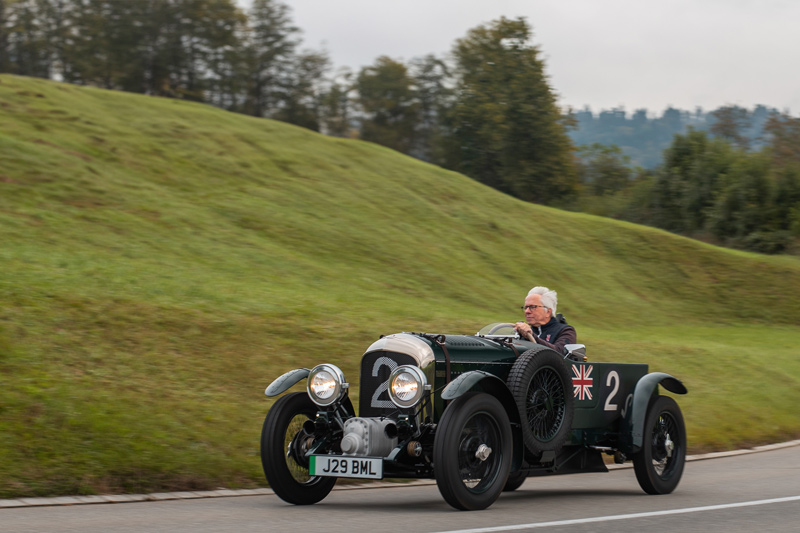
The organizers had prepared a special tribute for the most loyal and therefore only participant in the event, who has taken part in the OGP every year since its debut in 1973 in his pre-war BMW 328: Uli Sauer from Iserlohn. The Nürburgring and the event community dedicated a tree to him on Rolf-Stommelen-Strasse, the connecting path between the historic paddock and the modern Grand Prix paddock, where a special avenue honors selected people with a very special connection to the Eifel circuit.

It is also already certain that the most traditional and largest German racing event for historic vehicles will continue. The 51st AvD Oldtimer Grand Prix is expected to take place at the Nürburgring on the second weekend in August 2024.