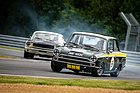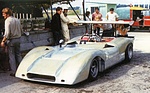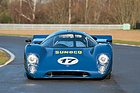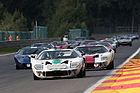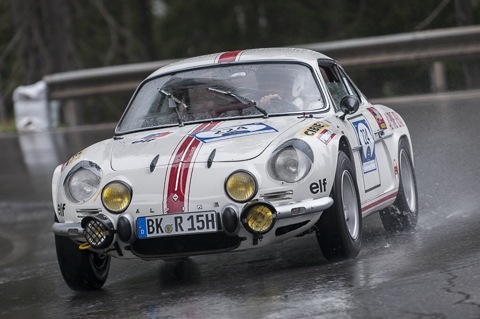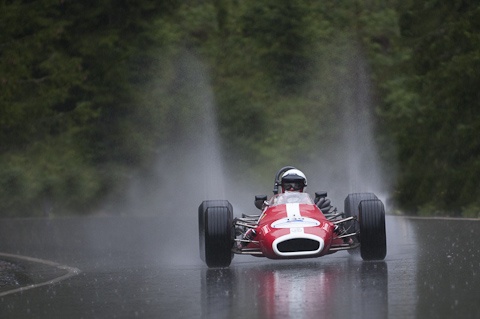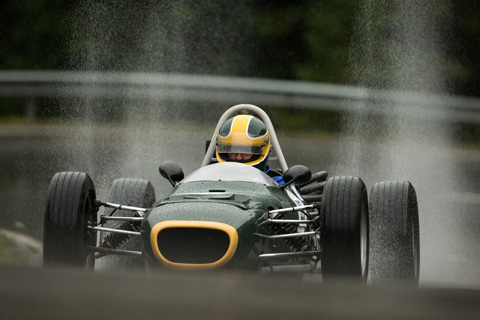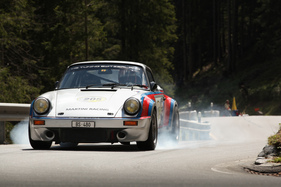
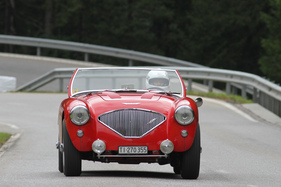
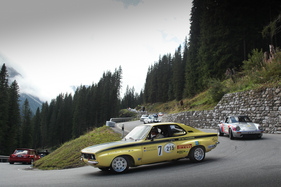
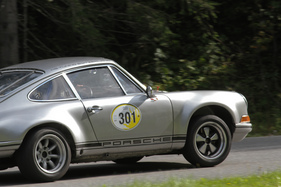
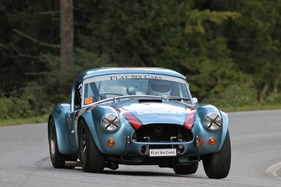
The Arosa ClassicCar Hill Climb took place for the eleventh time from 3 to 6 September 2015 and once again the organizers were not entirely lucky with the weather. Around 160 temperature- and moisture-resistant racing drivers took part with their sports and racing cars to compete on the seven-kilometre-long winding course.

Old track, new chicanes
Hardly anything has changed on the basic route from Langwies to Arosa. As before, the "Nürburgring of the Alps" leads from around 1400 to almost 1800 meters in fast twists and tight hairpin bends.

On the way, there is the famous downhill section to master, which, as in previous years, has been somewhat defused with a chicane. For the first time, there were also barriers in the way of the riders in the finish area, which led to lower average speeds and a slowdown in the finish area, probably introduced from the experience of previous years.
"It will cost a few seconds," said one of the participants.
Changeable and cool weather
However, the weather affected the brave drivers more than the track safety. While it remained dry all day in practice on Friday, the race runs on Saturday required a sensitive foot on the gas on a very wet track. On Sunday, it was drier again and, according to the weather forecast, should have remained rain-free, but the track got wet in between and it was very cool with temperatures of around five degrees, which didn't really make the tires grip any better.

As a result, some of the top riders, including local hero Roger Moser on Saturday, skipped a run here and there when they felt confident.
And those who did race usually had to contend with different track conditions at the bottom and top. But it remained cool to cold even for those who stayed in the paddock above, with temperatures of five degrees Celsius or less, some were glad to be able to go into the catering tent.
Bodywork damage
The difficult conditions on the track and occasional technical problems unfortunately led to a few mishaps. The worst was a Porsche driver who, after having to park his car in a hairpin bend, was hit almost immediately in the side by an Austin-Healey. You think the advantage of hillclimbing is that you're alone on the track and then your car is undulated in front of your eyes. Fortunately, there was no (expensive) bodywork damage and no one was injured in other accidents (including Alfa Romeo, Mini).
Rarities on the track and in the paddock
In 2015, the Arosa Hill Climb once again featured vehicles that you don't see everywhere. For example, an Aston Martin DB 2/4 Bertone Competition Spider from 1953, a rarity with attractive curves, caught the eye.

Urs Beck once again competed in his original 1954 Shelby Cobra 289, while Toni Seiler again relied on the power of the 1966 Lola T70 Spyder Mk 2.

The three De Tomaso Pantera, which competed in different classes, had an inspiring effect on the audience.

The Ardun Allard J2 from 1951, which still breathed the spirit of the pre-war era with its free-standing fenders, was more for connoisseurs, especially the Healey X1 Red Bug from 1946, which some spectators had certainly seen for the first time.
Unfortunately, some of the registered vehicles did not take part in the race and Zumtobel and his notoriously fast 1966 Porsche Carrera 6 did not take part in 2015. What a pity!
Helpfulness written in capital letters
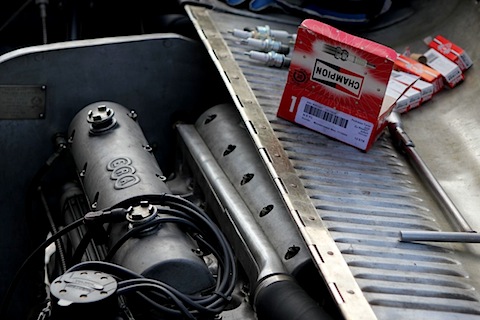
It's certainly not just about winning in Arosa, camaraderie and helpfulness are just as important, as one example impressively shows. Claudia Franceschetti had problems with her Austin-Healey 100/4 BN2, which on initial inspection turned out to be carburetor problems. The diagnosis was made quickly, but where do you get replacements for SU carburetors in such a short time?

Hans-Jörg Good heard about the mishap and reported that he probably had such spare parts in stock at home (in Bad Ragaz). And he takes it upon himself to drive home during dinner and pick up not just one, but two replacement floats for the SU carburetors. Long after dark, Stefan Furter sets off to install one of the floats, only to soon realize that the second one is gone too. Thank goodness Good had thought ahead and with the second spare part installed, the Austin-Healey ran as before, so Claudia Franceschetti was able to enjoy all the races instead of watching.
Beaming winners
In contrast to most other classic car events, Arosa ClassicCar remains a race that is all about seconds or fractions thereof, despite all the camera work.

As in the previous year, Roger Moser was ahead in his 1983 Martini-BMW Mk2B Formula 2 and set the best time with 14:18.54 from three timed runs.

He was followed in second place by Toni Seiler in the 1966 Lola T70 Spyder Mk 2, who of course also won his class.

Third place in the overall classification went to Arnold Luciano in the 1971 Brabham BT 38. 21 of the 24 Competition drivers entered were classified, which was also a respectable result for Arosa.

In the "Classic Trophy", the aforementioned Hans-Jörg Good won on his 1958 Austin-Healey 100/6 BN4. The difference between his two most consistent runs was just three hundredths, so you can see that helpfulness doesn't have to come at the expense of results. And some of the participants in the audience certainly didn't begrudge him the victory.

The "Sport Trophy" was won by Daniel Uebelhard in his 1981 Audi UrQuattro 10V. He was only two hundredths off the pace.
A total of 22 drivers achieved deviations of less than one second over the weekend, so the competition was very close.
The complete results can be found on the Arosa ClassicCar website .
Good marks for organization
The majority of the drivers who took part gave the organization good marks, with the hospitality and support in particular being well received, although there was still a need for enforcement or communication when it came to the line-up for the races on Saturday/Sunday, which should have been based on the times of the Friday training session. And the hard-working team led by Markus Markwalder really couldn't be blamed for the weather.
In 2016, the dozen will probably be full on September 1 to 4, hopefully it will be a little warmer (and drier) then ...