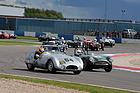

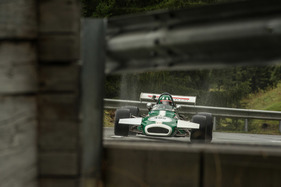
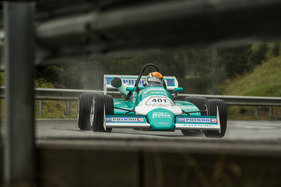
The Arosa ClassicCar hill climb took place for the 13th time from September 1 to 3, 2017. Paddock manager Noldi Heiz calls it a buzzing class reunion and he certainly hits the nail on the head.

But it is even more than that, namely the only historic hill climb in Switzerland with a real racing class, i.e. a classification in which the fastest car wins. And to make this possible, the most extensive safety precautions are necessary. These also benefit the regularity drivers, as they prevent serious consequences in the event of accidents.

However, even with crash barriers and elaborate protective measures, it is not possible to make a hill climb completely safe, as was demonstrated on Sunday. But more about that later.
Difficult weather conditions
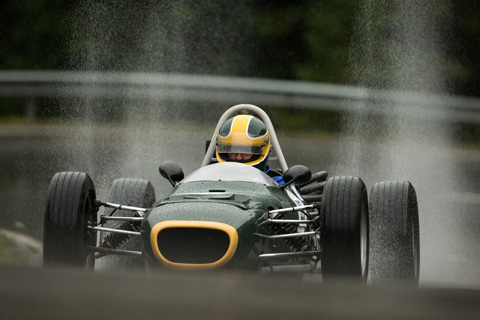
The weather gods really didn't mean well with the organizers of the hill climb in 2017. Low temperatures, lots of rain and even snow meant that some people were happy to reach for a mulled wine or at least a warming coffee.

Some even had to clear their cars of snow in the morning before they could set off. The road remained wet well into Sunday afternoon, but at least the snow didn't settle.

While one person was happy about the slippery road conditions - "at least you can drive across without danger ..." - some other participants were annoyed and said "hardly any grip with the semi-slicks".

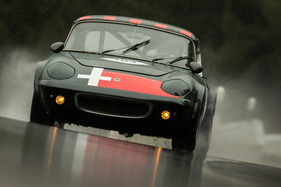
Martina Garovi, competing for the first time in her father's Lotus Elan, did not let her good mood be spoiled. She was very happy with the car, which she was driving fast for the first time. She said that it had much more grip than she had expected, but that she still had to learn the track. In fact, she had never driven up to Arosa before, so her running times were quite respectable.
Close battle at the top
Of course, everyone was looking forward to the new battle for overall victory in the Competition class. Last year, as is well known, Thomas Amweg took first place, while Roger Moser had to draw the short straw.

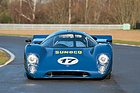
There were even four candidates for victory in 2017, as Bruno Staub in the 1978 Ferrari 308 GTB Group 4 and Toni Seiler in the 1968 Lola T70 were also contenders. In the end, however, Thomas Amweg, coached by his father Fredy Amweg, came out on top in the 1988 BMW Mk50 03.

With a fast third run in 4:52.14, he sealed the deal.

Bruno Staub crossed the finish line in second place in his Ferrari, with a gap of 3.85 seconds after three countable runs.

Third place then went to Roger Moser from Arosa, although his gap was already significantly larger. Toni Seiler unfortunately had to park his car before the third run, as he could probably still have threatened Moser.

Urs Beck inherited fourth place in the Chiquita Porsche, his times were impressive, as he was clearly the fastest in his class.

Due to numerous non-starters and technical problems, the Competition class was reduced from 25 to 18 cars.
Perhaps the biggest surprise in the overall classification was the performance of Lotus 11 driver Markus Jörg, who brought the old car from 1956 to the finish line between much younger GT and racing cars.

Consistent, but how!
Alexander Boller achieved the feat of completing his best two hill climbs in exactly the same time. He therefore took the win in the Arosa Classic Trophy on Saturday, as only one run was timed on Sunday and this ended up as a scratch result.

However, Boller is not exactly driving a small, easily tamable small car, but a downright huge 1963 Ford Galaxie 500. The car has already raced at Goodwood, so it belongs to the crème de la crème, but it is neither a typical car for hill climbs and tight bends, nor is it known as the king of smoothness. Well, maybe that's changing now, but in any case you can only take your hat off to this achievement.

Stephan Jöbstl in the Jaguar C-Type would also have had a good chance of winning, as his best two times were only two hundredths apart.
Adrian-Richard Michel in the Ferrari 365 GTC took third place, followed by Thomas Kern in the Maserati Mistral 3700. Ten drivers managed to stay within one second of each other.
Riley ahead of Quattro
In the third category, the Arosa Sport Trophy, two pre-war cars and an Audi Quattro from 1981 took the top three places.

Gian-Pietro Rossetti won in the 1936 Riley TT Sprite with a difference of 83 hundredths, followed by Daniel Ueberhard in the 1981 Quattro and Ruedi Siegrist in another Riley, albeit with twin tires at the rear and therefore blessed with plenty of traction.
The special birthday present
Jost Wildbolz celebrated his 80th birthday in August and he gave himself a really hot present, a TVR Griffith 200. The car was built in the mid-sixties and the Grantura was actually designed for the installation of four-cylinder engines.
However, an American named Jack Griffith saw things differently, ordered complete vehicles without engine and gearbox in Blackpool and installed a V8 Ford 289 engine in the front. This was not entirely possible without a heavy hammer, as the pipes of the frame were initially a little too narrow, but somehow the eight-cylinder engine fitted in. And it turned the Grantura, which was already not slow, into a sports car that was reminiscent of the almost re-tameable Cobra.

Back then it had around 270 hp, today it has a few more. No wonder, these Griffiths are often among the front runners in historic racing. And it was in one of the fastest of these cars that a smiling Jost Wildbolz sat in Arosa.
It goes without saying that the wet road was not quite the ideal terrain for the lightweight Griffith, which is blessed with a short wheelbase. But Jost brought the light blue Anglo-American safely from Langwies to Arosa. And with this example, he set a good example to many of us that you don't have to think about stopping at the age of 60 or 70 ...
Many tête-à-queues
The adverse conditions meant that some riders ran out of road, talent or even both. Some were already caught out during practice on Friday, on Saturday a BMW M3, among others, crashed heavily, on Sunday a formula car was no longer able to turn the corner and later a Ford Mustang was also caught out.
The worst crash, however, occurred on Sunday afternoon, when a driver lost control of his car in the finish area, injuring three spectators in the process. However, the consequences were much less serious than initially expected. However, because technical faults and lengthy clean-up work had already caused long delays, the organization decided to stop the hill climb at that point and cancel the times of the fourth race.
Thankfully, nothing worse happened overall, as the Swiss hill climb scene, especially the modern events, cannot exactly boast a run of good luck in 2017.
In the additional picture galleries, the vehicles of the regularity group 1 and group 2, as well as the cars of the racing class are almost completely photographed.