It was a tightly timed project. It was only in January 2016 that conversion work began on the steel tank that was once used by the Swiss Alcohol Board to store up to 2.8 million liters of alcohol. On October 15/16, 2016, the completely refurbished steel tank was handed over to visitors to the Autobau Experience with an attractively staged opening.

A suitable environment for the car collection
Fredy Lienhard had been thinking for some time about how he could better present his racing and road car collection. When the opportunity arose to repurpose the former premises of the Federal Alcohol Board in Romanshorm, he seized it immediately.
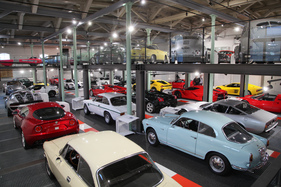
After some construction work and no doubt many discussions with the authorities and heritage authorities, the "Erlebniswelt Autobau" was officially opened in 2009. Since then, the museum has established itself as a center for classic car enthusiasts in Eastern Switzerland and far beyond the cantonal and even national borders with the business units created for this purpose, which include car maintenance, construction and restoration, as well as racing support.
Over 90,000 visitors have already made a pilgrimage through the various rooms of the car showroom and have been able to admire famous road sports cars as well as special racing cars from Fredy Lienhard's collection and have them explained to them in detail.
A historic steel tank as a museum?
The expansion and conversion of the gigantic round steel tank with a diagonal of 20 meters, which is surrounded by a dodecagonal and two-tone brick shell, was not an easy task. It was only after an intensive project and planning phase, as well as extensive discussions with the conservation authorities, that the conversion work began in January 2016. However, good planning and a motivated architecture and construction team meant that the project could be completed in just nine months.

The aim was to preserve as much of the original substance as possible. The steel tank, which was inaugurated in 1902 and is held together by 60,000 rivets, was also used to store rapeseed oil and extinguishing water after storing alcohol. After thorough cleaning, there is no longer any smell of alcohol or rapeseed oil, while the interior fittings with steel beams, grilles and glass allow a view of the historic structure in many places. The ingenious lighting flatters the exhibits and delights photographers and viewers alike.
Festive opening
On the evening of October 15, 2016, the polygon, as the now repurposed steel tank is called due to its shape, was officially opened with several hundred guests.

Fredy Lienhard took the floor as host and thanked everyone involved, as well as the 90,000 previous visitors to the car park who had made the expansion possible with their interest.
He happily mentioned that a never-before-seen special exhibition of Formula 1 cars from Sauber's history had been put together for the opening, thanks to a generous loan from Peter Sauber.

Representatives of the canton and the monument preservation authorities also contributed their thoughts and thanked Lienhard for his initiative and the excellent cooperation. Finally, the architect explained some of the finer points of the conversion and then, together with Fredy Lienhard, impressively inaugurated the new building with a light, color and fog show and appropriate musical accompaniment.
View of the new museum section
After the opening, the invited guests were then allowed to view the extension and were visibly impressed.

Peter Sauber, who of course did not miss out on attending the opening ceremony, and Monisha Kaltenborn, team principal of the current Sauber team, were visibly moved as they walked through the impressive collection of Sauber's early Formula 1 cars.

Fredy Lienhard was also unable to hide his delight at the successful expansion of his museum.

On the three semi-transparent floors connected by circular staircases, the Sauber Formula 1 cars are now on display on the first floor, starting with the C12 from 1993 and ending before the transition to Sauber-BMW.

On the middle and top floor, racing cars that Fredy Lienhard drove himself or that raced as part of the Lista team's racing activities are on display. The oldest car on display is the soapbox with aluminum bodywork with which Lienhard started his racing career.

In addition to the Formula 1 cars, the Autobau exhibition in the racing car hall also features some of the sports cars from Peter Sauber's career, including the C1, the C3, the C5 and the C9.

Successful addition
Car construction was already an attractive museum, and the addition of the Polygon is an ideal addition.

Anyone who has never been to the Autobau in Romanshorn (on Lake Constance), who is interested in unusual architecture or the cars of Peter Sauber, but who has also visited Romanshorn some time ago, should definitely take a look at the beautifully presented and competently labeled collection of road, sports and racing cars.
The opening hours, visiting offers and special shows are always documented on the Autobau website .