From March 26 to 29, 2015, the Stuttgart Reto Classics opened its doors and welcomed visitors with superlatives.

Record trade fair
Even before the start, trade fair initiator Karl Ulrich Herrmann announced records. With 120,000 square meters for the first time, Stuttgart had outstripped its European competitors. 1430 exhibitors awaited customers and interested parties in the spacious eight halls.
On Sunday evening, Retro Classics reported over 87,000 visitors, another new record for Stuttgart.
The organizers were of course also delighted that interest from journalists had also grown by almost 15% with 819 accredited journalists and that the event was also much more international.

And people were eager to buy, with almost half of the visitors purchasing smaller or larger products, starting with a car magazine and ending with a Mercedes-Pagoda or another classic, depending on their budget. By Friday, many vehicles were already bearing a "Sold" sign, and dealers were hoping for lucrative post-show business for the vehicles that did not find new owners at the show itself.
High price level
Prices were high across the board, and the vendors were obviously expecting a well-heeled clientele from Baden-Württemberg. For example, a BMW M3 E30 was spotted with a price tag of 59,800 euros and was soon sold. No wonder the dealers were rubbing their hands with satisfaction, as no one reported a decline in buying behavior.
One-off Autonova GT
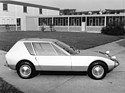
Recaro had a special attraction on its stand, the Autonova GT, which was first presented at the IAA in Frankfurt in 1965. Designer Michael Conrad had created a neat little hatchback coupé that could rely on the mechanics of the NSU Prinz 1000 and was intended to appeal to young people in particular. Inside there was a forerunner of the Recaro sports seat.

The car was the result of a collaboration between Fritz B. Busch, Pio Manzu and Michael Conrad. The Automobil Revue commented jokingly on the plastic prototype in 1965 as follows:
"The - let's say soberly: unusual - line of this pipe-smoking car is not for the sake of looks, but for the sake of function, just the way it is. The coupé is based on the NSU Prinz 1000, but has the new 110 engine in the rear and is designed to run at 170 km/h. Despite its exemplary drag coefficient (figures, Mr. Busch, figures!), it is exceptionally spacious. It has more room for two people than some larger sports cars, but the roof has a roll bar. That can be useful."

If it had been built like this, the Autonova GT would certainly be a sought-after classic today.
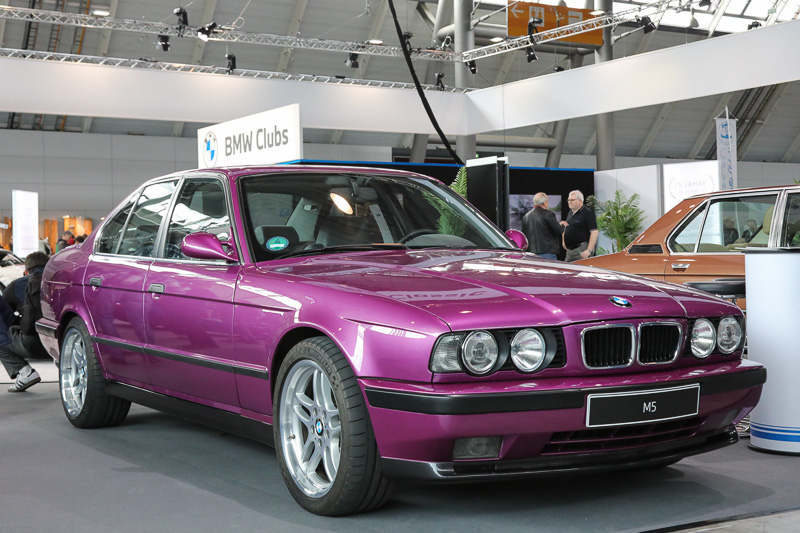
30 years of the BMW M5
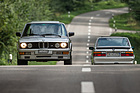
The first BMW M5 based on the E28 series was presented 30 years ago. It was powered by the in-line six-cylinder engine from the BMW M1 and the almost 280 hp enabled driving performance that hardly any other saloon could offer.

In 1988, the second generation followed in the form of the E34 series, still with a descendant of the M1 under the hood, now with 315 hp.
As early as 1992, a station wagon version called the M5 was available for the first time, with just 891 units being produced by 1995.
The third generation of the M5 came onto the market in 1998 and is already considered a youngtimer today. Instead of the in-line six-cylinder engine, however, a V8 was now actively at work.
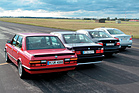
On the occasion of the 30th anniversary, the M5 models could be admired in a special show and the interest was great, as hardly anyone walked past the cars without at least pausing for a moment.
Manageable manufacturer presentations
The major manufacturers kept a low profile, especially when compared with the trade fairs in Paris or Essen.

As local heroes, Mercedes and Porsche naturally presented themselves with brightly lit stands, but the other vehicle manufacturers largely left the field to the clubs, which is not necessarily a bad thing, as they had plenty to show. At Opel, for example, hot Opel Ascona 400s and second-generation Manta models were on display.

Resurrected manufacturer Borgward was also absent, but the club's two Isabella models fully compensated Borgward fans.
Relative exclusivity
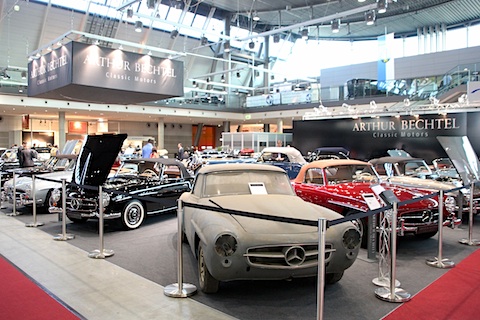
Surprising for some, for others a logical consequence of the investment boom in classic vehicles was the dominance of the trade fair by two model families, namely the SL (300, 190, Pagoda, 107) and Porsche 911.

While the examples of everyday cars produced in their millions in the past, such as the Renault 4 CV, Citroën 2CV, Fiat 850 or Morris Minor, could at best be counted on one hand, the Gullwing and its brother from the W 198 series were on display dozens of times (and more frequently). Almost like at a new car dealer, they appeared in a wide variety of color combinations and mostly in better condition than when they left the factory.

The almost forgotten cars of Mr. and Mrs. Everyman, on the other hand, led a niche existence, but received all the more attention because they could hardly be spotted. The stories about the Renault 4 CV on display at the Zwischengas stand, for example, would have been enough to fill half a book. There was just as much talk of self-installed underfloor heating, tuned racing cars and various breakdowns as there was of nine people in the 3.6-meter-long car and long vacation trips to Rome or Spain.
The happy eyes of the onlookers showed that these cars deserve a place at classic car shows just as much as the highly acclaimed luxury classics.

Of course, the exclusivity is put into perspective when there are 20 Mercedes-Benz 300 SLs for every Fiat 850 and a good hundred or more Porsche 911s for every Alfa Romeo Alfasud. Rarely has it been so clear that what was once rare is not rare today and vice versa.
No big special show
Anyone hoping for a continuation of the special show tradition in Stuttgart - remember the Delahaye exhibition from 2013 or the display of forgotten French rarities from 2014 - was at least partially disappointed.

Although the Porsche Museum provided six concept cars and studies - Porsche FLA from 1973, 984 from 1985, 959 aerodynamic study from 1982, 928 Cabriolet from 1987, 944 Turbo from 1986 and 918 prototype from 2011 - for the atrium, it has to be said that this light-flooded space would have deserved more exhibits.

Nevertheless, many visitors to the trade fair probably got to see the long-term car research project (FLA) up close for the first time, and the 984 from 1984/1987 was probably only known to a few beforehand.

This "dynamic roadster" was to be offered to a young and sporty audience for DM 40,000 (today this would be Euro 20,000). The engine was to be an air-cooled four-cylinder boxer engine with 120 to 150 hp and the convertible was to be launched with an innovative folding fixed roof. Even a four-wheel drive version was envisioned at the time. However, the sales crisis in the USA in 1987 put a premature end to the project, and some of the ideas were probably taken out of the drawer for the Boxter.
A special treat in the special design exhibition was certainly the presentation of the Opel CD from 1969, including a technical mock-up.

Oldtimer?
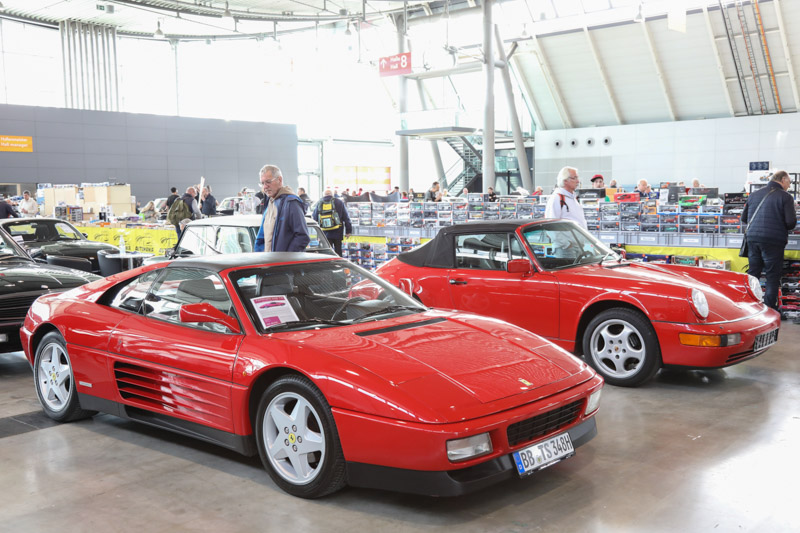
Retro Classics is actually a classic car show, but the proportion of newer vehicles seems to be increasing every year and the interest shown by buyers probably proves the organizers right. Christoph Zerbini from Revo Klassik, for example, said: "I would not have expected newer models to attract so much interest."
Knock, knock
Although there were "Please do not touch" signs or similar requests on some cars, the trade fair visitors were only marginally restricted by this. There was so much feeling, patting and knocking that it was a bit too much for some vehicle owners. Would you have gotten one euro per knock - plastic body yes or no? - one euro for each knock during the four days of the fair, even the largest stand would have been paid for.
One day was hardly enough
120,000 square meters spread over eight halls is a lot to take in. Anyone who really didn't want to miss anything was well advised to spend at least two days. Even the chronicler of these lines has to limit himself to a few highlights; the picture gallery is recommended as a supplement.

Almost every visitor we spoke to knew about specialties and features that others had missed. Whether it was a Lancia Trevi with two engines (!), a rare Opel Rekord Coupé with a six-cylinder engine or a Fiat 850 Coupé from Vignale, there were exclusive and unique things to discover in every hall and on many stands.