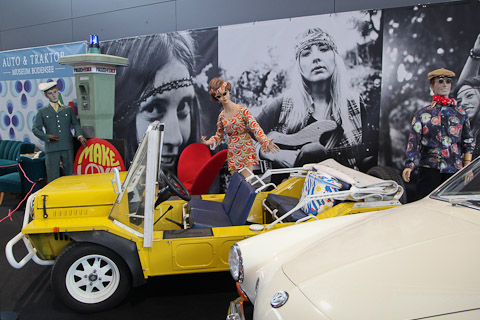
Retro Classics Bavaria took place for the third time in Nuremberg between December 7 and 9, 2018. Four halls with around 36,000 square meters hosted the regional classic and modern classic car scene for three days.

Around 26,000 visitors were expected, but exact figures on actual admissions are not yet available.
From the region for the region
Retro Classics Bavaria is clearly a regional trade fair; the catchment area is the greater Munich area and, of course, Nuremberg, which results in a considerable purchasing potential of around 16 percent of the total German classic car market if the H license plates are taken as the basis for calculation.

Accordingly, Nuremberg was mainly home to suppliers based in the region, but hardly any international companies. However, this also ensured that there was only a slight overlap between the cars on display and the trade fair in Cologne a few weeks ago, which was certainly advantageous for visitors to both events.
Two-faced (Janus)
In terms of history, Nuremberg is more of a motorcycle metropolis than a car metropolis; brands such as Ardie, Hercules, Hecker, Mars and Victoria were primarily at home in the two-wheeled environment.

Some fine examples of this motorcycle tradition were presented on a 700 square meter area and, of course, the Zündapp brand was not missing.

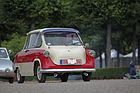
As one of the few car manufacturers, Zündapp also had its own special show dedicated to the Janus. There you could not only learn a lot about the history of this small car, but also admire almost half a dozen of these vehicles. The special feature of the Janus was that the four passengers sat back to back and each got in and out through a front or rear-mounted swing door.

The entire construction was set up as symmetrically as possible in order to minimize the number of components required. The design was conceived by Claudius Dornier in his office in Madrid back in 1953. He called the small car "Delta" because it looked like a triangle. His prototype was only 2.88 meters long; the first test drives took place in 1954 and showed that the design was easy on the road and comfortable to drive.

Because Dornier did not want to build the car himself, he turned to Zündapp-Werke in Nuremberg at the beginning of 1955, who then named the car "Janus" because of its two faces and launched it on the market in 1957.
Special show from France instead of Franconia (Matra)
As is well known, Nuremberg is located in Franconia, so it is not far (from the point of view of the history of peoples) to France, which was founded by the West Franks. At any rate, this could explain why a special Matra show was presented at Retro Classics Bavaria.

Although the announced Matra Djet was missing, the M530, Bagheera, Murena and Rancho models represented a considerable proportion of the cars produced by Matra.

A Simca 1100 Citylaster, the technical basis for the Matra Rancho, a forerunner of today's SUVs, was placed on the stand as a particular specialty.

A line-up of movie cars also almost had the character of a special show, including a police car as used in the movie Blues Brothers, a DeLorean DMC-12 from Back to the Future and an off-road vehicle from Jurassic World.

And let's not forget the Red Cross Museum, which drew attention to itself with ambulances from the past.
Almost like 80 years ago (IAMA)
The IAMA, the International Automobile and Motorcycle Exhibition, was in principle a forerunner of today's IAA. It took place in Berlin and attracted hundreds of thousands of spectators at the time. Not only the VW Beetle was presented there, but also many BMW automobiles and motorcycles.

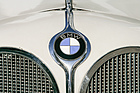
In memory of the years 1936 to 1938, so to speak, BMW two- and four-wheelers from that period were presented in a special show in Nuremberg, including the Fachsenfeld Coupé based on the BMW 328, which was only built twice.

Old photos on the walls were reminiscent of the IAMA exhibitions of the pre-war years.
Two worlds
At Retro Classics Bavaria, two worlds collided from the spectator's point of view, and in more ways than one.

While the large dealers and restorers presented their cars in the brightly lit and modern Halls 3A and 4A, parts and privately offered cars as well as club stands and tractors and commercial vehicles were set up in the older and much darker Halls 3 and 4.

But there was also a dichotomy in terms of the age of the cars on display. On the one side, classic car dealers offered their cars, while on the other there were neo-classics, i.e. almost new cars.

The public didn't seem to have any trouble with this and it may well be that the trend towards younger cars will intensify in the future. After all, a Bugatti Veyron or a Porsche 911 GT3 are not lacking in fascination.

Nuremberg also had a respectable selection of pre-war vehicles to offer as compensation, so to speak. BMW in particular was well represented, not only on the IAMA stand, but those who looked closely could also find over 70-year-old Fords, Buick, Talbot, Salmson and Singer, to name just a few examples.

The popular ones shaped
The range of classic cars for sale was, unsurprisingly, dominated by the vehicles that are particularly popular in Germany.

These certainly include the VW Beetle, but also the SLs of the R107 series and the Porsche 911/912, all of which are high up on the registration hit parade for H license plates.

There were also many younger BMWs on display, which are enjoying increasing appreciation (and thus rising prices).

There was also no shortage of youngtimers and former bread-and-butter cars that are now slowly becoming rarities, such as a Fiat Ritmo 60 or a Saab 96 De Luxe, but also an Opel Rekord E or a Ford Granada Ghia.
Actually enough space, but ...
In principle, there was no lack of space in Nuremberg; part of Hall 3 was even left empty. So it was all the less understandable that an interesting line-up of Japanese rally cars from Mitsubishi and Subaru was almost overlooked.

Why couldn't a small gravel track (similar to the start/finish straight of the dwarves in Cologne) be set up for these cars at the back of Hall 3 and show the cars in their element, so to speak? The spectators would certainly have been more likely to get their money's worth and perhaps the cars could have been labeled ...

But even without this extra luxury, the spectators, who paid between 8 and 20 euros for admission, certainly got their money's worth.