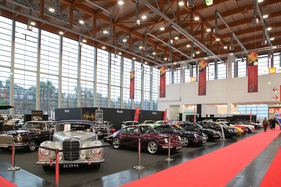
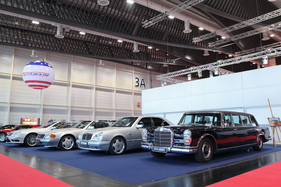


The new classic car trade fair Retro Classics Bavaria from December 9 to 11, 2016 was a big hit, and even the first time it was as big as Retro Classics Stuttgart in its seventh year. Four halls, 37,000 square meters and 350 exhibitors, impressive figures that Karl Ulrich Herrmann was able to quote at the press orientation.

"We are relying on a similar concept to Stuttgart, trying to organize the halls according to themes. Of course, this doesn't work as well here as in Stuttgart due to the smaller size," Herrmann added, not forgetting to mention the approximately 1800 vehicles on display.
It was also interesting to note that over 80% of the exhibitors were not present in Stuttgart. The area around Nuremberg, a catchment area of over 3.5 million inhabitants, obviously has a thriving classic car "industry". And this industry made a convincing appearance at the event in the large exhibition center in the southeastern part of the city of Nuremberg. The exhibition has plenty of potential for expansion, with a total of over 170,000 square meters available.
More and more regional?
According to Herrmann, classic car fairs are becoming increasingly regional, which would also reduce costs for exhibitors traveling to the event. Incidentally, there was already a classic car fair in Bavaria, albeit in Munich, many years ago.

The expected 30,000 visitors, who were to be recruited primarily from Franconia and the surrounding area of Nuremberg, could not quite be realized, but the 26,544 visitors counted by Sunday evening are still quite impressive. In any case, hordes of people were already streaming into the halls on Friday and some dealers were actually able to put up "sold/sold" signs on the first day, although these tended to be the cheaper offers.

By Sunday, however, many expensive vehicles had also been sold, such as a Ferrari F40, which, according to official figures, was sold for a seven-figure sum.
The very special Japanese show
Of course, there were also many Mercedes-Benz and Porsche cars to be seen in Nuremberg, but the overall range of vehicles on display seemed to be more varied than in Stuttgart. For example, Autohaus Macht from Eckental-Brand put on an interesting special show with several examples from its extensive Mitsubishi and Subaru collection.

There was, for example, one of perhaps ten Mitsubishi Colts in existence worldwide from 1967, with 51 hp and a steering wheel gearshift. Six people were allowed to ride in it at the time, and the car will soon be completely restored.

The Galant Coupé A110 from 1976, which Anja and Tilo Macht tracked down in Scotland, is also likely to be rare. And the Mitsubishi Sapporo convertible from 1983, once the press test car that was also featured in AMS magazine, is of course also a rarity.
BMW diversity
Actually, one would have expected many BMWs in Nuremberg, after all Munich is only a good 160 km away. But there weren't that many after all. However, some clubs did show their support for the brand, such as the BMW V8 Club with its proud eight-cylinder models and the E34 IG five-cylinder models.

The Isetta Club of course had the cabin scooter on display, but also the BMW 700. However, Christian Silberhorn, who will make his collection public in Nuremberg-Fischbach in 2017, showed an even wider selection.

However, visitors to the trade fair were already able to get a taste of the BMW 328, i8, M1, 502 and Dixi.
Fantastic plastic from Great Britain
They are among the exotic cars in Germany, the sports cars from the British company TVR. The TVR Club Germany spared no effort to bring three of the rare models to Nuremberg, no easy logistical task in the winter months.

A TVR Vixen and a TVR Grantura from the sixties as well as a TVR 3000M Cup from 1976 were on the stand.

And as a visitor, you could learn something new at the same time. This white 3000 M was a special model that was only built ten times and was fitted without bumpers and with simple small rear lights to reduce weight. Only the model shown is said to still exist.
Many Italians too
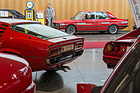
Fiat and Alfa Romeo were also well represented both in the club stand area and among the dealer offers.

The red Fiat 124 Spider with skis on the trunk, for example, created a wintry atmosphere.
A piece of Nuremberg's industrial history
The Merks Motor Museum and the Motorrad Museum Nürnberg showed a selection of vehicles that were built in Nuremberg.

Starting with a Viktoria motorcycle from 1904, various other two- and three-wheelers were also on display, including a Herkules Roller 200 from 1955 with sidecar.
Tractors, commercial vehicles and buses
As is already familiar from Retro Classics in Stuttgart, a special show with historic buses, trucks and tractors as well as agricultural machinery provided additional splashes of color and nostalgic feelings.

Wide range of classics for sale
Among the hundreds of vehicles on offer to potential buyers, there were some interesting rarities that you don't see everywhere. For example, a VW Scirocco L from 1977, the one with the rectangular headlights, with only 77,000 km on the clock could be bought. A little further on were two rare Lancia limousines, a 2000 from 1970 and an Appia from 1960, as well as an Alfa Romeo 33, the successor to the Alfasud. Or a white BMW 700 Coupé Sport from 1961, which was advertised for EUR 24,900.

Of course, not all of the cars were for sale, for example the Opel GT/E from 1979, which was shown with the new car purchase contract from back then, was a collector's item.

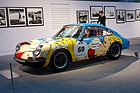
On the other hand, visitors could choose from a wide range of VW Beetles, from the Pretzel folding roof version to the Harlequin in multiple paint finishes.
Some of the prices were very ambitious, but some were also reasonable, especially when it came to less exotic vehicles.

Parts and accessories too, of course
Of course, there were also some parts dealers, model car sellers and literature suppliers in Nuremberg, just like at any other classic car fair. The jacuzzi provider or the seller of safes seemed a little more unusual.
Successful premiere
Overall, the first edition of the Bavaria version of Retro Classics was a success. An interesting and varied range of vehicles, beautifully designed stands, an overall airy and good atmosphere in the halls and exciting special exhibitions, which were largely thanks to private initiative, certainly justified the admission price of around EUR 20.

The organizers have already announced that the trade fair has even more potential and that it is not a one-off event. The next five editions are already planned and the December date is to be retained.

However, we will certainly see whether this regionalization will lead to a certain cannibalization between the individual trade fair providers when Hamburg and Cologne organize their own classic car fairs.