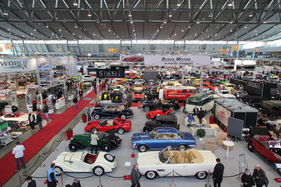
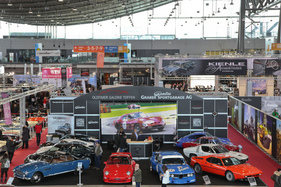

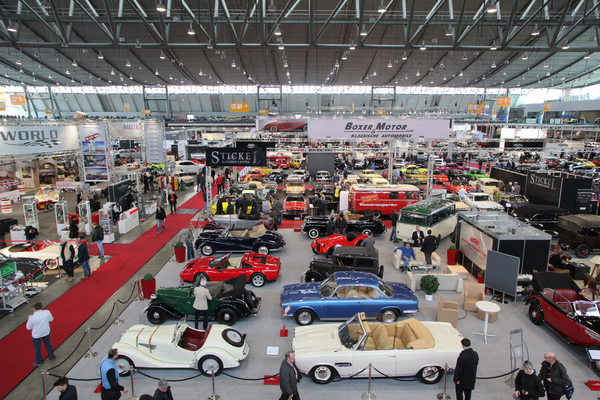
Retro Classics has now come of age, announced Karl-Ulrich Herrmann at the opening of the 18th edition. And indeed, it was quite grown-up, with 140,000 square meters. No other classic car fair is larger in terms of space.

In any case, the distribution of visitors was much better than at other trade fairs, with 87,000 entries counted over the four days. At two percent, the decline compared to the previous year was kept within reasonable limits, especially as "a market companion" (meaning the Techno Classica in Essen) targeted classic car enthusiasts as visitors on the very same weekend.
Nevertheless, Herrmann was able to report sold-out halls, which was certainly helped by the fact that, as in previous years, he was also open to new classics and also has a heart for commercial vehicles and tractors, which certainly enrich the trade fair.
Manufacturers in the background
In contrast to Essen, where the major car manufacturers had their own stands, in Stuttgart most of the car brands left this task to the well-organized clubs.

Only Porsche made an independent appearance and showed, among other things, the only Le Mans sports car with all-wheel drive that the Zuffenhausen-based company ever sent to the 24-hour race, the 961 from 1986. René Metge and Claude Ballot-Lena finished seventh with the 640 hp 959 derivative. A year later, the second start took place at Le Mans, but the drive and thus the car's career ended in an accident.

Ford, Opel, Mercedes, Audi and other German brands were widely represented by clubs and dealers. The large Ford Capri presentation was particularly eye-catching, as was the usual large Opel following.

The various Mercedes series were also well represented by the clubs.
50 years of fast Opel - Irmscher
Opel and Irmscher belong together for most people, and indeed there were many Opel vehicles on the stand celebrating Irmscher's 50th anniversary, but not only. Irmscher is also a manufacturer and produces a roadster, for example.

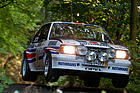
Of course, it was mainly the hot racing cars in bright colors that attracted interest at the stand, such as the GT from 1968 or the Commodore GS/E from 1973.
Birthday BMW M1
Anyone who didn't know until Retro Classics that the BMW M1 is now 40 years old certainly couldn't have missed this anniversary on site. The fast plastic coupé in road and racing versions was on show in several places.

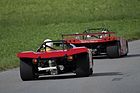
The prototype from 1977, which was still built by Lamborghini and differs from the production version in many details, was certainly very special. Presumably the only surviving prototype, it was restored to its original condition after years of use in Procar trim.

The story of the racing car that started in the 1980 24 Hours according to IMSA regulations, which is painted with the map of France and marked with BMW dealers who supported the start financially, is also exciting.
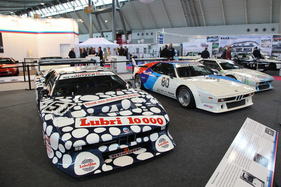
And the Schnitzer-BMW M1 Turbo from 1981, which developed a whopping 800 hp at 8000 rpm and took part in the DRM in 1981 with Hans-Joachim Stuck at the wheel, was certainly also special. Stuck won three times, but this was only enough for 8th place overall.
Huge - SK Collection
Just like Irmscher, the SK Collection special show was also located in the new Hall 10. SK stands for Saulus Karosas, who is best known as a collector of fine Erdmann & Rossi bodies, which were also on display in Stuttgart.

But his interest does not stop at luxury cars, as demonstrated by a rare 1957 Volkswagen-based Rometsch Beeskow or the 1935 Adler Junior Sport.

For many people, however, vehicles from the eastern car tradition were more interesting. For example, there was a compact SMZ S3A-M from 1969 or a Moskvich 400-420 A from 1951, which is basically a post-war Cadet.

The Russian limousines from GAZ, which were available in various sizes and also as Volga station wagons, were impressive.
The presidential vehicles from the ZIL brand, which boasted large-volume V8 engines, went in a similar direction.
Art and automobile
Another special show, located in the atrium, was devoted to the theme of art and automobiles. The MAC (Museum Art & Cars) juxtaposed automobiles with works of art. Of course, a real art car was not to be missed, including a BMW M1 painted by Andy Warhol.

But there was also a 1969 VW Beetle from Mexico, which had been wrapped with motifs by James Gill as a work of pop art.

The cars and works of art represented past exhibitions at the museum, which is soon to be expanded.
Dominance of the stars and Zuffenhausen sports cars?
The Stuttgart trade fair is said to have a clear over-representation of cars from Mercedes-Benz and Porsche. And of course they are also very present. Herrmann said that he was embarrassed by this for the first ten years, but has been proud of it for the last eight years. And why not? After all, these cars were also created in the Stuttgart area and it is only logical that they have now found their way back here.

The Stuttgart trade fair is therefore not a uniform mishmash, as the dealers and private sellers have endeavored to provide a much more diverse range.

And the clubs, restorers and other exhibitors did the rest to counter the Mercedes/Porsche dominance.
Italians almost among themselves
After the small Hall 2 was given the theme "Passione Italiana" in 2017, this part of the trade fair was enlarged for 2018 by moving to Hall 7, which was now called the Italy Hall.
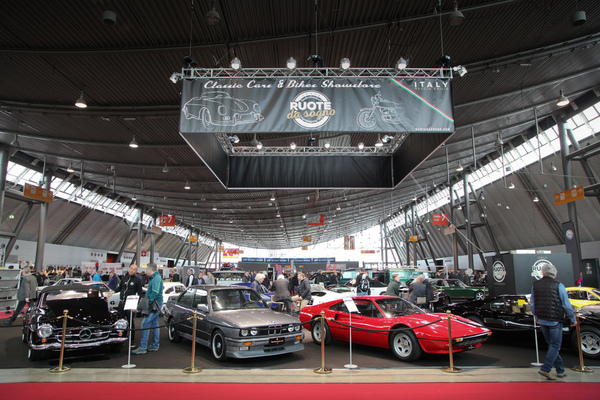
Italian dealers such as Ruote da sogno exhibited parts of their range of vehicles there, but there were also restorers, specialists, accessory suppliers and brand clubs representing Italian brands.

These stands were complemented by a large special motorcycle show organized by AMSC Leonberg, which of course also featured many Italian motorcycles. The culinary delights in this hall were of course also Italian.
All kinds of exotics
The major dealers naturally also exhibited vehicles with sales potential in Stuttgart.

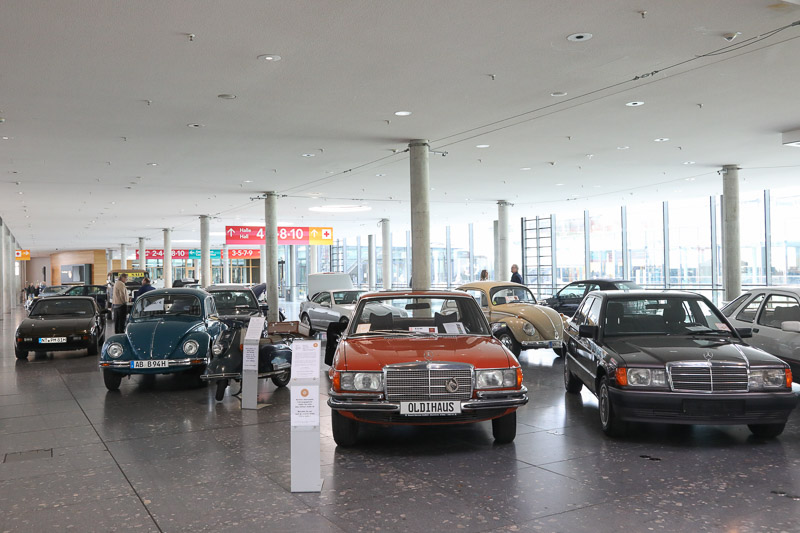
A glance at the German registration charts makes it clear that many of these are classics from the Mercedes and Porsche brands, as the 123, 107 and 113 series from Mercedes-Benz rank right at the top, as do the popular 356 and 911 sports cars from Porsche.

Amongst the many well-known classics, visitors to the trade fair were able to catch a glimpse of lesser-known exotics, such as a Woodill Wildfire. This was probably the first post-war sports car to be produced in (small) series in the USA, just one year before the Corvette.

Like the Corvette, the Woodwill, whose shape later reappeared at Glaspar, has a plastic body.

The body of the Colani GT, which could be spotted a few meters away, is also made of plastic. The basis here was the Beetle platform of a 1200-34 hp VW, while the brake system, rims and instruments came from the Porsche 356. The body was laminated by the Canadur company in Berlin.

The pre-war cars exhibited in the gallery of Hall 1 were certainly also among the exotic cars, regardless of whether they were called Rover 6 HP, Flocken electric cars or Peugeot 202.

To stay with plastic once again, the bodywork manufactured by Wacker, which could be mounted on a Ford chassis, was also made of this material, as the example on the Ford Club stand showed.

The body of the 1954 Fiat 1100-103 TV, on the other hand, was made of metal and could be admired on the Classic Trader stand right next to an Alfa Romeo 1900 Super Limousine.

One of the oldest cars at Retro Classics was the Popp patent motor car from Switzerland dating from 1898. Only two were produced, one of which is said to have been the first licensed motor car to be registered in Berlin in 1900.
Around 60 examples of the "Eco-Line estate car" based on the Mercedes-Benz /8 chassis were built between 1968 and 1976 by Christian Miesen's coachbuilding company. It can certainly be seen as the forerunner of the W123 estate.
The Morris Marina, especially as a coupé, as seen at the "Englsh Corner", is also likely to be counted among the exotics in this country.
A BMW 319/328 with a narrow 315 body, which has apparently been "on the road" in this form for many years, attracted a lot of attention.

And of course the Alfa Romeo TZ2 with Targa Florio history was also really exotic, even if its price has moved more in the direction of super classics.
The creations of the clubs
Of course, many clubs once again came up with attractive themes in 2018. The DKW friends arranged their automotive treasures around an artificial pond complete with fishermen and holidaymakers.

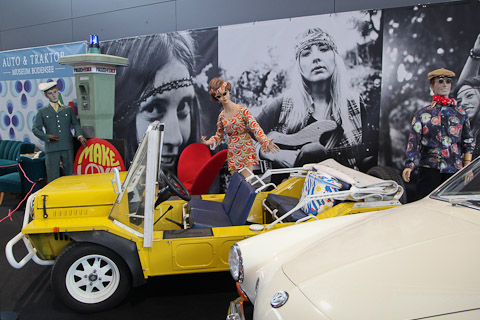
Renault 4 were embedded in a whole '68 make-love-not-war scenery. This theme also served as a suitable setting for a Mini Moke.

At the Opel GT Club, a mannequin with flared pants acted as a fitting companion to the beautifully shaped and color-coordinated coupé.

A Ford Capri being rebuilt was placed in a flower bed.
Festival of the tractor friends
Friends of commercial vehicles and tractors have been regulars at Retro Classics for years. In 2018, truly monumental agricultural giants and tractor heavyweights were brought to Stuttgart, including the Fowler AA4 Pluglokomobile from 1909 with a two-cylinder steam engine with 175 hp at 350 rpm and 13 bar boiler pressure.

The vehicle weighs 19 tons and consumes approx. 2 tons of coal per day and 600 liters of water per hour.
Lively vehicle trade
Even more than Essen, Stuttgart is a trading center for classic cars and modern classics, with a wide range on offer for a broad public. It is not for nothing that entire halls are dedicated to the commercial trade, while private sellers can display their cars in various places.

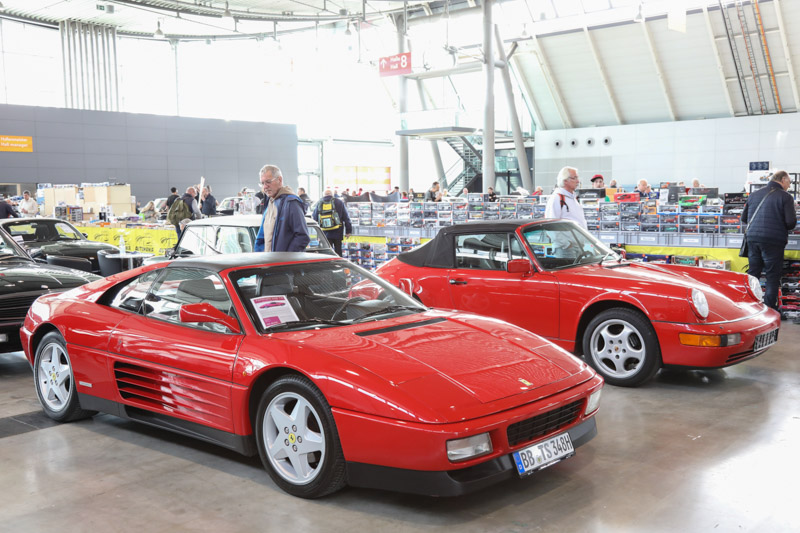
For more popular classics, the range is so large that you can often choose from different colors and conditions for one type of vehicle. Anyone looking for a Porsche 944 or a BMW 3-series E30 convertible, for example, could not complain about the choice.
In his opening speech, organizer K. U. Hermann spoke of a total of around 4000 cars for sale, of which around 1000 were offered by private individuals, while the others were divided between dealers with stands and commercial vendors without their own stand presence.
While some dealers reported pleasing sales results, others were less happy. After all, some vehicles had already been sold by Thursday, albeit probably a little less than in previous years.
In any case, the public was enthusiastic, spending an average of 5.5 hours in the halls according to the survey. Nine out of ten would recommend the trade fair to others and gave it a score of 1.8.
These visitors will be able to show that they like the trade fair at the next event in 2019, when it will take place on March 7-10 without clashing with Techno Classics.
If you would like to enjoy a humorous review of all three trade fairs taking place on the same weekend, please refer to the picture story .