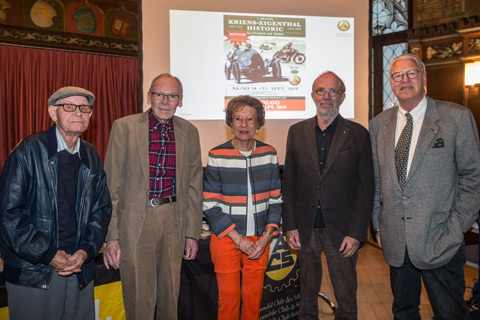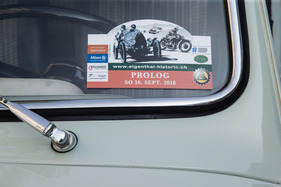
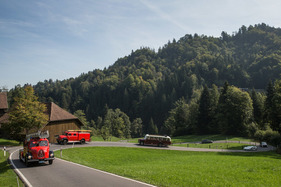
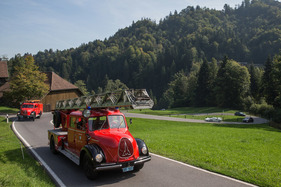
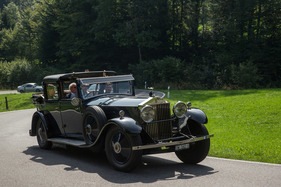
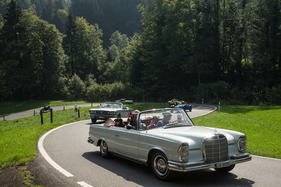
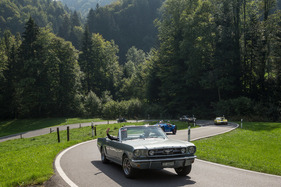
The original plan was to continue the tradition that ended 50 years ago with the Eigenthal Historic on the last weekend of September 15/16, 2018: From the 1920s to the early 1930s and then again in 1964, 1966 and 1968, the small mountain valley that stretches from the Lucerne suburb of Kriens to the Pilatus was a showcase for motor racing. Not only as a small national event, but also in the last two editions with the title "Race for the European Touring Car Championship" with great international appeal. Accordingly, renowned drivers found their way to Central Switzerland.
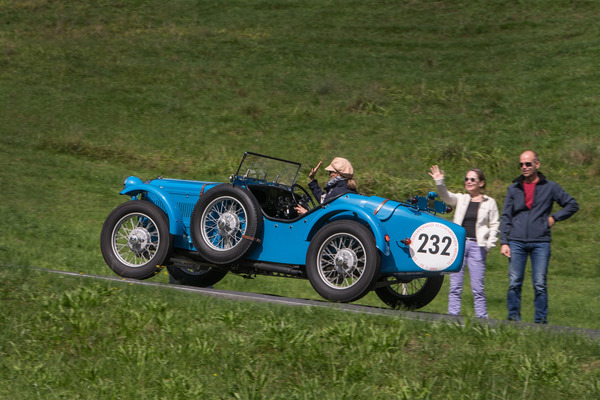
However, the fact that the Eigenthal Historic is being planned does not mean that it will work out in the end. The OC ran out of time and in order not to scare off a large number of potential starters, the "Prologue" was launched without further ado and the Eigenthal Histioric was postponed by a year to September 14 and 15, 2019.
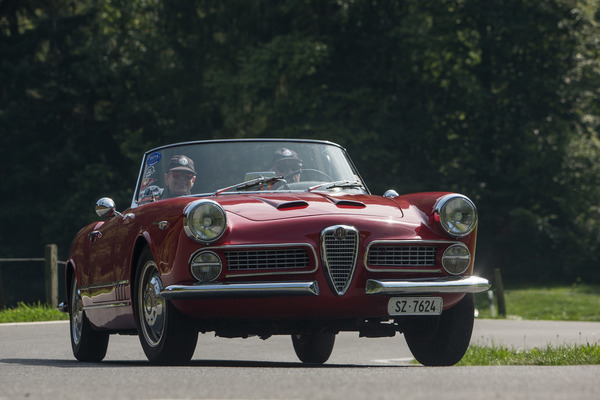
Well-attended prologue
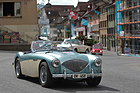
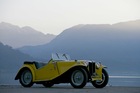
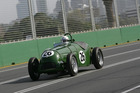
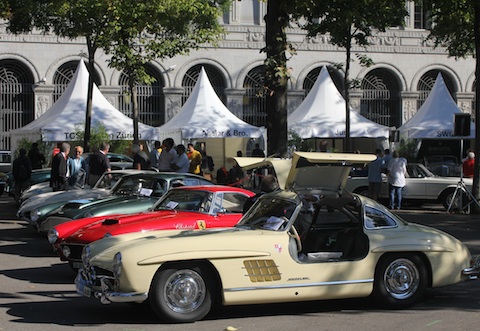
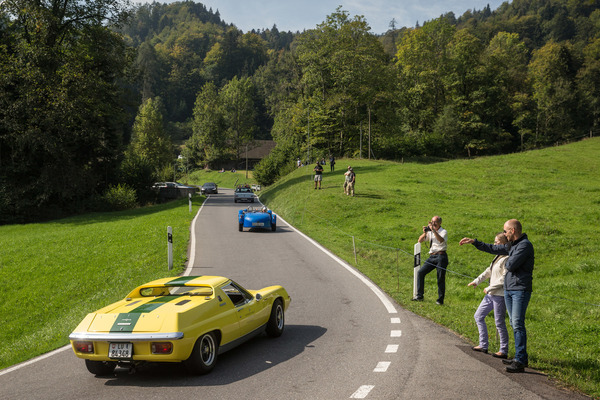
Over 100 four-wheeled classic cars, joined by several dozen motorcycles, headed for the starting point, the Museum of Transport in Lucerne, on Sunday morning - where they were welcomed by Museum of Transport Director Martin Bütikofer.
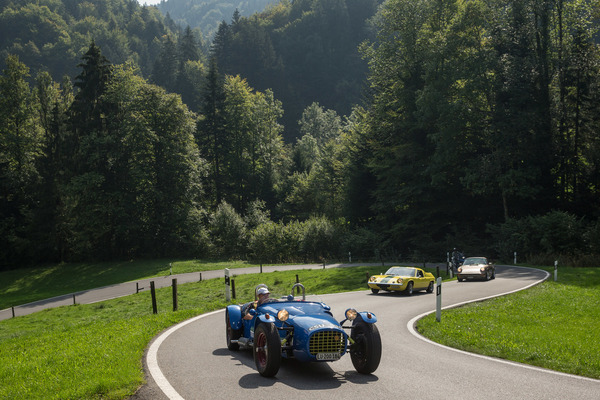
The entourage then made its way through the center of Lucerne to Eigenthal, stopping for an aperitif riche at the Bell Park in Kriens, naturally with the idea of visiting the "Kriens-Eigenthal Hill Climb" exhibition in the Bell Park Museum, which runs until next March.
Enthusiasm among the public
By Swiss standards, the prologue attracted an astonishing amount of attention from the public. Numerous kibitzers strolled along the parking lot in front of the Bell Park, the roadside from Kriens to Eigenthal was lined with waving and applauding spectators - it was almost like being at a historic rally in Italy with so much enthusiasm!
As little else can be said about the prologue, let's turn our attention to the past and philosophize about reminiscences of the Eigenthal hill climb of that time:
Famous drivers at the start
A look at the start and result lists of the events in the 1960s reads like a who's who of the racing scene at the time. In 1966 and 1968, the hill climb, which was actually an anachronism, was part of the European Touring Car Championship. However, unlike the circuit races, which counted towards the championship, only half the points were awarded.
In the sleepy valley above Kriens, a suburb of Lucerne, the "touring car crème de la crème" of the time competed alongside the top Swiss drivers. Top German drivers such as Hubert Hahne, Helmut Kelleners, Dieter Basche, the Australian Frank Gardner and the Austrian Dieter Quester found their way to central Switzerland. The former Formula 1 driver Arturo Merzario came to Kriens from Italy, still modestly driving a small Fiat-Abarth. Works driver Teodore Zeccoli drove an Alfa Romeo GTA for Autodelta, the racing division of Alfa Romeo.
These international cracks were joined by the top Swiss drivers, starting with Clay Regazzoni, Silvio Moser (both in a Formula 2 Tecno), Jürg Dubler (Formula 3 Brabham), Karl Foitek, Sigi Lang, Karl Vögele (all Porsche 910), Sigi Zwimpfer (Ferrari - and at the same time chronicler for a report for the Luzerner Neuste Nachrichten), Peter Mattli (in the ex-Jim Clark Formula 1 Lotus). And a certain Peter Sauber was also at the start in a VW Beetle...
Lucerne garage dynasties
Philipp Koch (Opel Kadett Rallye), Jürg Koch (Opel Kadett Rallye), Hans-Peter Schwerzmann (Mini), Heinz Macchi (Austin Mini) and Guido Wermelinger (Chevrolet Corvette) were all members of renowned Lucerne car garages.
Lorenz Fischer, a member of the ACS board at the time and himself a participant in the hill climb, said in an interview: "You could see from the way these gentlemen drove that the car could easily be repaired in the garage at home after a racing accident". Guido Wermelinger, Sales Manager at Garage Koch, earned the gold ACS racing badge during his career. And Jürg Koch remembers the 1968 Eigenthal: "It was my first race ever and therefore naturally something special for me.
Self-is-the-man (... or pilot)
Farmer Bucheli, who still lives on his farm in the "Stalden" section of the track, remembers a scene from the 1968 training session. Silvio Moser, the winner of the day in 1966, tackled the combination of bends around the farm with a lot of heart - a little too much heart, as it turned out, because the Formula 2 came to a halt offset from the road.
Moser didn't hesitate for long, got out of his car, inspected the mishap, put his own hands on it and then heaved the racing car back onto the track himself, got back in and drove on... Incidentally, on Saturday a heavy storm turned Bucheli's land into a boggy surface. Spectators were constantly falling over on the wet, steep terrain, contributing to the disfigurement of the agricultural land.
Formula 1 Lotus at Susten
Before the start of the 1968 season, Peter Mattli, who later became a member of the cantonal government of Uri, wanted to get ready for the races. A race track like Monza or Hockenheim for the test drives was a long way off. Mattli knew how to help himself: The Mattli family business was responsible for clearing the snow from the Susten Pass. So what could be more obvious than to clear the track neatly of snow, but not open it to traffic too early, and use the time for race-like driving with the Formula 1 Lotus. After all, it was the car that had raced with Jim Clark in the world championship the previous season.
It came as it had to: on a fast practice drive, Mattli touched a weirstone and tore off the rear suspension on his Lotus... Autodelta also noted that the driver from Uri was a fast racing driver. Mattli received an offer to compete in endurance races as a works driver. The deal fell through due to the veto of Mattli Senior, who preferred to see the junior working in the family business alongside racing. In 1971, Mattli took class victory in a Porsche 907 at the 24-hour race in Le Mans.
English nobility triumphs
In 1966, Sir John Whitmore was the measure of all things in international touring car racing. He dominated the entire scene. He was often dubbed the "virtuoso of racing saloons". There was no match for him. He also shone at the Eigenthaler hill climb, taking 2 seconds off his team-mate Bo Ljungfeldt from the Allan Mann Racing Team on the short, just over 3-kilometre course, while Gerd Schüler was penalized 4 seconds in third place in his Alfa Romeo GTA.
At the end of the 1966 season, at the age of just 29, he surprisingly announced his retirement from motor racing. This did not prevent the British aristocrat from coming to the Eigenthal in 1968, at least as an onlooker. He no longer had such a long way to travel to Central Switzerland, as he had since moved to Geneva. He died last year at the age of 80.
Big numbers from the year 1966
The Eigenthal mountain race, with its high safety standards for the time, stood up to all international comparisons. A few details: 4000 meters of rope for barriers, 280 signs with the message "No spectators", 140 signposts with the message "Spectators", 150 no parking signs, 30 no driving signs, 110 firefighters, 25 police officers, numerous volunteers for emergency services. Over 20,000 spectators rewarded this effort - a huge success for the organizers.
Jürg Dubler in F3 faster than the F2 cars
The Zurich native was known as a very fast circuit driver in Formula 3 and later also in Formula 2. When the car held up, he had few rivals. Niki Lauda, James Hunt, Emerson Fittipaldi and Ronnie Peterson were all beaten several times. He proved that he was also one of the fastest drivers on the mountain with the fastest time of the day at the Eigenthaler hill climb in 1964 and second place behind Xavier Perrot in 1968. The outstanding thing about this race: Perrot drove a Formula 2 Brabham, Dubler beat Silvio Moser in his Formula 3 Brabham in his Formula 2 Tecno by exactly one hundredth of a second...