"Passione" in Italian seems similar to the German word "Passion", but this hardly expresses what passione really means, namely passion.

And you also have to be passionate if, like Paolo Spalluto, you organize a rally in the footsteps of Rudolf Caracciola and want to offer something special. Which he has once again achieved with the second edition of the "Passione Caracciola" regularity rally, because it is not every day that classic car drivers can park their cars on the Bundesplatz in front of the Bundeshaus in Bern, the former route of the Bern Grand Prix in Bremgarten can only be driven on in exceptional circumstances, and local authorities do not open a mountain pass that is actually closed to every classic car driver.

In the footsteps of Caracciola
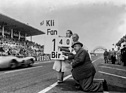
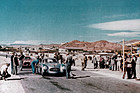
The rally, which took place from June 15 to 19, 2016, is dedicated to German racing driver Rudolf Caracciola, who won countless Grand Prix, mostly in Mercedes-Benz cars, including the German GP six times. He was an exceptionally talented driver who was always one car length ahead of his opponents, especially on difficult tracks and in adverse conditions. He was not a racer, but a considered driver who could get 100 percent out of a car when it mattered.

These qualities, which Caratsch, as he was also known, also impressed racing legends from recent history, such as Jochen Mass, who was on hand to answer questions on the opening evening. He himself had started out in hill climb racing and then moved into prototype racing and the Grand Prix world, battling for victories against men like Niki Lauda and James Hunt and winning the 24 Hours of Le Mans. Mass himself had no role models, but appreciated people like Jackie Steward, Jacky Ickx and Peter Revson for their talent.
Karl Wendlinger, the former Sauber driver who likes classic cars but doesn't (yet) own any, and Bernd Schneider, the multiple DTM champion, were also there.
Star dominance
Rudi Caracciola owed many great victories to the Mercedes-Benz SSK. Although such a model was not at the start of the Passione Caracciola, an Excalibur SSK Roadster from 1966, modeled on the Mercedes SSK, did take part in the rally.

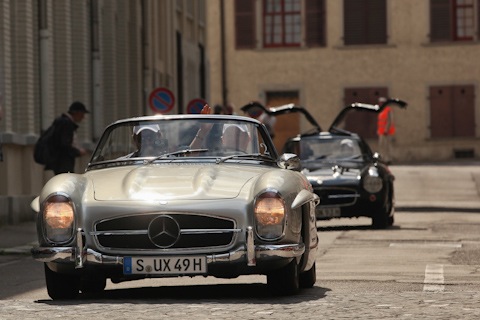
Like Caracciola's life as a racing driver, the field of vehicles at the regularity rally was also characterized by the star. Around a third of the 58 starting vehicles had a star on the front. The diverse field of participants included five Mercedes-Benz 300 SL (W198), a 300 B Adenauer Cabriolet from 1952, a 300 SC Roadster from 1956 and, of course, a considerable selection of Pagodas (230 to 280 SL).

Some rare vehicles that were originally announced were not present at the start, perhaps due to the weather. However, the drivers of the open-top pre-war sports cars proved to be weatherproof and were not deterred from braving the rain even in the worst conditions, protected by storm caps or helmets.

Exclusive Italians were also at the start, from the Fiat 8V to the Maserati 3500 GT and the Lancia Stratos HF.
Changeable weather conditions
"We can organize everything except the weather," said Paolo Spalluto before the start, looking up a little unhappily. In fact, the first day of the rally suffered greatly from the unusually humid early summer weather.

Even on the approach to the rally, some participants narrowly escaped accidents; aquaplaning had led to difficult situations on the Swiss roads. Nevertheless, the weather tended to improve as the rally progressed and some participants opened the roof of their cars.
Across Switzerland
After the opening evening at the Dolder Grand in Zurich, the participants moved to Regensdorf, where the official start was given. The highlight of the first day was the arrival at the finish line on the Bundesplatz in front of the Bundeshaus, where the drivers were allowed to set up their classic cars - an unforgettable moment.

The following day, the sports and touring cars were able to drive part of the historic Bern Grand Prix race track, a circuit that brought Rudolf Caracciola victories but also a serious accident in his 300 SL. Then it was off to the Alps, where the Grimsel and Furka Passes were crossed before spending the night in Andermatt.
On the third day, the rally once again took the drivers over the Furka and Nufenen passes into Ticino, where they were treated to an impressive air show by the P3 Flyers at Ambri airport.

The team then set off in the direction of Lugano, where the rally came to an end. Caracciola spent his last years in Lugano together with his wife Alice in a beautiful villa until his death on September 28, 1959.

A Rudolf Caracciola Museum is also to be built in Lugano. This is a goal that Paolo Spalluto has set himself and, it seems, he will also be successful here, as the signs are good. Unfortunately, however, this museum cannot be housed in the Villa Caracciola, as it is not available.
Exclusive event
The Passione Caracciola is not a rally for everyone, it is too exclusive and probably too expensive for some interested parties. However, participants are allowed to spend the night in luxury hotels, such as the Chedi in Andermatt, and are catered for in style. The rally is supported by sponsors that are no less exclusive than the event itself, be it watch manufacturer IWC, private bank Julius Baer or the Mercedes-Benz brand.

There is no need to suspect that Paolo Spalluto is making a fortune from the rally, as all the profits go to the foundation he set up in honor of Rudi Caracciola. And that's not even counting the thousands of hours that Spalluto spends year in, year out. True passion never ends!
"Smooth driving"
Rudi Caracciola was known for his calm and unspectacular driving style. Something similar was also required of the rally participants, who above all had to drive precisely if they wanted to join the ranks of Caracciola's winners.

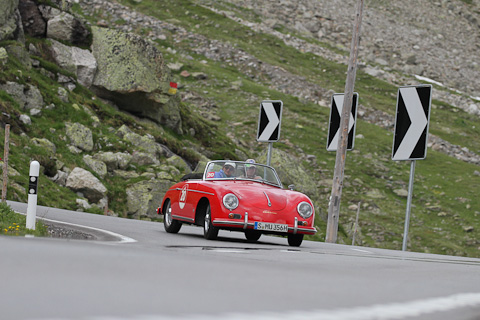
Marc Uwe and Anne Cathrin Fischer, driving a Porsche 356 A Convertible D from 1959, were the most successful in this respect, receiving the Caracciola trophy because they managed to keep exactly to the time limit on two special stages.

The overall victory went to Giustino De Sanctis and Claudia Morbiducci in a 1955 Mercedes-Benz 300 SL Gullwing, the class victories to Heinz and Doris Hofer in a 1928 Maserati 26 M, to Ermanno Keller and Wilma Fasola in a 1953 Fiat 8V, to Peter Straub and Madeleine Villiger in a 1969 Ferrari 365 GTC and to René and Rosemarie Meier in a 1976 Porsche Carrera 3.0.