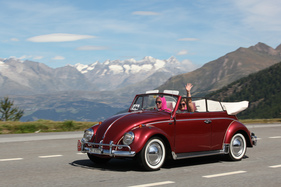
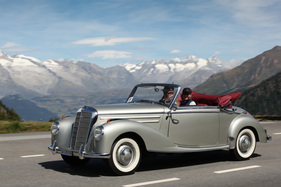
On August 28 and 29, 2015, the motto was "Ladies, start your engines!" for the tenth time. As in the previous year, the epicenter of the rally, where the steering wheel is traditionally firmly in the hands of the ladies, was Kandersteg in the Bernese Oberland.

However, a new feature of the anniversary edition was that the teams were guided through the rally by two historical figures, Emperor Napoleon and the Vogellisi. The figures stood for the destinations that the teams headed for during the two daily stages from Kandersteg. In the road books, the figures gave directions, showed the teams the way and always had a little bit of a chat.
With Napoleon on the Simplon
Friday was in Napoleon's hands: he led the 80 rally teams with their vehicles on a road that had been built on his orders at the time: the Simplon Pass. The crossing to Italy had already existed before, but it was only a mule track.
Napoleon had the road widened from 1801 so that he could drive over it with his artillery. Although he never used the road for this purpose afterwards, it was a masterpiece. Even today, a large part of the pass still runs along the route of Napoleon's engineers.

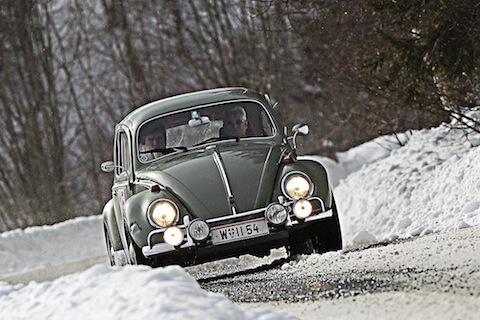
The section of the old pass road above Ried-Brig is of course a major exception. The teams were able to put their vehicles through their paces on the ascent through the Riederwald hairpin bends.
The lunch stop was in Simplon-Dorf. The last part of the route before lunch was not described using the classic road book signatures, but was marked on a map from the 19th century. This caused a few headaches, but also made us smile.
Tests on the road, evaluation in the evening
After the lunch break, it was back to Brig. On the way, the teams had to complete various special tests. In addition to classic light barrier courses, they also had to pay Napoleon the toll. The navigators (men are also allowed in the passenger seat) had to throw coins into Napoleon hats in front of the Stockalper Palace.

After a rather winding and promising additional loop via Bratsch-Leuk, the teams then traveled back to Kandersteg by car transport, including the mother-daughter team from Germany, which had won a starting place in the SwissClassics-Revue competition.

A concours was held there - another first at the OCC Jungfrau Rally. The judges were not quite ordinary: dress and etiquette were in the style of the Belle Epoque (the Belle Epoque Week takes place in Kandersteg at the end of January). The three women and their male jury colleague graded the vehicles according to special criteria, which of course included suitability for women.
If only I knew...
... where the Vogellisi was, was the final question on Saturday. At least the Swiss teams guessed reasonably quickly that Adelboden was the destination.
In the morning, however, they first headed to Lake Thun, and then via Ringoldswil and Heiligenschwendi to Heimberg. The teams then drove to Forst-Längenbühl, where they stopped for lunch. The route then led via Zwieselberg and Wimmis to Spiez, and from there to Frutigen and along the old Adelboden road to Vogellisi's home.
Here, too, the organizers included a map stage. It led via Achseten to the village center of Adelboden and on towards Gilbach. After a lap on roads for which the municipality had issued a special permit, the vehicles arrived at the Engstligenalpbahn valley station. There they stopped for a snack, completed the final tests and drove back to Kandersteg.
Late summer heat
The weather at the 10th OCC Jungfrau Rally was magnificent, giving the participants beautiful views of the Valais and Bernese mountains. However, the temperatures were unusually high for the end of August, climbing to over 30 degrees in the valleys.

Not only did the vehicle crews and marshals work up a sweat, the cooling systems of some of the cars were also put to the test. Those who had a functioning auxiliary fan were lucky.

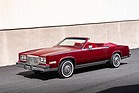
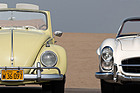
The field of participants at this year's OCC Jungfrau Rally was once again broadly diversified - the cars also came from a wide variety of decades. For once, however, no pre-war cars were entered this year. The oldest vehicles at least had pre-war genes, such as a 1947 Citroen Traction Avant or the various quaint MG roadsters. However, the majority of the vehicles - as at many other rallies - were from the sixties and seventies. The newest car was a 1982 Porsche 924.
Positive balance
Both the organizers and the participants drew a positive balance at the end. The rally was accident-free, but the breakdown service had an above-average amount to do this time. Many participants rated the choice of route as a highlight. For their part, the numerous spectators who were present by chance or on purpose were delighted with the classic cars, although some were a little surprised to see that only women were at the wheel... However, most of the ladies should be used to this reaction by now.
Anniversary winner
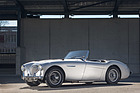
There was a small sensation at the awards ceremony afterwards: the anniversary edition of the OCC Jungfrau Rally was won by the very team that had already won the very first rally in 2006: the Garovi/Schützinger pairing in an Austin Healey.

First place in the Concours de Kandersteg went to the Rutschmann/Rutschmann team for their Chevrolet Corvette C2 Cabriolet - the car that impressed the jury the most.

A not-so-ordinary additional prize was awarded for the most aesthetically pleasing oil stain found on the cardboard boxes lying under the cars in Simplon-Dorf.
The 11th OCC Jungfrau Rally will take place again at the end of August 2016. The organizers did not reveal any details at the weekend. The venue and further details will be communicated on the website later this fall .