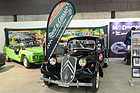
It had already been a year since the first classic car fair was held in Berlin. As the first edition was a success with around 20,000 visitors, the organizers set themselves even higher goals for the second edition. On October 6-9, 2016, Motorworld Classics opened its doors again with a significantly larger area.

Tradition can be felt everywhere
Berlin is not necessarily a car city like Wolfsburg or Stuttgart, but Germany's capital also has a rich automotive history. Until 1950, for example, the IAA was repeatedly held in Berlin - in exactly the same halls as Motorworld Classics.

Automobiles were also produced in Berlin, and some of the models were shown as part of a special exhibition, including the Amphicar, the Adler Autobahnwagen, the Hanomag 1.3 liter Autobahn or the Slaby-Beringer with DKW engine, which were produced in Berlin as a whole or in parts (e.g. bodywork).
Larger and more frequented
With more space and additional halls, including the grandiose and bright entrance hall 20, room was created for additional exhibitors and a total of over 1000 vehicles. While there was comparatively little going on on Thursday and Friday, the crowds of visitors streamed through the beautifully decorated halls, especially at the weekend. According to initial estimates, around 25,000 visitors were counted.
With charm and warmth
What sets the Berlin event apart from other classic car fairs is the fresh and charming way in which the theme is approached. The background music, which was performed with great enthusiasm and joy by the three gentlemen from the petrol station and the ladies, among others, deserves a special mention here.

As a visitor, it was much easier to get into the vacation mood in Berlin than at other comparable trade fairs, which was certainly also due to the sometimes good weather and the many friendly people you met everywhere.
Many stars
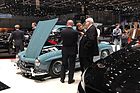
Two brands were of course particularly present, after all, we were in Germany. There was Mercedes-Benz, which was represented with an eye-catching factory stand, which was smaller than in Stuttgart or Essen, but offered plenty of space for the two exhibits, a blue 300 SL and a golden 280 SL. The factory presence was complemented by the "Alltime Stars", who already reported three cars sold on Saturday.

Mercedes automobiles were also to be found throughout all the halls, with the convertible models of the various model series in particular catching the eye time and again. Thanks to the Mercedes Veterans Club, rare saloons were also on display. And, of course, the pontoon friends showed off their chubby fifties and sixties treasures.

It almost goes without saying that the gullwing cars were not missing either.
The little horses from Stuttgart
The sports cars from Zuffenhausen were also well represented, especially the rear-engined 911 models were to be found in many places and in all their colorful glory.

The 356 was also well represented, while the transaxle models were much less conspicuous in terms of numbers. Porsche did not have a factory stand, but the dealers represented the brand well.
BMW with group brands
BMW was officially present with three Group brands, namely Mini, Rolls-Royce and of course BMW.

Three exhibits were the focus of the Munich presence: the 1999 anniversary Mini with chrome livery by David Bowie, a Rolls-Royce Phantom I 10EX with streamlined torpedo bodywork from 1926 and a BMW 2002 tii, which looked like an orange model from 1972, but was actually only assembled from individual parts and a body shell in 2005.

The presence was complemented (of course) by a BMW motorcycle, but above all by an impressive selection of lights that were adapted to the individual objects.
Dealers in particular ...
The second Motorworld Classics was certainly characterized by the strong presence of well-known dealers and specialists, some of whom had very large stands. For example, "Von Bargen", "Chrome Cars", "Garage du Pont", "Potomac Classics", "Rosier Classic Sterne" or "HK Engineering" showed cars that could be bought, even if not everything was intended for the small purse.

Some visitors rubbed their eyes in amazement when they discovered a Mercedes-Benz 280 SL for EUR 328,000 and for some classic cars the price was only given on request.

The fact that high prices do not have to be an obstacle was demonstrated by some thoroughly satisfied dealers and vehicles sold, such as the anniversary Beetle from 1985, which was listed for EUR 36,800 with 26 km on the clock.
... but also some clubs
What would classic car fairs be without the clubs and their attractive stands? However, it wasn't easy for them, as Veterama was taking place at the same time and some club representatives had to choose between one event or the other.
The Mercedes clubs, which represented the most important model series of the company, e.g. W124, W123, W201, R/C107, R129, etc.

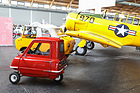
The Alfa Club also showed three interesting classics from its rich tradition and the Glas Club International was able to present a Glas 1304 TS with racing history on its stand. And on the Heinkel Club stand, there was of course the 154 cabin to see alongside the scooter.

The club stands were complemented by museum presences, dominated by the "PS-Speicher" museum, which not only had a 1957 Ford Taunus 15M with Mille Miglia history on display, but also organized a special show all about cars from Berlin.
Of course, many of the well-known service providers for classic cars in Berlin also took part, whether they were experts, insurance companies or automobile clubs.

In any case, anyone who wanted to find out more about classic cars or modern classics in Berlin would find plenty of people to talk to, most of whom were happy to make time for them. In a much less hectic atmosphere than at other trade fairs, better and longer conversations were possible.
The summer garden as dessert
Anyone who had had enough of wandering around the more or less well-lit halls could sit outside in the sun (if it was shining) or at least stretch their legs in the summer garden. And those cars that they might have missed inside the halls could be found outside.

They were allowed to park there free of charge in the inner courtyard, provided they had reached the age of 30. The many parking spaces in the summer garden were home to some rarities that you don't see every day, such as the Wartburg 312 station wagon, the Borgward Isabella, a whole series of Ford Transits and the Sunbeam Alpine, as well as many classics from well-known German brands.

Johannes Hübner commented on most of the new arrivals and shared many an anecdote and background story, which is well worth knowing and only made the old cars even more likeable.
Even more potential
What could the trade fair improve? A date that does not overlap with other similar events would certainly be desirable.
Of course, we would also be pleased to see some clubs that have not yet taken advantage of the opportunity in Berlin. And the (additional?) dealers could perhaps gear their offerings even more towards a broad range of tastes and also show a few pre-war classics?
The ADAC Youngtimer Tour, which made a guest appearance at Motorworld Classics on October 7, could perhaps be given a little more space. And the visitor guidance through the individual halls could be made a little clearer, and the culinary offer could be expanded a little.
However, this is all criticism at a high level; the most important thing for visitors is probably that none of the specific charm of the trade fair is lost in future growth.