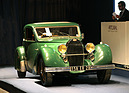
The Interclassics trade fair was held for the ninth time at the Brussels Expo site in the north of the Belgian capital. In three halls with 40,000 square meters of exhibition space, there was an outstanding range of high-quality products from the classic car trade. Automobile clubs and interest groups were also well represented once again. The relevant accompanying trade with automobilia and art was not missing either. Prizes were awarded in thirteen categories, for example for the best car of a decade on display, the best stand presentation and, of course, for the "Best of Show", the greatest car of the fair. Last but not least, visitors were also treated to an outstanding special show.
110 years of Maserati
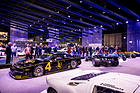
So let's start our tour (which cannot be complete given the wealth of impressions) in the mighty main hall "Palais 5". This year's special show "110 Years of Maserati", which had a decisive influence on this year's Interclassics in Brussels, was housed in the rear area of the hall. The eventful history of the brand with the trident was presented on the basis of 24 cars, several motorcycles, films and accompanying information in three languages. As in the previous year, the exhibits in the special show were effectively illuminated in red, but this is rather a hindrance from a photographic point of view.

It was certainly no easy task to illustrate the company's long history with a selection of racing cars, road-going sports cars and sports saloons, but the exhibition organizers did an excellent job. Visitors were able to follow the history of the Maserati company step by step. This extends from the early "racing era" of the Maserati brothers, through the period shaped by the industrialist Adolfo Orsi, the rather brief intermezzo with Citroën, the period under the aegis of Alejandro de Tomaso and the joint period with Ferrari to the current "Stellanti era".

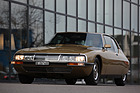
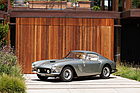
Typical cars were shown for each section, with motorcycles even bearing the Maserati name during the "Orsi era". The oldest exhibit was the Tipo 26 racing car from 1928, the youngest a current MC 20. During the tour, visitors could discover racing cars from the fifties such as the 250 F from 1954 or the Maserati 300 S from 1955. Of course, the Maserati A6GCS/53 from this year's exhibition poster was not missing. From the Citroën era, not only the characteristic SM, but also the Bora, Merak and Khamsin sports cars were presented.

The large Quattroporte sports saloon was shown as a prototype by Frua and in modified form as a fire engine for Formula 1. The 1951 Maserati 1500 GT designed by Carrozzeria Pinin Farina, which clearly reminded the reporter of the Cisitalia 202, also deserves a special mention. Finally, another example of successful design was the Maserati 2000 GS Frua Spider, on loan from the Louwman Museum.
Many clubs, many award winners
Once again this year, the Belgian D'Ieteren Group exhibited a number of treasures from the company's own "Gallery" on its award-winning exhibition stands: two Audi 100s, two Seat, two Golf Is and a Škoda Oktavia Combi from 1965. A classic BMW Isetta was also displayed alongside a modern-day Microlino.

Let's stay with the award winners for a moment. The "Best of Show" title went to the 1953 Maserati A6 GCS from Autoworld Brussels; the award for the best restoration went to an impressive Apollo 5000 GT Spyder from 1966. The Belgian Historic Vehicle Association (BEHVA) chose a BMW 319 Drauz Roadster from 1934 on the BMW Bavaria Club stand as "Best of Show".

Once again, it was pleasing to note that the classic car clubs were given ample opportunity to present themselves here. For example, there was a small exhibition of "microcars" and interesting club stands from the Belgian clubs for Citroën and Peugeot classic cars.

Italy, France, Germany
This year's special show also seemed to have had an impact on the dealer offer. Not only were numerous Maserati cars on offer. There was also no shortage of other Italian makes - namely Ferrari and Alfa Romeo. Apart from a number of "price on request" offers or a Ferrari 250 GT 2+2 for 450,000 euros, there was, for example, an Alfa Romeo Giulia SS for 139,500 euros, a Maserati Bora for 129,500 euros or 159,950 euros, a Lamborghini Espada for 195,000 euros, a Ferrari 348 Spider for 119,950 euros and a Lancia Delta Integrale Evoluzione II for 139,500 euros to choose from.

The Citroën SM, of which several examples were on offer - including a 1971 Chapropn Cabriolet "Mylord" for 145,000 euros - bridged the gap to the French brands, while a 1971 DS with only 42,600 km on the clock was on offer for 39,500 euros. Cars from British manufacturers were also well represented again. For example, one would have been spoiled for choice between a few left-hand drive roadsters from Morgan, a Lotus Esprit, a Range Rover for 55,000 euros or a Daimler SP 250 for 68,500 euros as well as an ultra-flat Aston Martin Lagonda. A Jaguar XK 120 OTS, which probably needed some attention, had already been sold on Saturday, as had several other exhibits.

Of course, there were also vehicles from German manufacturers on offer, even a rare Glas 1700 GT Cabriolet for 97,500 euros. At BMW, the range of cars on offer began with a six-cylinder Z3 from 1999 for 17,000 euros and ended with a 507 offered by Axel Schuette for no specific price. A BMW 327 sports convertible from 1939 for 119,327 euros was in between. Several Mercedes-Benz 123 series cars - including coupés - were on offer; a 300 CE-24 Cabriolet from the 124 series with less than 100,000 km on the clock was on offer for 45,500 euros. A 380 SEC from 1982 was to cost €17,500.

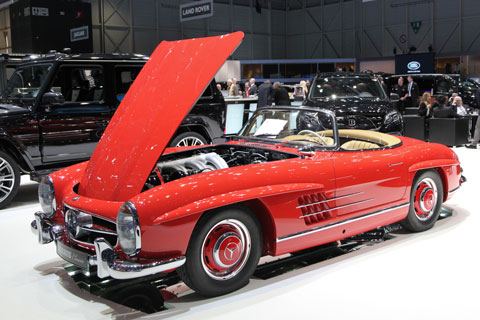
Almost eleven times as much - namely €189,000 - would have been due for a Mercedes-Benz 300 Cabriolet D from 1954. The upper end of the price scale was probably marked by two 300 SLs - a Gullwing and a Roadster - again on the Axel Schuette stand. For Porsche, examples include a 911 Targa from 1969 painted in the color "blood orange" for 117,500 euros, a 928 S4 with an intense green interior for 34,750 euros and a 968 from 1992 for 31,750 euros.

Low price or low mileage?
There were also some cars with low mileage, often offered by the Dutch company Alphons Ruyl. For example, you could find a 1984 Peugeot 505 Familiale with a mileage of just 26,700 km for 28,000 euros or a Citroën AX 14 with 35,000 km for 14,500 euros. A mimosa yellow Mercedes-Benz 230 CE from 1982 was already "overcooked". Finally, there was a light green VW Lupo 1.0 with only 6828 km "on the clock" for 8750 euros.

Even if most of the cars on offer were in a different price league, this time the visitor could have made a really extreme choice in Brussels for less than 9000 euros: Would he have chosen the €8500 Methuselah Chenard & Walcker 10 CV from 1927? Or would he have opted for the often underrated Renault Renault Avantime 2.2 CDI for 8000 euros?

Conclusion: Like its sister fair in Maastricht, Interclassics Brussels also showcases high-quality classic cars. Three well-filled exhibition halls are more than enough for an eventful day. It dispenses with non-automotive "lifestyle" products as well as an excess of modern so-called "hypercars" and provides sufficient space for the club scene. Visitors to a classic car show really couldn't wish for more.