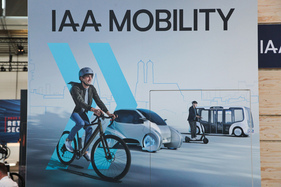


The car-savvy visitor to the IAA Mobility 2021 must be wondering. What did the three letters "IAA" stand for? Exactly for International Motor Show. Well, the trade fair is indeed international, but actually almost trinational, as most of the exhibitors seem to come from Germany, China and Switzerland. The trade fair organizers also no longer take the term "automobile" very seriously. In fact, there are significantly more bicycles than cars at the IAA 2021. The last "A" for "exhibition" is correct, but compared to previous IAAs, the space has shrunk enormously and a maximum of 2000 square meters per exhibitor has been approved in the new trade fair concept. You can't fit too many cars in there if you also want to accommodate presentation areas and seating.

The IAA Mobility is more of a battle of concepts than a comparative show of today's existing cars. While the pioneering premieres are mainly shown in the exhibition halls of the Munich trade fair, there are other exhibition points spread across the city where car models intended more for consumers are also presented.
Hardly possible without a plug
The fact that most of the cars on show, regardless of whether they come from Germany or China, are equipped with an electric drive is certainly no longer surprising.

But the fact that even the (few) motorcycles and scooters on show are battery-powered is perhaps more surprising. The fact that cell phone providers such as Huawei are also exhibiting fits in with the idea that a car is actually a smartphone on wheels.

However, the good old combustion engine has not yet been completely displaced, on the one hand Deutz is showing a hydrogen combustion engine, on the other hand Motorworld is taking up the cudgels for the automobile as we still know it with its "IAA Heritage" hall.
Old sheet metal in Hall B4
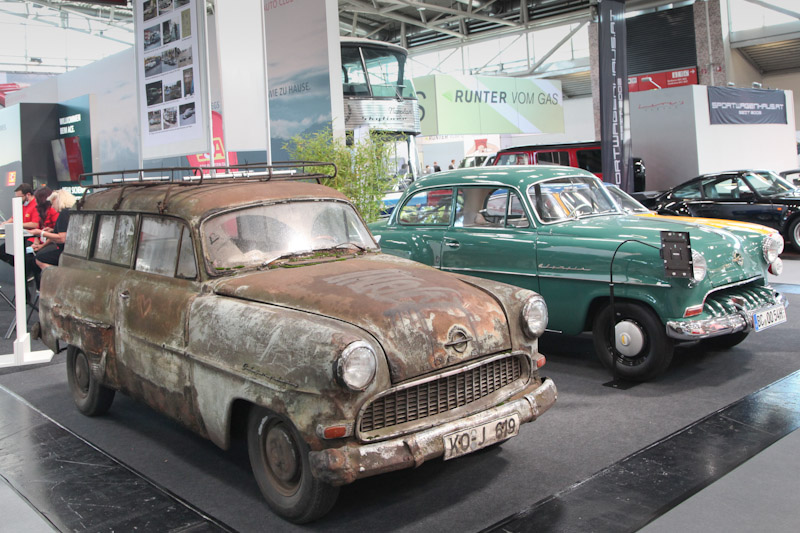
The "Motorworld IAA Heritage" in Hall B4 looks a bit like a trade fair within a trade fair. In principle, you change eras when you step from B5 (bicycles) or B3 (Mercedes-Benz, Wey, etc.) into Hall B4.

The look is not unintentionally reminiscent of a classic car show. Of course, this has to do with Motorworld, which is the organizer.

And it is a real consolation for all automobile-enthusiastic IAA visitors who have hardly come across any vehicles with combustion engines and classic drive technology after walking through the other halls. But there are plenty of them in Hall B4.

It could even be said that there are more cars in this hall than in the rest of the trade fair, which is spread over nine halls, at least approximately.
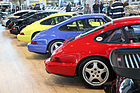
There are numerous Mercedes-Benz, Ferrari, Alfa Romeo, Opel, Ford, Lamborghini, Porsche, Borgward, BMW, Jaguar and others from past decades, as well as contemporary super sports cars and tuning art.
In the middle, a cozy inn invites you to enjoy a Bavarian breakfast or simply a drink. Here, but also in the Heritage Hall in general, people seem to be in a good mood and more inspired than in the other halls, at least that's the feeling.

The Isdera Imperator 108i, the patina Opel Olympia Caravan and the two Ford Taunus 17Ms are certainly worth a second look.

The Ford Capri, which took part in the 1972 Olympic Rally, including the press bus from back then, is also a feast for the eyes. The two are promoting next year's resumption of the Olympic Rally as a classic car event to mark its 50th anniversary. They will then drive along the original venues from Kiel to Munich.

And inside the Motorworld stand, there will probably also be the only petrol-powered scooter at the trade fair, a Lambretta.
For those who like to be active, a 15-minute slot on the Carrera racetrack is recommended. After all, you can never feel too young ...
The small car show
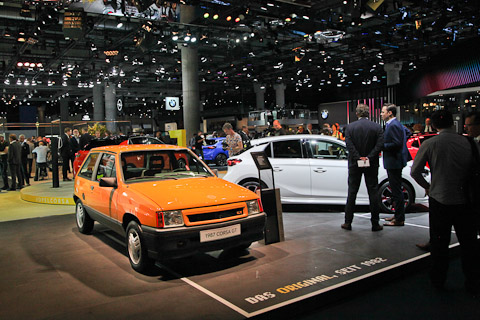
Until now, people always thought that the Geneva Motor Show was clearly laid out and that the stands were compact, but the IAA Mobility goes at least one step further. The focus for car manufacturers is also on concepts, studies and a look into the future.

The fact that a 1602 from 1972 has nevertheless found a place on BMW's clearly laid out stand can almost be considered a miracle. At the other car manufacturers, the past appears at most (as at Volkswagen) on the video wall (as a Beetle scurrying past).

Unfortunately, the number of car manufacturers represented can be counted on two hands; the Japanese are missing, as are the entire Stellantis Group, the British and most of the Volkswagen Group brands. Even the Chinese are unfortunately only present with a small part of their portfolio.

Some interesting new products will be on show in Munich, such as the "i Vision CirCular" study from BMW and the "AVTR" concept car from Mercedes-Benz.

Volkswagen presents the ID.Life, Renault the electric Mégane.

And then there are a few Chinese companies that have some interesting products to offer, such as the Ora Cat. Note the "rally version" in particular.

The accessories industry is also on site and shows components and stylized cars, but little concrete for the end consumer.

Continental celebrates 150 years and presents a rather different Volkswagen Bus T2.
Two-wheeler show?
The IAA is more of a bike show than a car show, as can be seen from a glance into Halls B5 and B6, where you not only encounter a broad ecosystem of bicycle manufacturers, but also two unfortunately almost hidden and barely illuminated special exhibitions on the history of racing bikes and mountain bikes (in the form of individual exhibits), which would have deserved more attention.

Bicycle enthusiasts have it good anyway, because behind Hall 6 you can take a test ride and get a feel for the potential new purchase.

Whether moguls or flat tracks, everything is available.

The air is getting thinner for motorcycle enthusiasts. At least there are a few electric scooters on display, but there are hardly any real motorcycles.
One exception is Husqvarna, where you can see the study of an electric Pilen.

And then there is the stand of a German start-up called "Black Tea", which is presenting an electric scrambler-style moped. The name "Black Tea" harks back to the idea of the "café racer".
Is this the future?
One may ask whether the trade fair concept, as now presented at the IAA Mobility in Munich, is really the future. A long journey is hardly worthwhile for journalists, especially as most of the information is distributed practically live via the Internet. Consumers can hardly find any cars at the trade fair that they can actually buy. The classic car enthusiast would probably be better served by a pure classic car show.

Is Munich trying too hard to strike a balance between the most diverse demands? Are they too afraid of the climate movement, which threatened to stage demonstrations? The ever-present police presence does nothing to improve the mood, and the fact that the exhibition is spread throughout the city doesn't make things any easier.
Almost like back then?
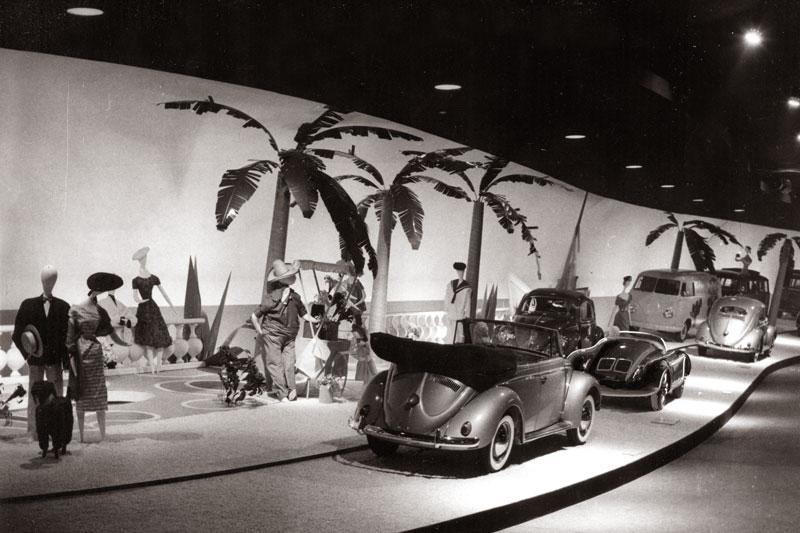
To be honest, it has to be said that there have been motor shows with cars, motorcycles and bicycles before. The Geneva Show even featured boats, plus camping and all kinds of accessories. So the idea of mixing different themes is not entirely new. However, the variety of products on offer has increased dramatically since the 1950s, and the information culture has changed at the same time.

We refrain from making a final verdict; after all, the trade fair is still a few days away. Readers are welcome to add their impressions via the comments function!