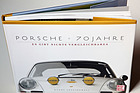
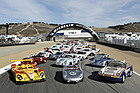
On Monday evening (14.2.2011) at the Pantheon Basel, Dr. Heinz Rabe gave a talk on the life and work of the Porsche family on the occasion of the current Porsche exhibition.
Dr. Heinz Rabe, son of long-time Porsche chief designer Karl Rabe, provided unique insights into his father's eventful career and the development of the Porsche company. With his fascinating presentation, he was able to inspire the numerous guests with unique visual and audio documents.
We would like to share a few excerpts from his presentation with our readers. Dr. Heinz Rabe said:
"In 1907, Ferdinand Porsche was inspired by his friend Count Alexander Sascha Konrad to build a racing car, the later "Sascha"! The Sascha ADSR 2 with a 2-liter engine reached a speed of 170 km/h as early as 1922 at the Targa Florio!
Porsche was involved with small cars from an early stage, but his love was always for sports cars and racing cars, as he used them as opportunities to experiment with his ideas. In 1923, Ferdinand Porsche moved to the German Daimler works in Stuttgart as technical director and member of the board. Heinz Rabe's father remained in Wiener Neustadt and took over the design office and technical management of Austro-Daimler. Under his leadership, the ADR, Bergmeister and an 8-cylinder vehicle were developed. On May 1, 1923, Ferdinand Porsche took up his position at Daimler Motorengesellschaft in Stuttgart. Under his leadership, various famous vehicle models were created which bore the unmistakable signature of Ferdinand Porsche. The 4 cylinder, 2 liter supercharged racing car from 1923, which he improved and in which Christian Werner won the Targa-Florio. The 2 liter, 8 cylinder supercharged racing car in which Rudolf Caracciola won the 1926 German GP on the Avus. The 2-liter, 6-cylinder passenger car, the 838, as an inexpensive and robust entry-level Mercedes model. The 6-cylinder, 6.8-liter compressor sports car of the S (Sport) model, which became a legendary vehicle in 1927 with a top speed of 180 km/h. The 7-liter, 6-cylinder SS (Super Sport) model sports car with an output of 225 hp and the SSK (Super Sport Kurz) with a shortened chassis. These were joined by all-wheel drive off-road vehicles and Schwimmwagen. In 1928, Daimler-Benz presented the "Nürburg" developed by Ferdinand Porsche with an 8-cylinder in-line engine.
On January 1, 1929, Ferdinand Porsche, who had already received an honorary doctorate from Stuttgart Technical University in 1924 for his achievements, moved to Steirer Werke in Steyr (Upper Austria) as Technical Director, where Karl Rabe was also working in the meantime. From then on, their professional paths would never part again. Under their leadership, the Type 30 and Type Austria passenger cars were developed as comfortable in-line 8-cylinder cars.
In 1930, Ferdinand Porsche returned to Stuttgart and founded Dr. Ing. hc Porsche GmbH in Stuttgart at Kronenstrasse 24, near Stuttgart's main railway station, together with 12 designers with whom he had already worked in Austria. Heinz Rabe's father became chief designer and remained so until his retirement in 1965.
The first design order was a mid-range passenger car with a 6-cylinder engine for the Wanderer Werke in Chemnitz. This was followed by the Type 8, a streamlined saloon with an 8-cylinder engine, also for Wanderer Werke. The Type 12 was a small car with a 5-cylinder radial engine for Zündapp in Nuremberg. The Type 22 was a 16-cylinder racing car for Auto Union. The Type 22 was used in various engine and body variants and won 43 first places in 79 races between 1934 and 1939. The monoposto was powered by a V16 cylinder with 528 hp, plus a synchronized 5-speed manual gearbox, a multi-plate clutch and front torsion bar springs, which was also a Porsche invention. The top speed was around 340 km/h. Ferdinand Porsche personally took part in almost all the races.
The Type 32 from 1932 was a 4-seater saloon for NSU (Neckarsulm). This vehicle already had an air-cooled 4-cylinder boxer engine in the rear and torsion bar suspension and can be described as the forerunner of the Volkswagen. The Porsche Type 60 is the VW Beetle, which was built essentially unchanged in its basic design until 2003.
On June 22, 1934, the Reich Association of the German Automotive Industry and the Porsche company signed a contract for the development of a Volkswagen. Similar to the American Ford-T model, a vehicle for everyone was to be mass-produced in Germany. Initially, two preliminary prototypes, an open and a closed vehicle, were built in the garage of Villa Porsche on Feuerbacherweg in Stuttgart. These vehicles had 2-cylinder engines and consisted of a wooden, sheet metal chassis construction. The car floor was made of planks. The bodies were manufactured at the Reuter body factory in Stuttgart's Augustenstrasse. The air-cooled four-cylinder, four-stroke boxer engine with a displacement of 985cc and an output of 23.5 hp was only used in the further developed form. All three vehicles in this series had torsion bar suspension and one of them already had an all-steel chassis. The floor panel now formed a completely closed underside of the car. No window at the rear, but ventilation slits and typical for these models, the headlights were mounted on the hood. A further prototype series of 30 Volkswagens was built at Daimler Benz in Untertürkheim from January to May 1937 and subjected to a large-scale series of tests covering a total of 2.4 million kilometers. Each vehicle covered 100,000 kilometers. The costs were borne by the state. In addition to 29 coupes, there was also a convertible. The all-steel bodies had headlights integrated into the fenders and a small hood, and the doors opened to the rear. The interior was spartan and simple for cost reasons. The VW 38 series gave the Volkswagen its final form.
In addition to developing the Volkswagen, Ferdinand Porsche also designed the Daimler Benz world record car, the Type 80. The first test run with the aircraft engine prototype was successfully carried out on the Daimler Benz AG chassis dynamometer, but then the war put an end to the preparations for the world record. Porsche was also involved in the development of tractors for agriculture.
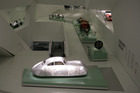
In June 1938, the Porsche company moved to what is now Plant 1. There was now also a testing department here. With the Type 64, a sports car was added to the VW family in 1939. The vehicle had an aluminum body and a VW engine with a displacement of 1.5 liters. As a result of the air raids, the plant was relocated to a former sawmill in Gmünd, Austria, in 1944. The Zuffenhausen plant remained confiscated by the American occupying forces until the end of 1955 and was used as a repair plant for trucks.
On the basis of contractual agreements with the Italian company Cisitalia, a racing car was developed in Gmünd, the Porsche Type 360! A 12-cylinder monoposto, water-cooled, with torsion bar suspension and selectable four-wheel drive, synchronized gearbox and the chassis consisted of a welded tubular frame. This was a sensation at the time. In 1947, a beautiful sports car was also created for Cisitalia under the Type 370 in two versions, a racing version and a road-going version, with a 2-liter 8-cylinder V-engine in the rear.
Numerous changes and improvements were made to the Volkswagen since the start of post-war production, but the basic design always remained the same. The Beetle became a symbol of the German economic miracle. In 1978, the last Beetle built in Germany left the Emden branch plant and in July 2003, VW production in Puebla, Mexico was finally discontinued. But a total of 22 million Beetles were built. The largest ever production figure for a vehicle type up to that point!
On 8.6.48 the first sports car with the name Porsche was finished in Gmünd. The new car, an open roadster with a light-alloy body and mid-engine, was powered by a VW engine with a reinforced cylinder head. In 1950, the company returned to Stuttgart, although Plant 1 was still occupied at first, but premises were rented from the Reuter company. In 1964, the Reuter company with its 1000 employees was taken over by Porsche. A new era began in 1951 with the construction of Plant 2 for production and administration next to the Reuter body plant. From now on, Porsche is no longer just a design office, but also a production plant for its own sports cars. Ferry Porsche took over the management of the company and led it to become the global company it is today. His father Ferdinand did not live to see these successes. He died on January 30, 1951 after spending a year and a half in prison in France working for Renault on the development and series planning of a new small car, the 4CV. He made suggestions for changes to the suspension and weight distribution. With the 4-camshaft engine, the Fuhrmann engine, Renault finally said goodbye to the previously used improved VW engines. The engine initially developed for the 1.5 liter, racing Spyder, Type 550 was later used as the Carrera engine in the production 356 sports car. By the time the 911 was launched in 1964, a total of 78,000 Type 356 sports cars had been sold.
In September 1963, the new Porsche with the model designation 901 was presented at the IAA in Frankfurt. However, as Peugeot had protected the number combination with the zero in the middle, it was renamed the Type 911. The first Targa was presented in September 1965. And the first Porsche with a plastic body was the 904 racing sports car in 1964. Production of the 356 finally came to an end in 1965. The 911 has survived to this day and continues to enjoy a huge fan base.