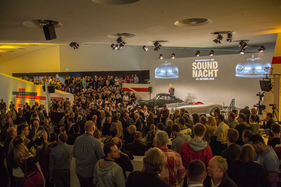
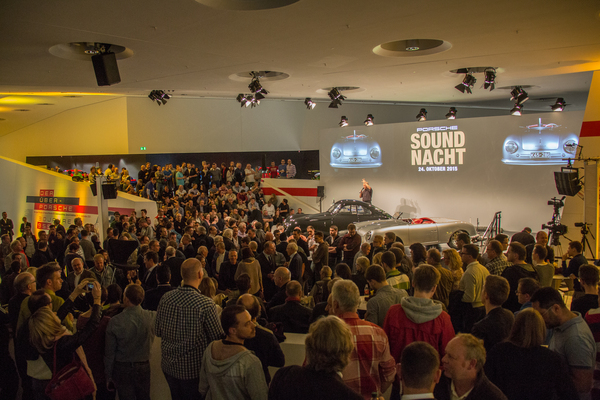
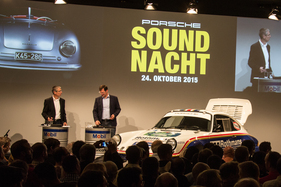
Almost at the same time as the premiere of the new James Bond film, Porsche invited guests to the fifth Sound Night at the factory museum in Zuffenhausen. However, the competition with the British agent did not dampen demand for the 911 tickets at all.
Orchestra rehearsal
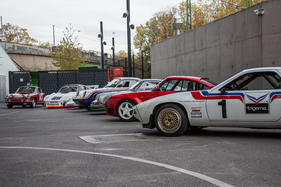
Even before the event, the S-Bahn passengers at the stop behind the museum got their money's worth; the warm-up of the engines before the event was the event of the day that afternoon in Zuffenhausen.
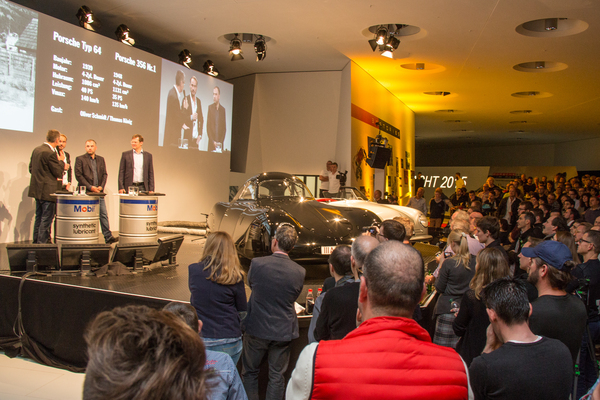
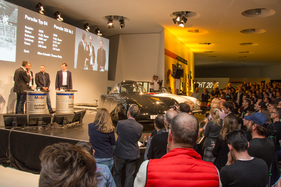
As in June of this year at the "Le Mans in Zuffenhausen" event, Austrian motorsport journalist Walter Zipser once again welcomed the expectant guests. He was assisted by Dieter Landenberger, head of the historical archive. For motorsport enthusiasts, the event was a kind of first warm-up for Christmas, which is just two months away.
With contemporary witnesses and insiders
The history of the vehicles on display was brought to life above all by the contemporary witnesses present, a concept that was convincing. Racing legends of the past and successful drivers of the modern era, including a total of four Le Mans winners, had found their way to Zuffenhausen to inspire the audience with their stories and previously unknown details.
The beginning
Two icons of Porsche's early history made the start. The first ever Porsche sports car, a 356 with the number 1, was on stage as a prototype in silver. With this car, Ferry Porsche realized his vision of driving in its most beautiful form in 1948.
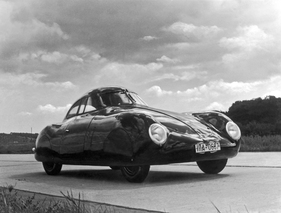
Built with many VW parts, modified and with a light but rigid tubular frame, following the mid-engine concept.
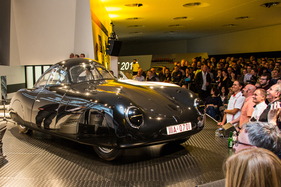
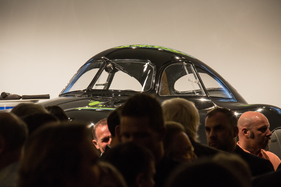
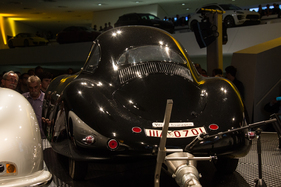
The beautiful aluminum body designed by Kommenda defined the design language of the company for decades. Next to it stood the ancestor of all Porsche sports cars, the Type 64 Berlin-Rome car from 1939, painted entirely in black, the eye-catcher of the evening. This car belongs to the Prototyp Autonmuseum in Hamburg, represented by its two creators Oliver Schmidt and Thomas König.
Only three of these cars were built to take part in the planned 1680 km race from Berlin to Rome. Only two vehicles survived the war. While the better-known silver vehicle was stored in Gmünd, the car on display in Zuffenhausen survived the war in Zell am See.
Both cars were acquired by the Austrian racing driver Otto Mathé, who later sold the black car to Hamburg. By then, however, the car was already in a pitiful condition. The Americans had abused the car so badly for off-road excursions that some parts of the chassis had simply found their way out through the mudguards. And as if that wasn't enough, since the car was very cramped, they had also removed the roof without further ado.
But what was the title of the fifth Bond film? You only live twice. Exactly. Over the years, the Prototype Museum bought several cars from Otto Mathé and, as luck would have it, there were often parts that belonged to the Type 64, so that over time it became more and more complete and came back to life.
The legendary number 3842, which was noted on all parts of the car, made it possible to bring the technology together. Otto Mathé had not only been involved in car racing and lubricants, but also made ski bindings. The door handles and other light metal parts for the engine were also found in a box of ski bindings that was sold to Hamburg, so it was no wonder that it took many years before the car could be resurrected in its original form, and it took over a decade to rebuild the technology from the parts puzzle, and the bodywork could be reconstructed true to the original with the help of the other vehicle still in existence.
The Berlin-Rome race, intended as a counterpart to the Mille Miglia, never took place, as the Second World War intervened. It was not until eleven years later that the car was put to the test, when Otto Mathé competed in the international Alpine Rally in Innsbruck.
This was his first major Porsche success, although it should be noted that he drove with one arm, as his right arm had been paralyzed since a serious accident in 1934. With this success, private driver Mathé laid the foundation for countless Porsche victories that were to follow in the years and decades that followed.
However, the museum owners never savored the 140 km/h that the 32 hp car was supposed to run. It is amazing what the test car was able to achieve in terms of speed with a displacement of only 985 cubic centimetres, the streamlined body design and its narrow tires. However, this also meant that the driver had to sit in the middle of the car, while the passenger had to make do with an emergency seat diagonally behind. The two spare wheels, which were housed in the front of the car, fared comparatively well, because unlike the occupants, they hardly felt anything of the heat in the car.
Porsche used the car for test drives. The average speeds of well over 100 km/h achieved prove that nothing was given to the car. The engine concept, which was later also implemented in the number 1, began with an increase in performance through twin carburetors, higher compression and later also with its own cylinder heads.
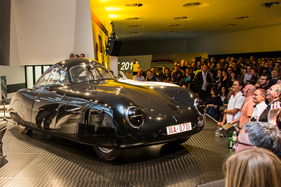
And the sound was indeed inimitable, the visitors had already been waiting impatiently for it. The engine started up impressively spontaneously and made a strikingly sonorous sound for such a small engine, even when idling.
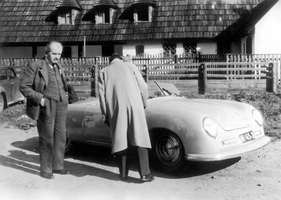
From 1939 to 1948: The number 1 again had a four-cylinder boxer engine, albeit enlarged to 1100 cc, with larger carburetors and a sharper camshaft, and thus produced 40 hp. With the passenger seat covered, this enabled 140 km/h on the highway at the time. Number 1 was completed in June 1948 and just three weeks later it went to its first race at the Innsbruck city race.
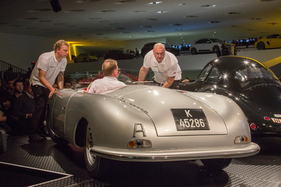
The four-cylinder sound of the small engine still thrills more than just Porsche fans today.
Flatter, faster, more extreme
The Porsche 718 RS 60 Spyder entered the stage next. It was built in 1960 for the World Sports Car Championship and was already successful in its first race in the USA: a double victory at the 12 Hours of Sebring. The flat sports car was accompanied by the driver and mechanic of the time: Hans Herrmann and Egon Alber.
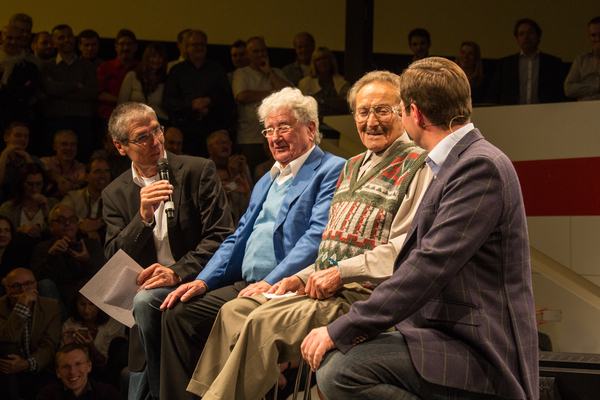
Alber joined Porsche at the age of 14 and never left the company, a true veteran of the company. And Hans Hermann hardly needed to introduce Walter Zipser to anyone; he is one of the most famous Porsche racing drivers of all time.
He achieved great victories with the 718 and there was a lot to tell.
Actually, in 1960 Porsche was not yet ready to compete with the large-volume Ferrari and Maserati, but the heavier cars were less able to cope with the transverse grooves on the Sebring airfield. For the time, the car had a futuristic body, and competitors were amazed that the car could even keep up with the small 1.6 liter engine.
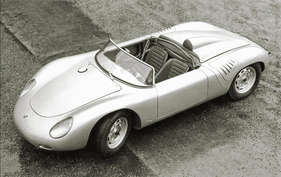
The Targa Florio, with only one long straight and the rest of the track consisting of bends and downhill sections, naturally suited the small Porsche, which enabled it to achieve its first overall victory.
Egon Alber - as a mechanic in the USA for the first time - first had to get used to the high temperatures in America and then use his expenses money to pay for the transporter to take the cars to Sebring.
Hans Herrmann explained that the successes were largely due to the mechanics. They had worked until they were finished, nobody was interested in what time it was or how long they had been working. This was also due to the fact that instead of the 12 to 15 men actually required, only seven were available. With the first gearboxes, changing the transmission was still very time-consuming, and it was only later with the "tunnel gearboxes" that this work could be done more quickly.
Hans Mezger was the contact person for engine issues, otherwise the mechanics had to see for themselves how they got on. This cannot be compared with the effort that Porsche puts into Le Mans today. And to see how work is done in Weissach today would be of interest to the old warhorses, said Herrmann. A new organizational task for Dieter Landenberger?
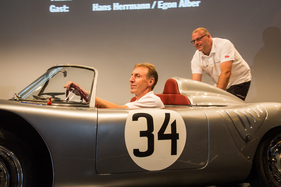
The type 547/4 engine installed in the Spyder not only produces 160 hp from 1.6 liters of displacement, it also sounds incomparable, or as one of the mechanics at the time, Karl Moser, once said: "The sound, it drives me crazy".
Monte Carlo participant with a powerful sound
The next car on the stage celebrates its 50th anniversary in 2015. It was the first time a 911 raced in the Monte Carlo Rally. Herbert Linge and Peter Falk as well as the owner of the car, Rolf Richter, came on stage.
The 1964 Monte Carlo car, a 911 with a displacement of 2 liters, is in a condition today that it certainly wasn't in back then.
The entire rally was covered in snow right from the start, which meant that over 200 of the 350 participants gradually dropped out. When it came to the "night of the long knives", the Porsche was among the last 30 competitors.
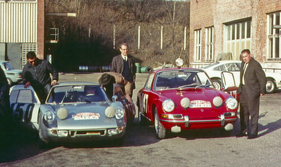
The car, which was continuously registered from the rally until its purchase by the current owner, was then used as a test vehicle and later sold on without its engine.
The next owner contested 20 rallies with the car, after which it was used in hill climbs, after which the car was driven by a privateer with no racing ambitions.
Rolf Richter immediately followed up on the tip that the Monte Carlo rally car was for sale. A test drive in Monte Carlo was quickly followed by the signing of the purchase contract, and the subsequent two-year restoration at Porsche Klassik was very costly in view of the car's history and therefore "not entirely inexpensive", but certainly of a high standard.
But before the car came to Freiberg, Rolf Richter and Dieter Landenberger researched the archives to see what documents were available on this vehicle. Even the racing drivers of the time came to the workshop to give tips so that the car could be rebuilt true to the original.
Linge and Falk knew a lot about the "wild times" back then: After Herbert Linge had leaned the car against a wall of snow "for braking reasons", Peter Falk got a bit fed up. The exclamation "Stop it, we still want to get there" was followed by the road book flying into the back of the car.
The source of the problem: Eugen Böhringer was supplied with the studded tires intended for the red 11 at the last control point, so that the Porsche had to start over the snow and ice of the Col de Turini with tires that were already more than half worn, i.e. with better M+S tires. But the road book was not far behind. After the question "yes, do you not want to continue now or what about it?" it was brought back to the front and the journey continued amicably.
In the end, the car finished in 5th place overall, a great success for Porsche. Especially when you consider that the original task was not to show what the car could do in competition, but to bring it to Monte Carlo undamaged to present it to the world's press in the royal court. Both drivers must have forgotten that along the way ...
However, the new 911 appeared in the world's press, which means: mission accomplished for James Bond.
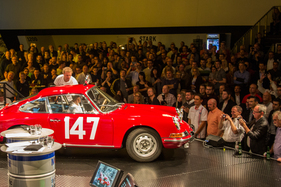
he 911 has gone on to win around 20,000 races to date, and it all started with the red car on the stage here. The engine started up so well that it was a real pleasure, the engine not only sounds good at high revs, the idling at 600 rpm is also a feast for the ears.
The only gullwing from Zuffenhausen
Things continued in 1966: the 906 Carrera 6, the only gullwing Porsche, can be credited with over 2000 small and large racing victories. Hans Mezger, the engine designer at the time, answered questions about its development.
The 50 cars required by the FIA regulations for production sports cars were quickly sold out; DM 45,000 was the price at the time, and for private drivers it was the car to have. Behind the crew, but before the rear axle, the first racing version of the 911 engine, Hans Mezger's baby, was used.
However, the Type 901/20 engine was not a tuned 911 unit, but a thoroughbred racing engine based on the 911 engine. At its debut in Daytona in January 1966, the vehicle was not yet homologated and had to start in the prototype class, which did not detract from its success.
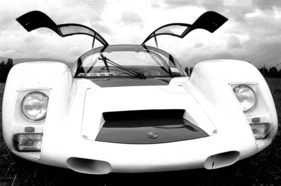
In the old workshop in Zuffenhausen stood the first 1:1 scale body model of the 906 and Gerhard Schröder - no, this refers to the body designer at Porsche, not the later German Chancellor - stood in front of it looking for a solution for the door construction. For the Le Mans start, which was still the norm in the sixties and in which the cars were parked on the pit side of the track while the drivers sprinted over from the other side of the road after the start clearance to get into the car and drive off as quickly as possible, the normal door arrangement was problematic for various reasons. Hans Mezger then suggested that they try hinging the doors at the top of the roof, and the first and only gullwing Porsche was born.
The Porsche Soundacht 2015 car was used as a camera car at the 1000 km race on the Nürburgring in 1967, driven by Paul Frère and Reiner Günzler at the time. The camera was mounted on the passenger side and the restored car was on stage in its original 1967 outfit.
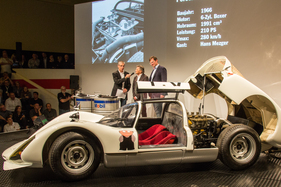
The racing engine proved to be just as reliable as the 911 production engine. The 210 hp versions were usually equipped with carburetors, but there was also a variant with fuel injection, while the 911 production engine with a displacement of 2 liters initially only had 130 hp. Thanks to the use of magnesium and titanium parts, the racing engine was also around 50 kg lighter. And the engine proved that it could sound good in a racing sports car that is still breathtakingly beautiful today.
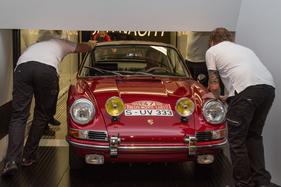
The vehicles were swapped on the stage in no time at all, Le Mans precision was at work here, and there wasn't much space, as the photos show. The fact that this went so smoothly was worth a big round of applause from the audience for the helpers in the background.
The Targa Florio RSR
The winning model of the 1973 Targa Florio, a 911 Carrera RSR 2.8, which had prevailed there against the prototypes of the competition, was presented by a driver who had won more than "just" the Targa Florio with this car. Gijs van Lennep, who came from the Netherlands, has also driven in Formula 1 and won twice at Le Mans, in 1971 with Helmut Marko and in 1976 with Jacky Ickx.
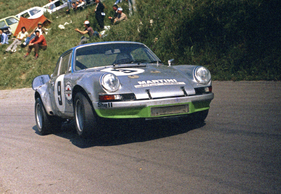
The victory at the Targa Florio is particularly valuable for him, then came the fuel crisis and then the races in Sicily came to an end. What was it like back then? "Well, we drove non-stop from eight in the morning until 5 in the evening to test the car extensively. Apart from driving, eating and sleeping, there was no time for anything else or to rest in between," said van Lennep. The hard work paid off.
What the Dutch racing driver particularly liked about the RSR was that the weight of the engine in the rear made it easy to get the power to the ground, which was very important when accelerating out of the bends at the Targa Florio. "The car was so nice to drive," he enthused, a pity that the guests were not able to experience it for themselves.
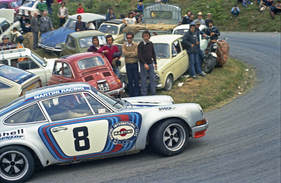
One lap meant 72 km of hard driving. There was only one long straight on the entire route, otherwise it consisted only of uphill and downhill sections and more than 700 bends, it's hard to imagine what the drivers had to do here! How do you survive this race? "Well," said van Lennep, "you had to be a bit strong and, above all, drive very precisely, otherwise you couldn't". The roads were narrow, lined with houses, crash barriers and rocks - mastering all this for eleven laps was not for beginners.
Today this would be unthinkable, but back in the seventies the road ran between enthusiastic crowds, there were only spectators to the left and right of the road and even the five to six training laps each day were a considerable physical challenge. The requirement back then was to have completed a total of around 30 laps in order to memorize the route.
Without good orientation, nothing worked. In training, i.e. on an open track with oncoming traffic, the lap could be completed in 42 minutes; in the race on a closed track, the time was around 37 minutes, just 5 minutes less!
Unimaginable when you consider that in training there could be a herd of sheep behind a hilltop, a truck on a bend or an elderly woman in traditional black clothing sitting on a donkey slowing down the drivers. We drove through the villages at 200 km/h, passing narrow doors at a distance of three meters, behind which the women sat and watched the goings-on, until suddenly the police stopped the car. But only to take a closer look at the "bella maccina", they had no interest in parking tickets.
But woe betide you if you had an accident. Even if only a sheep was hit, the pilot would end up in prison. "We had a letter with us, which we had to show to the station chief, then we were allowed to drive on. Mafia Island," said the Dutchman with a laugh. And immediately added another anecdote: He once arrived late at Palermo airport with Toine Hezemans; the seats had been given to others in the meantime. Toine Hezemans grabbed the man at the counter, spoke to him for two minutes in plain Italian and ten minutes later they were both on the plane. Or, in the words of van Lennep, "you also need a bit of luck in life ...".
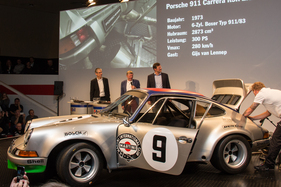
And what it sounded like back then was demonstrated by the aria that the 2.8-liter engine with twin ignition and 300 hp let out.
Shaken - not stirred, that's how James Bond loved his Martini
For Porsche, the legendary liaison with Martini began in the mid-1970s, when the 935 became a perennial winner on the world's racetracks and an instant one-make world champion, usually equipped with the three-liter engine with over 600 hp. But there was also a little brother: developed for the small division of the German racing championship and built only once, the 935/2, affectionately known as the "baby" or the lightest 911 of all time, now entered the stage.
Manfred Jantke, Porsche's racing manager at the time, explained that this car had only been built for a single race. In the German Racing Championship, the forerunner of today's DTM, there were two divisions. The small division up to two liters and the large division above that. In the small division, BMW, Ford, Alfa and others took the points from each other, while the large division was dominated by Porsche with the 935. The two-litre drivers were angry and said that the small division was where the music was played, while the victories in the large division fell into Porsche's lap.
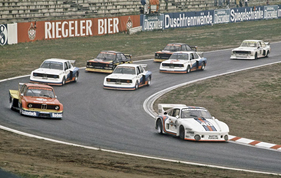
"We built a 935 for the 2-liter class to finally put an end to the complaining," Jantke recalled.
If you think about the development costs behind such a project, it speaks volumes for the spirit at Porsche at the time! According to the regulations at the time, 1400 cc including turbo resulted in a calculated displacement of two liters, still large enough for 380 hp. In order to make the car as light as it was allowed to be in the 2-liter class, i.e. 700 kg, everything that was not really needed was left out.
At the Norisring, Jacky Ickx was keen to drive this car, but the heat on the track made it difficult for him. For weight reasons, the car was built with very thin walls, there were no insulating panels or insulating mats, and the exhaust air from the radiators in the front was drawn through the cockpit. To cut a long story short, Ickx collapsed halfway through the race and was only just able to bring the car into the pits - the race was over.
Only at the second attempt at the Hockenheimring, also with Ickx, did everything go as planned. The lead at the end of the race was over half a minute, so this mission was also accomplished.
The car was never used again later, but the small division had been shown the way. From baby to Moby Dick - the 935 was simply unbeatable in its day. A great time for Porsche back then.
One man should not go unmentioned in this context: Helmut Bott, Chief Technical Officer at Porsche and boss in Weissach. The really big racing successes, the racing developments, none of that would have happened without him. He was the central figure in the background who gathered people like Falk, Singer and Mezger around him and built a team that functioned perfectly. Porsche was a small company back then, there was never enough money, the team always overspent its budget and Helmut Bott was always the one who had to answer for it at board meetings. But the successes proved him right.
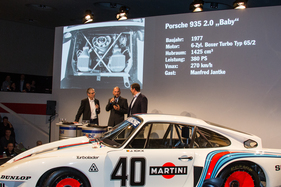
And the baby then showed quite impressively what he sounds like.
Off to the desert
In 1984, Porsche not only moved into Formula 1, but also into the desert, with the first all-wheel-drive Porsche 911 Carrera 4x4, known internally as the Type 953. The topic of all-wheel drive is almost as old as the Porsche brand itself; it started in 1947 with the Cisitalia Grand Prix racing car, the Porsche Jagdwagen was followed by the Type 597 in 1953 and then all-wheel drive was introduced in the 911.
The all-wheel drive was actually intended to be tested for the later Type 959, but the whole thing was immediately implemented with great success in the world's toughest rally, finishing first, sixth and twenty-sixth. Jürgen Barth and Roland Kußmaul, two other Porsche warhorses, took to the stage.
The career of engineering legend Kußmaul at Porsche did not begin without a hitch in the military department that still existed at the time. He was supposed to design an aluminum pedal assembly for a battle tank. However, this could not withstand the force of a Krauss-Maffei test driver. The pedal broke, causing the tank to drive through a brick wall, not without leaving its silhouette behind ... The requirement was a pedal that could withstand 30 kg, after all, it only had to operate the valve of a hydraulic brake. So Kußmaul said let's assume 60 kg plus a safety margin, that's 120 kg, so nothing can happen. The test driver, surprised by the rapid acceleration of the tank, panicked and braked for his life. 180 kg, frantically pushed out of the knee, was too much, so the pedal was just gone ...
He practiced on the really heavy things, the toolbox for the Leopard was also designed by him. In 1974 there were problems with the dampers on the rally cars at the Safari, so Kußmaul was borrowed for this and after his boss at the time said, "You work 3/4 of the time for the racing department, if it goes on like this then go straight there. No sooner said than done, Peter Falk had nothing against it.
In 1978 came the first rally works assignment together with Jürgen Barth, at that time Waldegaard drove the rally, Kußmaul was responsible for the technology, Jürgen Barth was the driver of the service vehicle and had to follow the racing car in order to be able to provide rapid assistance. There are many episodes from this time to tell. After Waldegaard "lost" parts of his rear axle after heavy rain on a special stage, they were immediately replaced at the roadside in the light of the service vehicle's headlights. It was only later that the mechanic realized why his legs were so itchy - insects had discovered his shorts and seized the opportunity ...
Jürgen Barth had already experienced a lot at Porsche in the racing department. But when he was told at a meeting with Mr. Bott and Mr. Falk that they were planning to drive the Paris-Dakkar next year, he thought "now it's time to burn out".
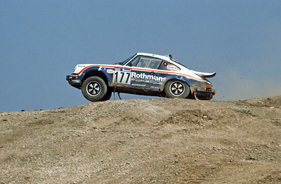
That was in February March 1983. If you know that the team actually rode in 1984, then you can imagine what the world looked like in between. His argument "unfortunately I can't do anything at the moment, we don't have a four-wheel drive at Porsche" was countered by Bott very curtly "yes, I do have one". To make a long story short: Bott's company car was gone from that moment on, it now functioned as Dakkar's development vehicle. After extensive testing, the rally equipment went to Africa in September. On November 11, the starting shot was fired for the construction of the cars for the 84 Dakkar, which started on December 31, 1983.
How do you turn a 911 into a rally car? The biggest problem with the sports car is the lack of ground clearance. At the pre-start in Paris, the professionals from Range Rover and Mitsubishi laughed wickedly: "Look at those idiots from Porsche, they want to drive around in a sports car where we can't get through with an off-road vehicle ..."
Barth explained: "The Dakkar regulations at the time still stated that everything you needed had to be in the car. Every truck that had parts with it had to drive the entire competition, only tires were allowed to be gripped in 3 places, nothing else". However, the large truck ran at a maximum speed of 30 km/h in the sand, which meant that the parts only arrived at four in the morning for special stages of 600 or 700 km. However, the damaged racing vehicle had been waiting for support since 5 o'clock in the afternoon - perfect emergency assistance looks different. This year, Kußmaul was also allowed to take on the role of the rescue vehicle, and a course lasting several days with Dr. Huber at the University of Freiburg also earned him the job of team doctor. And if no spare parts were available, a broken wishbone was splinted with a branch and the journey continued.
It's hard to imagine the difference in temperature between day and night in the desert. During the day you sweat in temperatures of up to 40 degrees, at night the mechanics protected themselves with crash helmets and anything else they could grab as protection against the icy cold. After the exertions of the day, the drivers could sleep well in their sleeping bags two meters from the generator, which didn't bother anyone. The fact that Kußmaul here in Weissach, where he also lives, tried out the sleeping bags in winter, on the balcony at night, so that he didn't freeze to death in the desert, that's just Roland live.
The Dakkar-Porsche's engine only produced 225 hp, which was due to the poor quality of the gasoline in Africa. The engine therefore had a lower compression ratio and the ignition setting was also reduced. The deafening exhaust noise - after all, the race was held on public roads - was intentional on the part of the organizers. Thierry Sabine instructed the teams not to drive with quiet cars, as he was afraid that people would stop on the road and not notice the fast cars in time. What remained was a system that could also be described as a flame tube, which could be heard right outside the museum that evening.
Eight-cylinder GT in racing action
The next car came onto the stage virtually freshly restored. A 928 in the racing version is rarely seen in the museum, and then with Swabian lettering, but first things first: Günther Steckkönig and Hans Klausecker worked in road testing at the time, and their second home, so to speak, was the Nordschleife.
There they saw Jaguar, BMW and other big cars competing in the European Touring Car Championship. "Our 928 would actually fit in wonderfully," thought Steckkönig and Klausecker and wanted to show what the car could do.
As nobody else had the idea of turning the 928 into a racing car, they went to Helmuth Bott and were met with an open door. After it had already been clarified that the car would be allowed to race as a prototype on the Nürburgring - homologation would have required 5,000 vehicles to be built in 12 months - an endurance car was quickly recruited for use.
The next step was to use the connections to Trigema, but anyone who knows Wolfgang Grupp is aware that he also knows what he wants, so it was no easy task. The clever man's first question was where to drive the car. Instead of a race all over Europe, the Porsche men could only talk about the Nürburgring, which could not be of interest to Grupp.
However, the guys in Zuffenhausen hadn't fallen on their heads either. "We drive to the Nürburgring with a team and trailer on Friday evening and back on Sunday. The racing car with your lettering is on top for everyone to see and at 80 km/h there are an infinite number of people overtaking us and looking at the eye-catcher," explained the two initiators. The argument worked - that's how you attract sponsors.
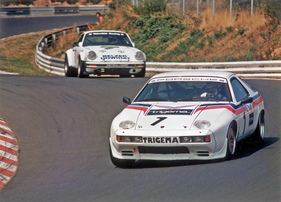
Klausecker's task was to reinforce the body of the sports car, which had already clocked up 80,000 km, integrate a roll bar and optimize the tanks, wheels and other accessories.
Meanwhile, the engine, gearbox and chassis were left in the hands of Günther Steckkönig. All this was done alongside the actual work, an "eight to five job" looks different. In the summer of 1983, the first start at the Nürburgring was on the agenda, whereby the car not only had to be driven around the Ring, but also brought there and back to Weissach.
As befits a Porsche, the race was for overall victory, not for class wins. In the first race, the podium was missed by one place, second place in the second race was better, and the last three races were then won. And this despite the fact that the Porsche needed one more refueling stop than the competition. Back then, refueling was carried out using a normal fuel pump, which was an exercise in patience for the drivers every time, as all the competitors that they had painstakingly overtaken over the last few laps drove past them again. This was certainly interesting for the spectators, but a challenge for the drivers.
In 1984, unfortunately, the 5000 cars for homologation did not materialize and so Bott sent the two of them to Daytona with the car, but that also had to be done quickly. The designer had to quickly paint the Style-Auto logo while the car was being prepared, which is also possible.
The opponents were vehicles with a tubular frame and a plastic cab on top, pure racing cars that had little to do with a Camaro, for example. The 928 drove through 24 hours without complaint, tires, fuel, oil and brake pads were checked, that was it. Only once did Klausecker have to cut out the "lost windshield" with his Swiss army knife, insert a new one and fix it with adhesive tape and pull two metal strips from the roof over the windshield to prevent it from flying off.
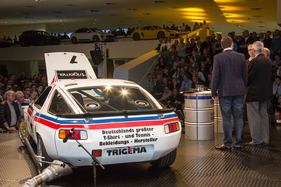
So much for the story. Now to the present: Some time ago, Klasecker and Steckkönig came back to the museum and asked whether the car, which had been gathering dust for 30 years, could be revived. Under the direction of the two "old pensioners", the apprentice department was allowed to resurrect the little treasure, a great project, the result of which delighted visitors with an unmistakably powerful eight-cylinder sound.
The super sports car from Porsche
In 1985, Porsche presented a car that helped to coin the term super sports car. It was called the 959 and combined everything that was technically possible at the time: a bi-turbo engine with register turbocharging produced 450 hp from 2.85 liters of displacement, the car had electronically controlled all-wheel drive, a 6-speed gearbox and body components made of Kevlar, the tires were mounted on magnesium rims and had a new air pressure control system.
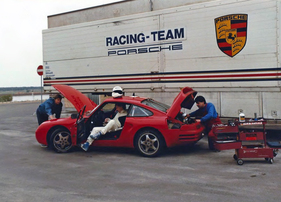
The fastest cars of the time were tested in Nardo at the time; the red car on the stage was one of the rare 959 S models, boosted to 550 hp and measured at a top speed of 339 km/h. Not only that, but the price of 450,000 DM in 1985 was a real announcement, but technology suitable for everyday use with the performance of a racing car had its price.
No one covered more kilometers on this vehicle back then than Dieter Röscheisen, who was responsible for chassis development, tire testing and brake tuning at the time and was an informative contemporary witness from times long past on this evening.
The first tests of electronically controlled all-wheel drive in conjunction with ABS systems took place in Sweden. Low friction values for initial testing were simply easier to obtain in Scandinavia than in our latitudes. It should be borne in mind that no road-going Porsche had ABS or all-wheel drive at that time, not even in the remotest of places. The Motronic control system was the technical highlight in series production at the time.
The test car had no passenger seat, the space was filled with measurement technology right up to the roof, and visibility from the car was extremely limited. What is possible today with a small laptop filled half the car back then, and the data was not recorded electronically but on paper rolls, the evaluation of which was correspondingly time-consuming. The later drives on race tracks in southern Europe had to show whether the system also worked at higher friction values and rounded off the test program. In the beginning, the top speeds with the still immature vehicle were an adventure; from 300 km/h, 3 lanes were needed ...
Testing was initially carried out in public test traffic at VW on the Ehre-Lessien track, where the Polo was also tested. However, the VW people quickly went on strike, because the Porsches, which reached speeds of over 300 km/h, frightened the VW drivers, which was understandable given the difference in speed of 200 km/h. From then on, the track was used exclusively by VW. From then on, the track was only used exclusively by Porsche.
At that time, the Turbo was capable of 250 km/h, now the sound barrier of 300 km/h was broken and every additional kilometer was noticeable when driving. In the beginning, with aerodynamics that were not yet sophisticated, the car became light at the front at 320 km/h and could be kept on the track with two fingers on the steering wheel - not everyone's cup of tea. By the time the car was allowed to drive in Nardo, the body and chassis technicians had done their homework and the car drove like it was on rails.
The ABS and brake development was a matter in itself. It is not easy to control the performance of a racing car in a relatively heavy car, and the brakes quickly reached their limits in terms of temperature, especially as the additional weight of the measurement technology also had to be slowed down. When the brakes were extremely hot, the car suddenly jumped two meters to the left or right when braking without being able to predict the direction. The problem had to be solved.
So the Nordschleife was rented exclusively, the bosses from Wabco Westinghouse, the development partner for the brake system at the time, were there, as were the bosses from Weissach. The gentlemen stood behind the crash barrier on the Döttinger Höhe, where you could drive at top speed. There were two pilons on the track and this is exactly where full regular braking was required, at 317.9 km/h according to the digital display. First lap - all good, second lap the same, on the third attempt all wheels locked, the car went sideways, Röscheisen could look the gentlemen in the face.
"I was sure that if they'd been punctured, they wouldn't have given a drop of blood, they were standing frozen next to the track," said Röscheisen, who somehow managed to catch the car. It took him 0.8 seconds to realize that the wheels had locked and he let go of the brakes, the measurement recordings later revealed. "That wasn't without its problems," he said, "the tires were down to the metal fabric afterwards."
The cause was quickly found, a connecting plug between the ABS system and the measurement technology had slipped off, so new tires were fitted and the journey continued. The next problem arose with the brake fluid, which reached its boiling point due to the high loads, even though racing fluid had already been used - there was simply nothing better.
A pressure circulation flushing system was the solution; fresh brake fluid was now brought to the brake caliper with every braking operation, and the problem was solved. But Porsche would not be Porsche if they had now put the issue to bed.
An extreme test was needed to ensure that the brake system would no longer fail. So they drove back to Ehre-Lessien, the VW people didn't want to watch any more and cleared the track. They ordered three fire engines and three ambulances and started the program. Every 50 seconds, the brakes were fully reduced from V-max to 100 km/h and then immediately accelerated again to full speed until total failure. In the twilight, the deceleration slowly eased, but it became light around the car, the car seemed to light up the whole steep face. That must have been the time when the brake pads had already come off and only the brake carrier plates on the discs were still braking. Metal on metal. Still good for a deceleration of 0.8 g, a sensational value for a bright red glowing disk. The VW people saw the sparking rocket, doubted the sanity of the test drivers who had arrived and turned away shaking their heads.
"What's that madman doing?" asked Admiral Roebuck in the Bond film "Tomorrow Never Dies", to which M replied: "Doing his job" - life can be that simple. The brake pistons then put an end to the colorful hustle and bustle after they decided to leave the brake calipers ... The sound check of the car was much more moderate and would have suited James Bond well. The Überporsche from back then produces a beautiful sound that, in contrast to the thoroughbred racing cars, is also suitable for everyday use.
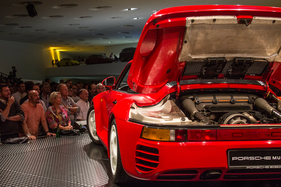
Soundless Le Mans winner
This was the last engine sound check for the evening; the racing car with the high-voltage technology, which was pushed in at the end, has a somewhat more complex starting procedure. The Le Mans winning car from 2015 was cheered on, and works drivers Timo Bernhard and Marc Lieb also took the opportunity to attend, even though they had to leave for their next race in Shanghai three days later.
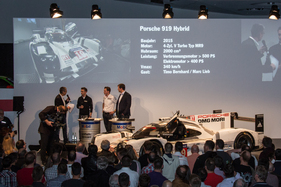
The car made history in 2015. After a long break and last year's retirement, the overall victory at Le Mans - the seventeenth overall - must have been enormous pressure for the drivers. The demands on a racing driver today are completely different to 30 years ago, the cars are extremely complex and the team at Le Mans 2015 comprised 120 people.
Handling the constantly updated software, communicating with the engineers, all of that needs to be managed. The amount of fuel and hybrid energy per lap are regulated, with the boost of the electric drive you have an all-wheel drive car, without it you have a rear-wheel drive car. The output of both energy sources adds up to around 1000 hp. Controlling this is extremely demanding for the driver.
It's a different world compared to the 917, Marc Donohue's car had "another 1000 hp" and it certainly wasn't any easier to control. Marc Lieb: "The guys were a bit crazier than us back then". The current well-coordinated and highly motivated team, which is now on the road for Porsche, takes its job seriously, or what did the Bond guys in the movie say? "We never joke when it comes to work." In any case, you can already look forward to the next sound night.



_RM.jpg)