Driving the Maybach DSH - the speedometer needle shakes at 137 km/h


You have only
1 out of 22
images seen in high resolution


Summary
Weighing over three tons and with "only" six cylinders in a row, this is how the Maybach DSH presented itself in the 1930s. An extremely imposing saloon, but one that demanded a great deal of sensitivity from the driver, as this review of a drive impressively shows. This report characterizes the entry-level Maybach of the 1930s and explains how it drives, supplemented by many archive photos.
This article contains the following chapters
- Reliable starter
- The necessary distance between chauffeur and passengers
- With the "small" six-cylinder
- Huge and heavy limousine
- Without rev counter
- Over 100 km/h
- A lot of attention required
- The advanced gearbox
- Millimeter work
- The Maybach six-cylinder
Estimated reading time: 11min
Preview (beginning of the article)
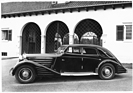
Weighing 3124 kilograms, spread over a length of more than six meters and a height of two meters, resting on four huge 7.50 x 20 tires, maneuvering at crawling speed without power steering is hard work. Getting this colossus out of the corner of the vehicle hall and into the daylight without bumping into anything takes a lot of effort. But the effort is worth it. Although the Maybach DSH, built in 1935, has not been moved for over a year, it only needs three large buckets of water for the radiator, which has been drained as a precaution, and two freshly charged 6-volt batteries. Once started, it is immediately loud and audible, blowing black clouds of smoke out of its enormous exhaust tailpipe. However, it soon blows itself free.
Continue reading this article for free?
Images of this article